Ben Dupuy, longtime Haiti activist, journalist and voice of opposition, is dead at 91
Ben Dupuy, a firebrand political activist and Haiti ambassador-at-large who became the voice of the radical opposition at home and abroad, has died. He was 91.
Dupuy died Sunday in Miami Beach of natural causes, his family said in a statement.
Benjamin J. Dupuy was born in Cap-Haïtien, Haiti, on Sep. 30, 1931. His parents were George and Ana Teresa Andujar Dupuy, and he began his professional life as a civil engineer working for the Development Organization of the Artibonite Valley/Organisation de Développement de la Vallée de l’Artibonite, a government agency involved in rural development.
During the dictatorship of President-for-Life Francois “Papa Doc” Duvalier, he found himself targeted by the regime for organizing workers’ strikes. In 1965 he fled to exile and landed in New York, where other pro-democracy Haitians, also forced from their homeland, were continuing their fight against the regime as they built new lives in the United States.
READ MORE: History of Haiti: From rebellious beginnings, Haiti has been beset by violence, meddling
As he became more involved in politics, Dupuy quickly became known for his staunch advocacy for improving the conditions in Haiti, his Marxist views and steadfast criticism of United States policy and support for the Duvalier dictatorship.
Adopting the pseudonym Jacques Arcelin from a friend who died as a child, he wrote about the evils of neocolonialism. He also employed the pseudonym on two films, “Haiti Enchainée” (Haiti in Chains), which expressedhis views on neocolonialism, and “Bitter Cane/Canne Amère,” a critique of the regime.
Working with several others, including journalist Kim Ives, Dupuy produced the film with the help of a network of clandestine Duvalier opponents in Haiti. The 1983 film looked at events in the country under Duvalier as the economy shifted from agriculture to manufacturing, with Haitians fleeing the countryside for Port-au-Prince in search of new American factory jobs.
“He was unwavering in his dedication to bring about meaningful and lasting improvement in the quality of life for the Haitian people,” his family said.
The same year that “Bitter Cane” came out Dupuy founded the weekly newspaper Haïti Progrès in Brooklyn, New York. The newspaper was circulated in the diaspora, Europe and Haiti, where it was circulated clandestinely before the 1986 fall of the nearly-30 year Duvalier family dictatorship. The paper’s goal was to mobilize Haitians to take action for change. That opportunity soon came with the fall of the Duvalier regime and the rise of a priest-turned president, Jean-Bertrand Aristide.
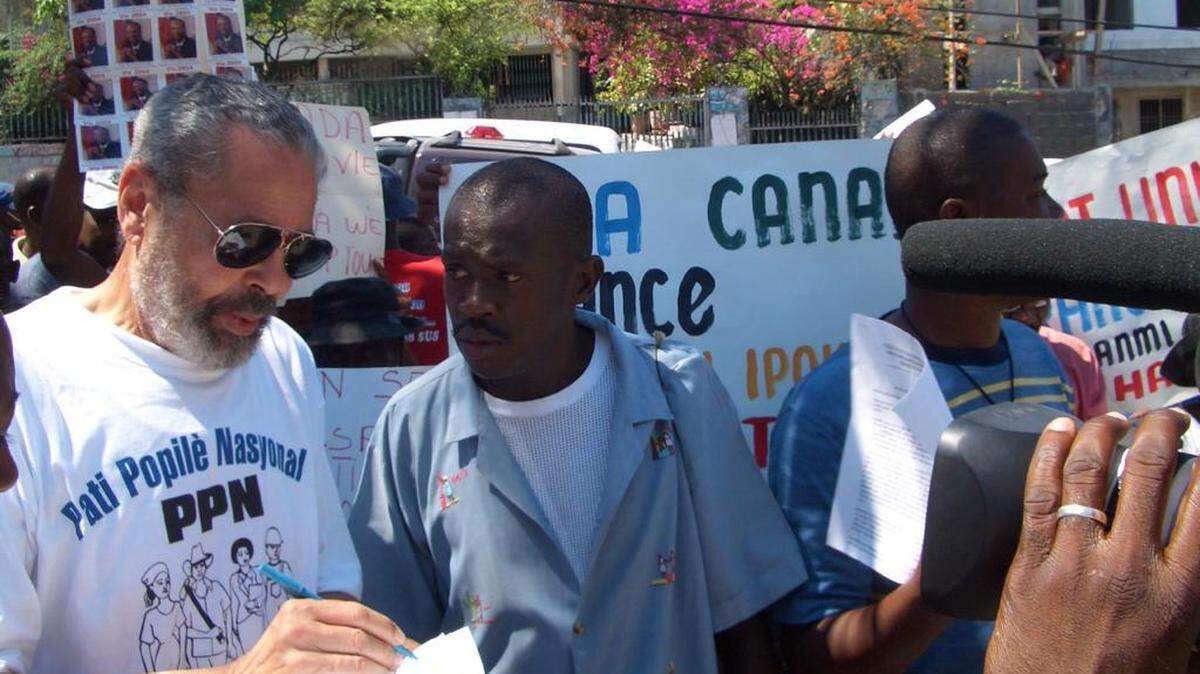
In Aristide’s St. Bosco Church in 1986, Dupuy established the National Popular Assembly, APN, a popular organization that worked with young militants and in 1999 became the National Popular Party, PPN, a leading political organization in the early 2000s.
When Aristide became Haiti’s first democratically elected president in 1991, Dupuy was appointed ambassador-at-large, a role he continued to play even after Aristide went into exile after being deposed in a military coup eight months later. Haïti Progrès became known as the voice of Lavalas, the movement that swept Aristide into power.
“He played a huge role in stoking the popular movement and anti-imperialist consciousness that brought Aristide to power in 1991,” said Ives, editor of the weekly newspaper Haïti Liberté.
Ives said Dupuy “was in fact the first figure to propose Aristide to be president in a rather famous press conference (which was busted up by thugs) at the Oloffson Hotel” in Port-au-Prince.
Dupuy’s support for Aristide and his Fanmi Lavalas political party and movement, and criticism of the United States, were both welcomed and criticized. Detractors accused him of leading a disinformation campaign on behalf of Lavalas, once the largest political movement in Haiti.
In addition to the newspaper, which was published until 2012, Dupuy also founded the Haitian Liberation Movement, a clandestine group that operated in Haiti, and with his then partner, Jill Ives, formed the support group The Friends of Haiti as a vehicle to raise support for the movement. In the diaspora, he also helped establish the Association of Haitian Workers and was involved in the formation of a student group, Idées.
“The struggle to liberate Haiti was Ben’s life’s work. He remained true to the cause at great personal sacrifice,” the family statement said. “He will be remembered for his uncompromising dedication to his convictions.”
Dupuy is survived by his children, Frantz, Mike, Regine (Gigi) and Sarah Dupuy. He is also the grandfather of Leyla McCalla, the award-winning Haitian-American musician and singer.
This story was originally published April 26, 2023 at 7:00 AM.