Trip to South Florida by suspect in Haiti president’s slaying is key to Colombian’s arrest
Three weeks after Mario Antonio Palacios Palacios arrived in Port-au-Prince last summer to assist in an operation to arrest Haitian President Jovenel Moïse, one of his co-conspirators flew to South Florida to ask for assistance with the plot.
The man had a written request for assistance furthering the plot to arrest Moïse on a bogus 2019 Haitian arrest warrant and then imprisoning him, according to an FBI criminal complaint unsealed this week in a Miami federal courtroom. The man told others that the individuals involved would get immunity in Haiti for helping.
Instead of being kidnapped, Moïse was killed on July 7, 2021, in the bedroom of his private Port-au-Prince hillside residence after the plan changed, Palacios told Homeland Security Investigations and FBI agents after he was caught in Jamaica in October after months of hiding out in Haiti and deciding to cooperate in the joint U.S. investigation.
“According to Palacios, co-conspirator #1 was one of the leaders of the operation,” the criminal complaint said.
U.S. officials have not publicly identified co-conspirator #1. But the Miami Herald has confirmed that he is James A. Solages, a former Broward resident and one of three Haitian Americans jailed in Port-au-Prince in the crime, and who according to the complaint and records left Haiti on June 28 and returned on July 1.
That trip and the request for assistance are now at the heart of the U.S. investigation, and gave federal agents the jurisdictional right to take Palacios, 43, into custody after he was detained Monday night during a layover at Tocumen International Airport in Panama after a Jamaican judge ordered his deportation to Colombia for illegally entering the Caribbean nation.
U.S. officials have not provided any details on how the arrest of Palacios — who is known as “Floro” and was among the four former Colombian military soldiers who allegedly gained access to Moïse’s private bedroom — came about, other than issuing a Justice Department press release stating he “agreed to travel to the U.S.” during the layover.
In a statement, Panama’s Ministry of Public Security said Palacios, a retired sergeant, was detained on an INTERPOL arrest warrant by the National Migration Service of Panama.
“Palacios, once he made a stopover in Panama, was approached and informed that there existed an arrest warrant issued by the United States. The citizen stated that he was willing to travel voluntarily,” the official statement said. Efforts were then made for him to be sent to the United States to submit to the country’s justice, the statement added.
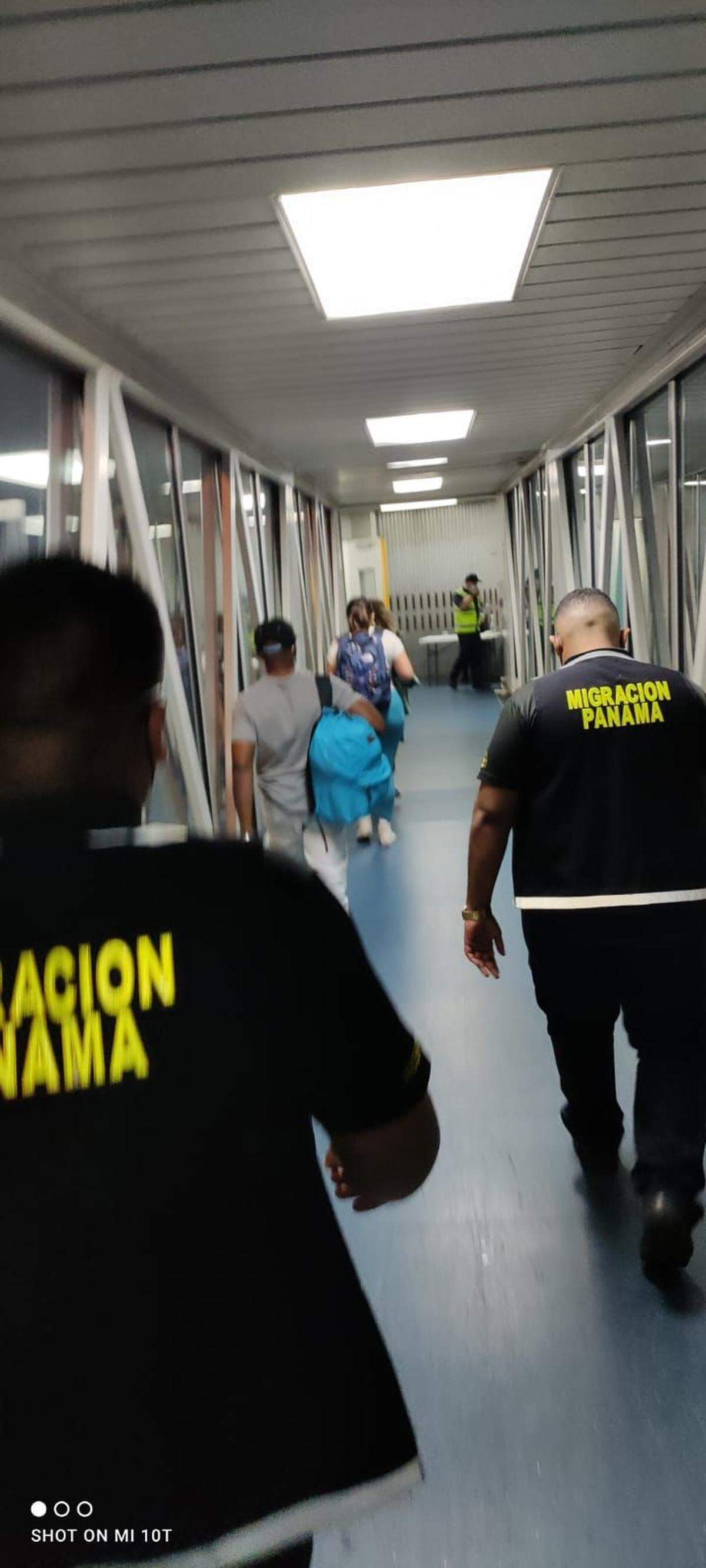
Photos and a video show Palacios, wearing a gray shirt and whitewashed jeans, being escorted by Panamanian immigration agents through the airport, and later boarding a Miami-bound flight with his few belongings. Upon arriving early morning Tuesday, both HSI and FBI agents were waiting for him at Miami International Airport, where he was arrested.
During Palacios’ initial appearance in Miami federal court later that afternoon, the FBI’s criminal complaint was unsealed and Palacios was informed that he was being charged with conspiracy to commit murder or kidnap outside the United States, and providing material support resulting in death, knowing that such support would be used to carry out a plot to kill the Haitian president.
Palacios didn’t enter a plea Tuesday, but his court-appointed U.S. attorney, Alfredo Izaguirre, told the Miami Herald that his client, whose next court date is Jan. 31, would plead not guilty.
“For now, we are planning on fighting the case,” Izaguirre said. “We are waiting to look at the evidence to see what the evidence is going to show and so far, he’s going to plead not guilty.”
Izaguirre takes issue with the conspiracy charge, saying that until Tuesday Palacios had never set foot in the U.S.
Kendall Coffey, a former South Florida U.S. attorney and current adjunct faculty member at several area law schools, said while he wouldn’t be surprised by jurisdictional arguments in the case, the Department of Justice has been successful in its “expansive view of its criminal jurisdiction.”
“If you conspire in the United States to assassinate someone overseas, the U.S. takes the position that it is a U.S. crime that we can prosecute,” he said. “The criminal complaint isn’t really detailed on the activity or portion that took place in the U.S., but they do make specific reference to the Southern District of Florida.”
Solages, who collaborated with Doral-based CTU Security before the assassination and who returned from Haiti to South Florida in late June, makes the jurisdictional case for the U.S. arrest of Palacios, Coffey agrees. The Colombian commandos in custody in Haiti have said they were hired by CTU to provide security to another jailed Haitian-American suspect, Christian Emmanuel Sanon, in the plot. The Haiti-born doctor and evangelical pastor, who lived in Boynton Beach, had been circulating a petition with signatures of support to replace Moïse as Haiti’s transitional leader.
Solages and another Haitian American, Vincent Joseph, told Haitian officials during questioning that their mission was not to kill the president but to remove Moïse and install Sanon as president.
According to a Haitian police investigative report obtained by the Miami Herald, Solages confessed that in the run-up to July 7, “a lot of meetings were held” at the offices of CTU, whose owner has denied any wrongdoing or knowledge of the assassination plot.
The report noted that Solages and other jailed suspects including Sanon were among those in attendance at the CTU meetings.
“The U.S. takes a very broad view of its federal criminal jurisdiction,” Coffey said. “It might not be obvious that an assassination in Haiti could become a major focus of U.S. prosecutors but if there is a connection within the statute, they have enough to go on, a crime like this is going to generate their utmost effort.”
Coffey added that Palacios’ arrest couldn’t have happened without the collaboration of foreign governments, from Jamaica informing U.S. authorities of his pending departure to Panama handing him over.
The assassination of Haiti’s president— the fifth since the country’s 1804 founding — sparked international intrigue, and launched parallel criminal investigations in Haiti and the United States. Haiti launched an international manhunt for Palacios by issuing an INTERPOL Red Notice, while the U.S. focused on whether U.S. citizens, implicated in the crime by Haitian officials, violated the Neutrality Act.
Under the Neutrality Act, it is illegal for an American citizen to wage war against any country at peace with the United States, including attempting to overthrow its government.
But while the U.S. investigation appears to be advancing, the Haitian investigation is stalled.
On Thursday, the Port-au-Prince National Human Rights Network accused Haitian authorities of blocking the investigation both by the Central Directorate of the Judicial Police, the institution’s investigative arm, which no longer has access to government agencies’ databases, and by the judiciary.
While offering up new details about the night that Moïse was killed inside his private bedroom and the stalled Haitian criminal probe, the National Human Rights Network noted that the investigation has never extended to the country’s banking institutions to learn who may have financed the crime.
“It remains a fact that transactions have been carried out and that at least two Haitian banking institutions have been used for... 10 [transfers] of exorbitant amounts, from the United States to Haiti,” the group said in a published report. “The information was confirmed by the FBI. Nevertheless, [Haiti] never allowed its investigators to delve into this aspect of the investigation, which would have helped to identify those who paid for the crime.“
The National Human Rights Network also says that Trial Magistrate Garry Orelien, who is leading the judicial probe, and his clerk, Elysée Cadet, should be investigated. Both are accused of trying to shake down individuals connected to the case. One incident involves the owner of RJ Rent a Car, where one of the prime suspects, Joseph Felix Badio, a former government functionary, rented four vehicles on June 21, 2021.
The owner of the rental company, according to the human rights group, has been the subject of threats and intimidation after Orelien’s clerk, invoking the judge’s name, demanded a vehicle be transferred to him.
“No judicial investigation is currently being conducted by Trial Magistrate Garry Orelien. On the contrary. The latter used his position, in complicity with his clerk Elysée Cadet to intimidate people and try to extort their property,” the report said.
From kidnapping to killing President Moïse
According to the FBI criminal complaint, Palacios said he arrived in Haiti on or before June 7, 2021, and was hired to provide security and participate in the arrest-warrant operation targeting Moïse.
While in Haiti, Palacios said he met with Solages. The two were photographed together in a widely circulated photo, along with other former Colombian soldiers in matching clothing. In other photos, according to the complaint, Palacios and his fellow Colombians were wearing ballistic vests.
“Documents seized during the investigation show that co-conspirator #1 was the person responsible for providing equipment and training for security personnel in Haiti,” the complaint said.
It also noted that based on interviews and photos seized from electronic devices, the Colombian nationals, along with several Haitian Americans including Solages, “trained in Haiti for several weeks to conduct the purported arrest warrant operation.”
“According to text messages seized from electronic devices (including texts from co-conspirator #1) and interviews conducted during the investigation, the initial plan was to ‘extract’ President Moïse from Haiti on or about June 18, 2021. That plan was abandoned when the co-conspirators failed to secure a private plane to spirit the president away from Haiti,” the FBI complaint said. “Based on this evidence, it appears that the purported arrest warrant operation essentially was, at least initially, a plot to kidnap the Haitian president and physically remove him from Haiti by plane.”
During the Haitian police investigation of the killing, Solages said that on June 14, 2021, the plan was to capture Moïse at the Toussaint Louverture International Airport when he returned from a trip to Turkey, which he visited three days later with his wife, Martine, and a large delegation. However, the plan failed to materialize because “the private plane assigned for this purpose was not available.”
Then on June 16 and June 18, the plan was to use the services of members of a group of renegade cops known as Fantom 509 to grab the president. The rogue force was to be provided with seven assault rifles, including one that Badio was supposed to hijack from the government’s anti-corruption unit where he worked until his firing in May over “serious breaches,” according to the unit.
Badio also is a former consultant in the Haitian Ministry of Justice and was once being considered by Moïse for a top post, according to a source familiar with the political negotiations at the time. He remains on the run and is considered to be another key suspect in the assassination plot.
El Nuevo Herald reporter Antonio Maria Delgado contributed to this report.
This story was originally published January 7, 2022 at 4:29 PM.