Fearing certain death in Haiti, a suspected assassin gambled on cooperating with the FBI
With a bounty on his head and Haiti’s dysfunctional legal system and dangerously decrepit prison system on his mind, an ex-Colombian soldier wanted in a wide-reaching assassination probe took a gamble.
After three months on the run, Mario Antonio Palacios Palacios fled Haiti by boat for Jamaica, from which he hoped he could be smuggled back to his native Colombia. Once back home, though, he planned to get in touch with the American Embassy to “bring clarity” to his role in the July 7 slaying of Haitian President Jovenel Mose, according to his lawyers.
Instead of contacting U.S. authorities from afar, he ended up in the United States, charged in federal court.
This report on Palacios’ state of mind is based on an interview with three of Palacios’ Colombia-based lawyers and his wife. The interview was conducted Wednesday by journalists for the Miami Herald, el Nuevo Herald and the McClatchy Washington Bureau.
“He left for Jamaica because it was the closest step toward reaching Colombia or making contact with U.S. officials — because searching for some kind of support in Haiti would be tantamount to searching for death,” said Nelson Romero, one of Palacios’ attorneys who waited in vain for him Monday night at Bogotá’s airport, final destination of his deportation flight from Jamaica, which had a stopover in Panama.
Palacios didn’t make it.
A Department of Justice press release said he was met in Panama and “agreed to travel to the United States.”
He was flown to Miami, where Tuesday he became the first suspect to be formally charged in the plot to assassinate the Haitian president.
A criminal complaint drafted by the FBI and unsealed in federal court accuses Palacios, 43, of conspiracy to commit murder or kidnap outside the United States, and providing material support resulting in death, knowing that such support would be used to carry out a plot to kill the Haitian president.
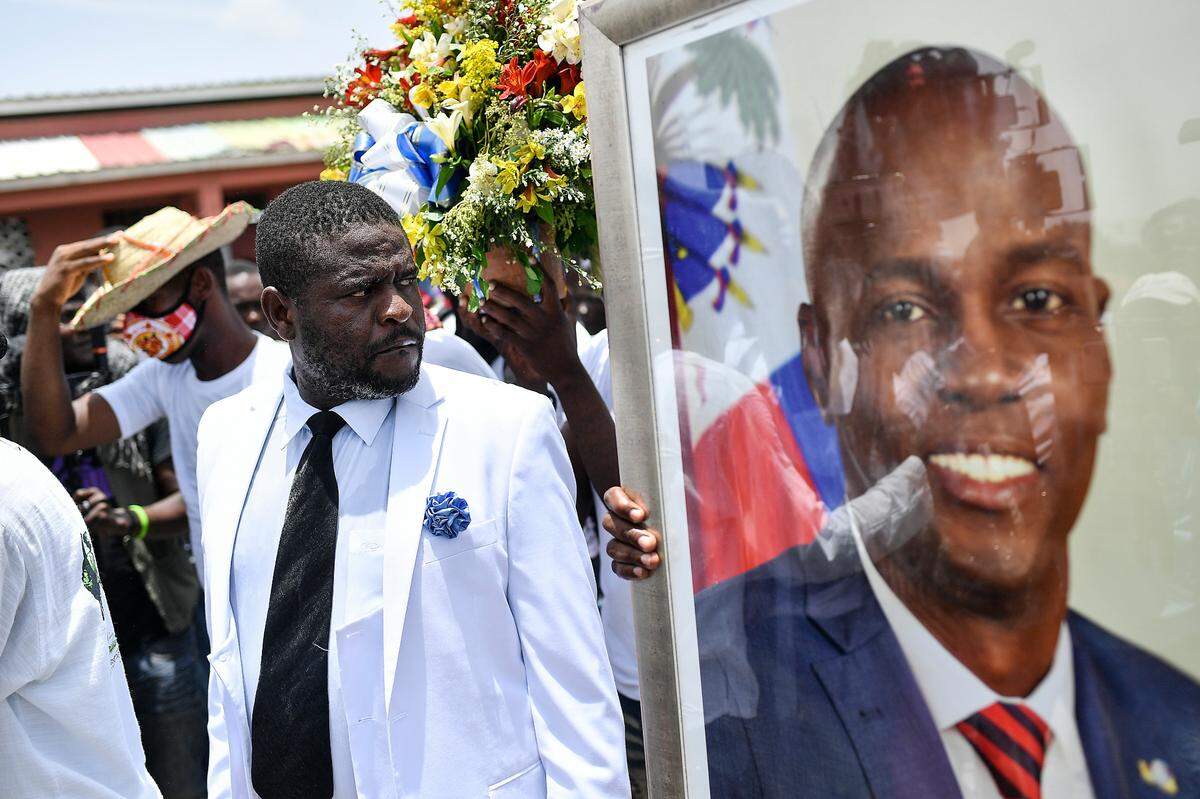
The charges, announced Tuesday as a shackled Palacios looked on during an initial appearance, potentially carry life in prison upon conviction, Assistant U.S. Attorney Walter Norkin told U.S. Magistrate Alicia Otazo-Reyes.
Before his arrest, Palacios seemed to think he could return to Colombia and cooperate with U.S. authorities from there as a free man, according to his wife and lawyers. His lawyers said both they and Palacios had been in touch with the FBI.
While Palacios wanted to help U.S. authorities in the ongoing investigation, his lawyers and wife said they were taken by surprise by the interception in Panama and subsequent transfer to the United States. How the plan to whisk him to Miami came about is not yet clear. Since his detention, Palacios’ lawyers have been unable to communicate with him.
Palacios’ wife, Lorena Cordoba, said staying in Haiti would have guaranteed her husband’s death. With 18 other Colombians jailed in Haiti and two killed by police after the middle-of-the-night assassination, Palacios was one of Haiti’s most sought after men. A Haiti National Police bulletin bearing his image was plastered all over social media, with a warning that he was “dangerous.”
“In Haiti, what they wanted was to see him dead,” Cordoba said on the video call involving the journalists and lawyers. “That was their goal, to kill him. That my husband is alive is a real miracle.”
Cordoba said she had been in constant communication with her husband during his time as a fugitive. She said she did not know where her husband hid in Haiti before fleeing to Jamaica, other than that “an angel” was protecting him.
On five different occasions, she said, her husband, the only Black Colombian in a group of former military soldiers, tried unsuccessfully to cross into the Dominican Republic, where he would have more easily blended in.
He told her, she said, that he was tired of hiding and that he could no longer continue doing so. He could not sleep, and was “worried sick for his compañeros” who were jailed.
“We would express surprise about how one’s life could change from one minute to the next,” she said.
Cordoba said she was not expecting Palacios, with whom she shares three children, to surface in the United States. She was at the airport in Bogotá, along with his lawyers, waiting on him to land Monday.
“He never arrived. It was later, at night, that we heard the news,” she said.
Jose Espinosa, one of Palacios’ lawyers, said they were all blindsided not just by the detention but the U.S. charges. Those charges were drafted in November but weren’t made public until Tuesday after the Miami Herald confirmed that Palacios was in U.S. custody.
Palacios had insisted in past interviews that the ex-soldiers were hired to do security work in Haiti, and emphasized they were not mercenaries.
“We had no knowledge that he was being investigated or that he was already facing charges,” Espinosa said of Palacios. His arrest in Panama was ”a total surprise.”
Espinosa and Romero said Palacios wanted to cooperate in the ongoing murder investigation into Moïse’s death.
They insist, however, that they didn’t know that cooperation would mean a flight to the United States. As late as Sunday, the night before he was set to depart Jamaica, there was no indication of an INTERPOL “Red Notice,” basically an international authorization to detain, on the police organization’s website.
The lawyers also represent the 18 jailed former Colombian soldiers held in Port-au-Prince. They are among an initial 44 suspects who were arrested and have yet to be charged by an investigative judge who is continuing to look into the assassination. The Colombian lawyers said the ex-Colombian soldiers, who are suspected of storming the president’s residence and shooting him 12 times while leaving his wife for dead, were set up.
“We are convinced of the innocence of the soldiers,” said attorney Andres Peralta, also on the legal team.
The president’s wife survived the attack.
Citing overcrowded and unsanitary prison conditions in Haiti, their clients’ lack of legal representation and translators, the lawyers say they have filed a petition before the Interamerican Court of Human Rights. They want Haiti to transfer the jailed soldiers to a third country and wouldn’t mind seeing the United States take over the investigation.
“We have confidence in the American justice system,” Espinosa said.
The Colombians in Haiti have been completely terrorized, he added.
The lawyers said they were informed during a trip to Haiti that gang members close to the government had placed a bounty on the soldiers’ heads. They were alerted that if Palacios, for example, “was found, either the gangs would kill him or he would be killed by the Haitian authorities and they would present him as killed while fleeing,” Espinosa said.
An online gang chat group allegedly was “offering $20,000 for executing a process of mass killing,” Espinosa said. The only reason the Colombians are still alive, he added, is because the case has garnered international attention.
This story was originally published January 5, 2022 at 7:49 PM.