
Cuba leader says island will ‘resist’ U.S. threats, refuses to release political prisoners
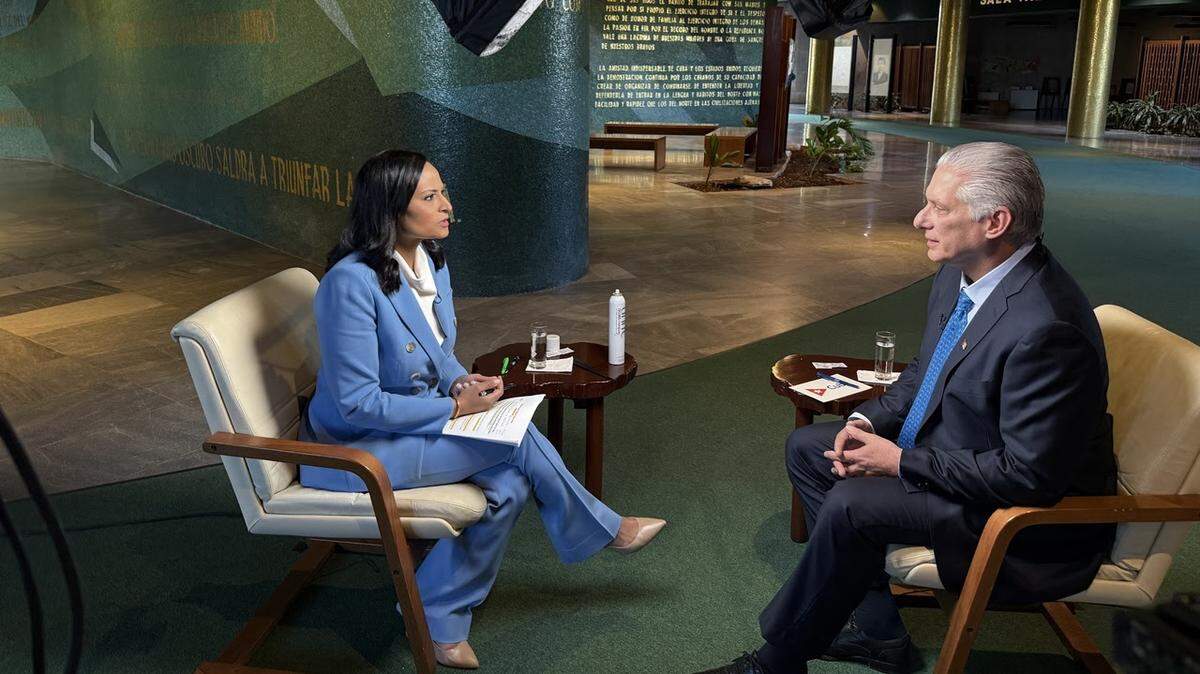
The chance of a deal between the U.S. and Cuba that would include major economic and political changes on the communist-run island appears remote, as the nation’s handpicked president, Miguel Diaz-Canel, told NBC News in an interview that he won’t resign and that his government is able to resist pressure from the cutoff of oil supplies and defend from a U.S. military attack.
The interview, recorded in Havana on Thursday and aired in part Sunday morning, lands at a moment of heightened tensions between the two countries, after President Donald Trump has suggested he could “take Cuba” and that the island was “next.” Secretary Marco Rubio is leading talks with Cuban leaders and said the country needs to make economic and political reforms and needs a change in leadership.
Díaz-Canel’s answers to NBC reinforce the view that any talks are stalled.
Taken together, his statements to “Meet the Press” moderator Kristen Welker portray a picture of a government that believes it can hold on to power without making major concessions to the United States, notwithstanding the severe costs of the humanitarian crisis unfolding on the island. His message bolsters perceptions within the Trump administration that he is an obstacle to efforts to secure a deal with Cuba.
In the interview, Díaz-Canel repeatedly said that Cuba wants a dialogue with the United States, peace and an agreement to “move away from confrontation”. But he said little that would suggest Cuba’s leadership is considering making significant changes to its socialist economic and political system, a key U.S. demand.
For one, he flatly rejected stepping down, even if that would mean “saving Cuba,” as Welker put it in her question. “I have no fear. I am willing to give my life for the revolution,” he added.
He said Cuba’s political system is not on the table, repeating what he and other Cuban officials have been telling the media for weeks. He also declined to commit to releasing political prisoners, scheduling multi-party elections or recognizing unions and a free press, conditions laid out in U.S. law as prerequisites to lift U.S. sanctions.
“Well, no, nobody has made those demands to us, and we have established that respect to our political system or constitutional order are issues that are not under negotiations with the United States,” he said.
“We need to leave behind all of these paraphernalia concepts about issues about Cuba and democracy and human rights, whether we are a dictatorship… about free press and the existence of free trade unions and so on, many things that are extensively manipulated, and there is a lot of prejudice,” he added. “We need to overcome that, and we don’t have the time right now.”
Pressed on whether he would release the 1,200 political prisoners in the country, including Grammy Award winner Maykel “Osorbo” Castillo, he denied Cuba holds any political prisoners.
“These people are not in jail because of protesting,” he said. “They will be in jail like anyone else in the world, any other country in the world, who are respectful of their constitution and the legal process for engaging in vandalism and crimes. There are no political prisoners in Cuba for that.”
The Cuban government announced the pardon of 2,000 prisoners earlier this month, but human-rights organizations said no political prisoners have been released so far. Last month, the government said it would release 51 prisoners, and about 20 political prisoners had been released in that group, according to Justicia 11J, a non government organization monitoring protests.
Dialogue and distrust
Díaz-Canel said he had “trust” that Cuba and the U.S. “can engage in dialogue respectfully, with decency, that we can find through dialogue solutions to our differences,” he said, while signaling at the same time that his government is approaching talks with the United States with suspicion.
“At present, the U.S. has been engaged in talks with other countries, and while these negotiations are under way, they have attacked those countries, and all of this creates a lot of distrust,” he said. He then went on to reiterate a list of areas his government has said the two countries could engage in cooperation, including fighting drug trafficking, terrorism and transnational crime, and handling immigration issues.
He also offered that Cuba “can have investments and businesses from American business people,” including Cuban Americans.
Cuba would “welcome American firms who would like to come in and participate in the energy sector,” he added, but said companies are prevented from doing so because of the U.S. trade and financial embargo, suggesting the U.S. government should move first to lift sanctions.
A message of deterrence
With an eye on U.S. actions in Venezuela and Iran, Díaz-Canel instead focused on a message of deterrence, insisting that Cuba is not “failing” — as president Trump has suggested — is ready to defend itself and has a “collegial” and “ideological” leadership that would make military targeting any one leader a futile objective.
He also highlighted “the costs” of a U.S. invasion of Cuba in terms of losses of life and damages to regional security and warned that any aggressor “will only collect blood-soaked soil if they don’t perish in the struggle,” citing Gen. Antonio Maceo, one of Cuba’s leaders in the 19th Century war of independence from Spain.
If the United States were to attack Cuba or attempt “the kidnapping of a president… there will be fighting, and there will be a struggle, and we will defend ourselves, and if we need to die, we’ll die, because as our national anthem says, ‘to die for the homeland is to live,’” he said. “But the thing is, we have a collegial leadership, and we have a unity, cohesion, ideological unity. And there’s a discipline, a revolutionary discipline. Therefore, removing one person within the structures of the institutions of the revolution will not solve any problem.”
“We haven’t collapsed. We maintain an organized country. We have a country with harmony,” he said at another point in the interview.
When Welker pushed him with skepticism on his claim that Cuba could successfully defend from a U.S. attack, he said that Cuba was preparing to use “irregular warfare” to make it “unstainable” for the United States military to “keep” and occupy the island in case of an invasion.
“For that territorial defense, we would be successful. We can be successful. There is no enemy that can’t be defeated,” he said.
‘We can resist’
Díaz-Canel also suggested that Cuba’s top leadership believes it can weather the ongoing energy crisis and unprecedented pressure from the Trump administration, whose actions in Venezuela and threats of tariffs to other suppliers like Mexico have cut off oil supplies. The Trump administration recently let a Russian tanker deliver 700,000 barrels of oil to the country.
He said that amount “will not save the situation” but said the country is increasing local oil production and adapting its refineries to process the local heavy crude output and produce other fuels. That, combined with renewable energy and an “energy efficiency” strategy, would “take us to a different situation,” he said.
“Still, this is a complex situation. It will take some time, but we can resist,” he said.
That determination means Cubans on the island will continue enduring desperate living conditions for the foreseeable future.
About half of the country has no electricity at night because the outdated power stations are constantly failing. The lack of fuel has worsened the country’s other longtime problems, from pumping water, picking up garbage to producing food, among others. Frequently, blackouts can last a day or more. Public transport is almost nonexistent and schools and workplaces have reduced their hours. The government also decided to suspend non-emergency surgeries, imaging and other services in hospitals, citing the lack of fuel.
But Cuba’s economy has been in a recession since before the COVID pandemic years, and medicine and food shortages have only worsened year after year. Inflation skyrocketed following a failed monetary reform under Díaz-Canel. Almost two million people left the country in recent years and hundreds are in prison for demonstrating against the government and its leader in 2021. Despite the country’s steep decline, the government has refused to carry out market reforms to liberalize its economy.
Blaming the embargo
Asked whether he would “take any responsibility for the pain Cubans are experiencing,” Díaz-Canel replied that the “main cause of the suffering” was the U.S. “blockade,” Havana’s preferred term for the embargo.
“The answer lies in that policy of permanent hostility by the U.S. government,” he said.
Díaz-Canel was visibly uncomfortable with some of the questions posed to him for the first time, since he usually only grants interviews to friendly foreign media outlets or Cuban state media.
When Welker continued pressing him on the issue, asking if it was time for Cuba “to take some responsibility, to look in the mirror and to change its economic system for the people of Cuba who are suffering here,” he repeated that “the responsible party here is the blockade implemented by the U.S. government,” and told her “to document yourself properly.”
When she asked him whether he would consider resigning “to save Cuba”, if Washington demanded it as part of any deal, Díaz-Canel pushed back with a question: “Have you ever asked that question to any other president in the world? Could you ask that question to Trump?”
There are two major caveats, however, hanging over Díaz-Canel’s message.
It is unclear whether he represents the position of other key people taking part in back-channel talks with the United States, including relatives of Raúl Castro, the country’s ultimate leader, who is 94. Díaz-Canel told Welker that he has not spoken to Rubio, who the Herald reported had been in contact with Castro’s grandson, Raúl Guillermo Rodríguez Castro. His admission reinforces the view that the Trump administration does not see him as a power broker.
And there’s little indication the U.S. is planning an invasion of Cuba that would put boots on the ground that could be met with the sort of guerrilla warfare Díaz-Canel said his government is preparing for. The “War of the People” doctrine, adopted by Fidel Castro from China’s Mao Zedong, also requires a politically mobilized population willing to fight – an uncertain proposition at a time of daily protests and when Cubans are struggling to meet their most basic needs.