
U.S. says it will send $3 million in aid to Cuba in aftermath of Hurricane Melissa
The U.S. State Department said it is coordinating with the Catholic Church to send $3 million in humanitarian aid to Cuba after Hurricane Melissa ravaged several provinces on the island’s eastern region.
“The United States is coordinating with the Catholic Church the distribution of $3 million in humanitarian assistance directly to those in eastern Cuba most impacted by the devastation of Hurricane Melissa,” the Department’s Bureau of Western Hemisphere Affairs said Sunday on its X account. “Our prayers are with the brave Cuban people.”
The announcement comes after Secretary of State Marco Rubio said last week that the department issued a Declaration of Humanitarian Assistance for Cuba and was prepared to provide “immediate humanitarian assistance directly and via local partners who can most effectively deliver it to those in need.”
The decades-old U.S. embargo on Cuba “includes exemptions and authorizations relating to private donations of food, medicine, and other humanitarian goods... as well as disaster response,” he added.
In a statement, the Conference of Catholic Bishops of Cuba confirmed the $3 million offer.
“We have received a humanitarian offer from the United States administration, channeled through Catholic Church institutions in that country, to provide direct assistance to those affected by Hurricane Melissa, with $3 million in resources,” the conference said. “The Catholic Bishops and Caritas of Cuba are taking the necessary steps and holding productive and positive discussions with all parties so that this offer can be realized.”
It is unclear if the Cuban government will allow the direct distribution of the aid by the church. In the past, that has been a point of contention, because the Cuban government prefers to distribute aid directly, which past U.S. administrations have rejected.
Cuba’s foreign affairs ministry has not commented on the latest announcement.
Following Rubio’s offer of humanitarian aid, Cuba’s foreign vice minister, Carlos Fernández de Cossío, said Cuban authorities contacted the State Department and were “awaiting clarification on how and in what way they are prepared to assist.”
On Saturday Johana Tablada, a Cuban foreign affairs official, said Cuban authorities “haven’t rejected anything, and they [the .U.S.] haven’t offered or sent anything. They only clarified the regulations, prohibitions and exemptions already in place. The gap between what the United States says and what the United States does is enormous.”
Melissa barreled over eastern Cuba last week as a powerful Cat 3 hurricane. The torrential rains and strong winds caused severe flooding that left several rural communities isolated and damaged buildings, roads, crops and infrastructure in poor areas that had already been hit by Hurricane Oscar last year. No casualties have been reported.
Videos circulating on social media in the aftermath of Melissa show that those more affected have been people already living in dire poverty, who lost precarious homes and have little resources to rebuild them. Some Cubans affected by the storm have complained on social media that local authorities did not provide transportation to evacuate residents, or have delivered aid afterward. Some said they have no drinking water. Others said there was no food at the schools and facilities used to shelter them. Electricity and communications services are still disrupted in most of the region.
“The difficulties and challenges faced by the Cuban people are widely known,” the Cuban Catholic bishops said. “Following Hurricane Melissa, our brothers and sisters in the eastern part of the country are experiencing a catastrophic, very painful and sad situation.”
Shortly after Melissa left Cuba, Francisco Pichon, United Nations coordinator on the island, said the “needs far exceed the capacity of the country.”
The current situation, he said, “is compounded by droughts in the area and also by a serious epidemiological situation with rise in arboviral diseases, and also a very delicate energy situation with frequent blackouts.”
Pichon added that “due to the U.S embargo and the sanctions, the country is excluded from international financial institutions and also from many global markets, and this makes it very difficult for the country to finance disaster response and I think broad support from international cooperation partners is really needed,” he said.
The U.N. has committed $4 million from its emergency budget to assist Cuba.
Rescue operations continue
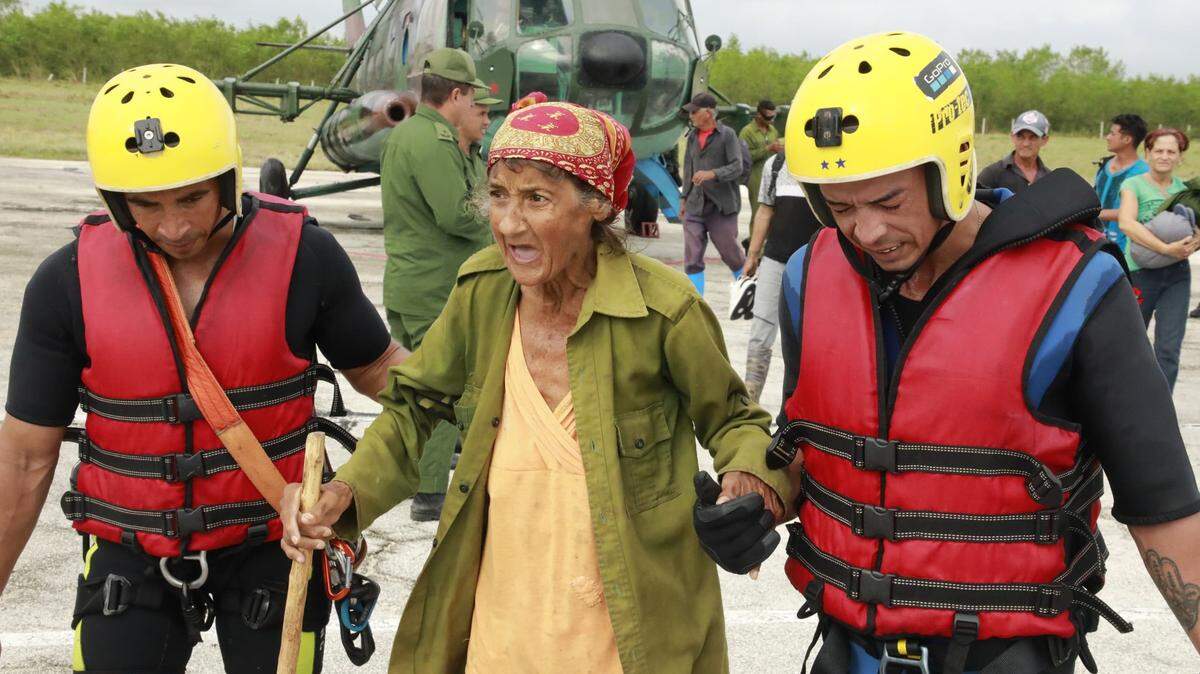
During the weekend, Cuban authorities continued rescuing people who were trapped by the flooding. Authorities ordered the evacuation of over 735,000 people ahead of the storm, most of whom took refuge with relatives and neighbors. But the government also conducted emergency evacuations during the weekend after local authorities failed to plan ahead for flooding caused by the overflow of the Cauto del Paso dam, in the province of Granma, and the Cauto River, along Granma and Las Tunas.
Granma, the Communist Party newspaper, prominently featured images of the rescue operations, which involved the armed forces, the ministry of interior and Soviet-era helicopters and amphibious transport vehicles.
Granma reported the rescue of:
- 11 people in Altagracia, a rural community in Holguín. One of the men said he had not eaten for almost three days. Eight people were rescued from the top of the roof of a local primary doctor’s clinic
- In the town of Río Cauto, eleven people were rescued after being stranded on the roof of a house in Santa Rosa.
- In the community of Grito de Yara, eight people were moved to safety, including three children who require specialized medical attention for respiratory problems.
-