
Cuba cancels May 1 workers parade over gas crisis, as report highlights labor violations
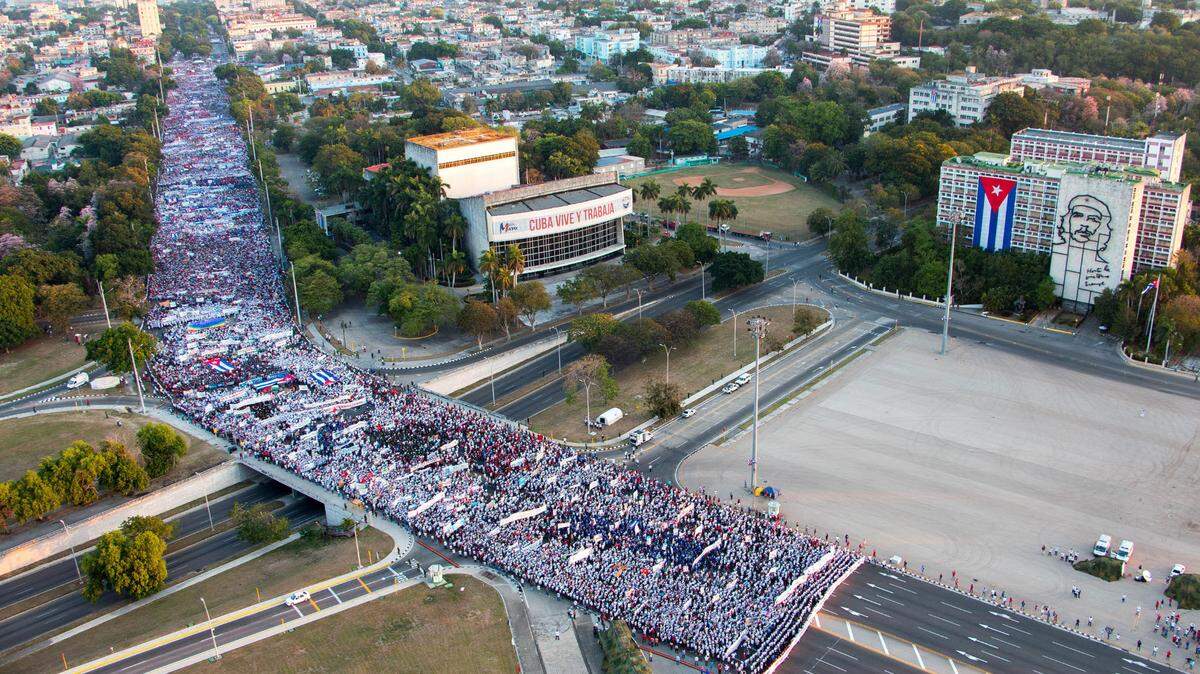
For decades, the images of thousands of Cubans, even a million at times, filling Havana’s Revolution Square during the May 1 parade were used by the Cuban government to convey the impression to foreign audiences of the population’s support of communism.
But in another signal of the island’s economic distress, the country’s leadership canceled Monday’s event because of a gasoline shortage.
Rain and some flooding on Sunday in Havana and other provinces in western Cuba also complicated things, and smaller events to make up for the canceled major parade were rescheduled for Friday, May 5.
Over the years, Cuban authorities have touted May 1 rallies, where people chant Patria o Muerte (Homeland or Death), slogans and carry banners with photos of Fidel Castro as a show of the population’s support. In reality, citizens are coerced into attending or face retaliation. State workers and students are usually carried on government buses from distant municipalities to fill public squares in Havana and other provinces.
But after weeks of hours-long lines at the country’s gas stations, Energy Minister Vicente de la O Levy confirmed in March that the island has a fuel shortage that is not going to be resolved soon — though he added the country was not going to reach a “zero” distribution level.
Cuban officials have given different explanations for the gas shortfall.
The country’s appointed president, Miguel Díaz-Canel, said the fuel crisis mainly stemmed from international providers unable to meet their commitments.
Shipments from Venezuela, a close Cuba ally again mired with production issues and shipment delays linked to a corruption investigation involving state oil company PDVSA, have been unstable in recent months. Cuba has received oil from Mexico and Russia but not enough to fill the gap.
Part of Cuba’s diesel fuel also had to be redirected for use to generate electricity, and an oil tanker was damaged at the Santiago de Cuba port, further complicating distribution, Díaz-Canel said.
Blaming U.S. sanctions, De la O Levy also said the cash-strapped island had trouble paying the high prices of supplies needed to refine oil.
“For several months now, we have had limitations on imports of refined crude and derivatives of diesel and gasoline,” said Néstor Pérez Franco, director of the state oil company CUPET. “This reality has not allowed our refineries to keep processing as they should and to guarantee the demand of the economy and the population.”
Jorge Piñón, an oil expert from the University of Texas at Austin, said the Cuban government could also be exporting more gasoline, at the expense of the local demand, to generate much-needed hard currency. Perez Franco has denied the government was doing so.
At its core, the fuel shortages are just another part of the government’s financial troubles in affording food, fuel and goods and guaranteeing essential services.
There were other tough times when the parade was suspended: in 1970, after the failed campaign to produce 10 million tons of sugar; in 1994 and 1995, in the middle of the economic crisis known as the Special Period, which followed the end of Soviet subsidies; and during the COVID-19 pandemic in 2020 and 2021.
Labor-rights violations in Cuba
On paper, the parade is organized by the Workers Central Union of Cuba, the single legal labor entity in the country, to celebrate workers’ rights and achievements under socialism. But labor activists and international organizations have for decades denounced the trampling of workers’ rights on the island.
In a report released last month, the Inter-American Commission on Human Rights, an autonomous agency of the Organization of American States, identified systemic violations of workers’ rights in Cuba. Those violations include “the lack of free access to work and lack of job stability; poor working conditions and lack of fair wages, … harassment in the workplace, … discrimination and persecution for political opinions,” among others.
The report also notes the “nonexistence of freedom of association in the workplace” because independent unions are prohibited. Workers are also not allowed to benefit from collective bargaining or to go on strike.
Accounts gathered by the commission show “that the State, as the largest employer, controls wages, limits the participation of the private sector in the labor market and imposes the labor conditions of the workers,” the report says. The commission “observes with concern how the labor situation of the working people of the island has become more precarious.”
The report notes that Cuban legislation violates the United Nations’ International Labor Organization’s Convention, which prohibits illegal retention of salaries by employers. According to the report, that’s a standard practice in Cuba, where state agencies negotiate salaries and control staffing in tourism and other sectors. Cuban doctors who have abandoned official medical missions abroad have also complained about similar practices.
Echoing concerns expressed by the. U.S. State Department, the commission said workers in those medical brigades “could find themselves in a situation of forced or mandatory work, concepts related to modern slavery.”
The commission urged the Cuban government to cease “salary retention,” end “acts of repression against Cuban workers,” provide working protection gear, increase minimum salaries, remove the ban on the private sector in certain professions and businesses, and end gender- and race-based job disparities.
Cubans interviewed for the report also highlighted how the low state salaries have made stealing at the workplace a widespread practice.
“Despite carrying out a complex job as an administrator, the salary I receive only allows me to survive with the basics for seven days,” one Cuban state worker told the commission. “Planning vacations, saving, or eating in a restaurant once a year is impossible. It is impossible for me to live without committing illicit acts to support myself and my family. ... Despite the fact that the company receives large benefits in local currency, there are no salary increases, so I, and most workers, have to steal small [portions] of necessary products like oil, flour, chicken and some pork.”
This story was originally published May 1, 2023 at 3:07 PM.