
Is your family name on this list? Time to sue for property lost in Cuba might run out
When he took power in 1959, Fidel Castro denied he was a communist, but he soon began the most ambitious nationalization process in Latin American history.
In just nine years, he confiscated, expropriated, and nationalized all private property, until not even a single street vendor was left in business. Many of the Cubans who lost their properties ended up in exile in the United States. And the revolutionary government was so proud of its radicalism that it published several lists naming those deemed “enemies of the people.”
Six decades later, those lists may come back to haunt the Cuban government, serving as evidence in U.S. courts of the extensive confiscation process carried out by Castro. Thanks to a surprising decision by President Donald Trump in May 2019, allowing people for the first time to sue under Title III of the Helms-Burton Act, owners of property seized by the Cuban government can now demand compensation from companies in Cuba “trafficking in stolen property.”
The targets are Cuban, American and other foreign companies that run businesses in properties previously seized by the Cuban government, and that don’t pay compensation to the original owners.
In 1972 and again in 2006, the Department of Justice’s Foreign Claims Settlement Commission certified 5,913 claims by U.S. citizens and companies for seized property worth around $8.5 billion, including interest. These claims have never been settled. Exploratory talks with the Cuban government during the brief thaw in relations under the Barack Obama administration went nowhere.
More than a year after Trump’s decision, experts doubt the court route will provide a definite solution for many of these claims-holders. Litigation will likely drag for years, cost millions of dollars, and face serious legal challenges regarding the law’s interpretation.
Big American companies like Exxon have taken a chance. Exxon’s lawsuit against a Cuban company now using a former Exxon refinery is one of at least 29 lawsuits filed since May last year. Among the properties in dispute are the main airport and the port in Havana, Santiago de Cuba’s port, a major refinery, a bank, a tobacco maker and coveted beaches that now house hotels run by Cuban and foreign companies.
But the bulk of lawsuits come from Cuban Americans, whose cases were not heard by the claims commission because they were not American citizens when Castro confiscated their family properties. Title III remedies that.
“I am grateful to the present administration for allowing Title III of the Helms-Burton Act to become active,” said José M. Infante Núñez, heir to Banco Núñez, which was nationalized in 1960. He and other family members are suing the French bank Société Générale for $792 million. The family accuses the bank of “trafficking” in their property for carrying out operations with the National Bank of Cuba, which resulted from the consolidation of several seized financial institutions. Société Générale has contested the accusations in what appears to be a long legal battle.
“I hope that Title III gives pause to companies considering doing business with the Cuban government because the Cuban government’s only business value is derived from confiscated property,” he added. Infante Núñez also said he hopes its implementation will speed up a democratic process in Cuba.
While there’s no indication of the latter, at least two French companies have already canceled contracts to modernize the Havana airport and the old Cuban rail system.
But given the uncertainty about the results of the next presidential elections, there may be little time left to file a Title III lawsuit. The Democratic nominee, Joe Biden, has not disclosed his position on this issue, but he has vowed to reverse some of Trump’s Cuba policies.
For a case to be successful, it must involve the “right plaintiff” and “the perfect target,” that is, a company over which U.S. courts may have jurisdiction, that has assets in the United States and that carries out activities that can be interpreted as “trafficking in stolen property,” said Pedro Freyre, a Cuban American attorney at Ackerman law firm. He advises companies that have been sued under Title III, such as Carnival, Latam and Expedia.
For example, the law prevents claims for properties that were valued at less than $50,000 when confiscated. The law also excludes thousands of Cubans whose homes were seized by the Castro government, unless they are occupied by an official of the Cuban government or the Communist Party.
For Cuban Americans without certified claims, the path “is more difficult because you have to establish ownership, that is, if you really own that claim,” Freyre said.
That’s when documents come in handy.
The lists
A 1959 law enacted shortly after the revolution prohibited confiscations of private property. Still, it included several exceptions to account for the potential enemies of the new revolution, including collaborators of the former Batista regime and “counterrevolutionaries,” those who enriched in the previous government, people who “committed crimes against the national economy,” abandoned the country to “avoid the revolutionary courts,” or conspired against the revolutionary government abroad.
In June 1960, the Cuban newspaper El Mundo published a list of almost 1,500 people whose assets had been confiscated by the newly created Ministry for the Recovery of Stolen Property. The agency was in charge of investigating former government members and people close to Fulgencio Batista, the Cuban dictator overthrown by Castro and his guerrillas, who fled the country in the early morning of Jan. 1, 1959.
If you cannot see the databases below, please click here to reload the page.
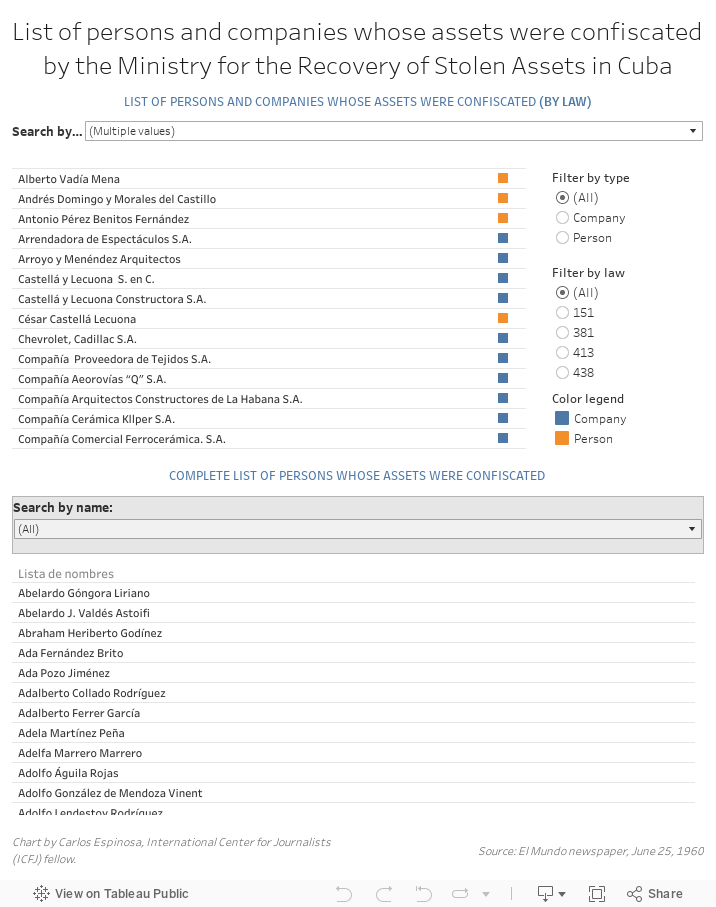
The list, obtained by el Nuevo Herald, is a rare document in which the Cuban government admits having carried out the expropriations and includes the names of those affected, who, at the time, had little legal recourse to challenge the seizures. Currently, the Cuban government restricts access to this type of historical document.
The short newspaper note with the headline Relación Completa de las Personas Cuyos Bienes han sido Confiscados, Complete List of Persons Whose Assets Have Been Confiscated, does not clarify the specific charges against the people on the list nor how the investigation process was carried out.
The document includes names of Cuban national police officers such as Conrado Carratalá Ugalde and Esteban Ventura Novo, whose crimes under Batista had been widely documented. Politicians loyal to the former dictator and their families were also included. But the government also grabbed the assets of early critics like Carlos Marquez Sterling, who led the convention that wrote the progressive 1940 Constitution, ran against a Batista-backed candidate in the 1958 presidential elections and created the Cuban school of journalism.
It is also possible that many members of the Cuban elite named in the list had simply fled the island, fearing for their lives as Castro began executing people accused of collaborating with the previous regime. The government also confiscated their properties, whether it was able to prove they committed crimes or not.
The Havana Airport
El Mundo also published a second list with 261 names of people and companies — most of them in real estate, construction, investment, and media — whose assets were also intervened or confiscated.
The first name on that list is Fulgencio Batista. Another one is his close associate, José López Vilaboy, a businessman accused by the revolutionary government of embezzlement and acting as Batista’s frontman in several deals. López Vilaboy and Batista’s wife, Marta Fernández Miranda, also controlled most of Banco Hispano Cubano shares.
Agents from the Castro government confiscated all of López Vilaboy’s properties, including the José Martí International Airport in Havana. His son, José Ramón López Regueiro, stayed in Cuba and did not see his father again, who went into exile in the United States. Six decades later, López Regueiro, who later emigrated to the U.S., sued American Airlines and Latam airlines for using the airport, in a lawsuit filed in a Miami federal court in September last year.
López Vilaboy’s close relations with Batista are well established, but his son denied the accusations about his father.
“For Cuba, either you are with the government, or you are bad, and if you are bad, you are a thief,” López Regueiro said in an interview with el Nuevo Herald. “For the Cuban government, nobody had properties, they were all stolen. They have stolen everything. They took over the island and made the island their private farm.”
His father had bought the airport through Compañía de Aeropuertos Internacionales S.A. (CAISA). Latam has defended itself by questioning the validity of the claim presented by his son because he “had not argued if Vilaboy was the owner of all or a percent of the shares of CAISA.”
Details about events that happened 60 years ago are difficult to prove in court, especially when the government carrying out confiscations also seized many property titles and financial documents to which it later restricted access.
But Guillermo Jiménez, a former Rebel Army Commander turned historian, was granted access to non-public shareholders’ books, bank reports and commercial records, which he then used to write the most extensive overview of Cuban companies before 1959.
In his book Las Empresas de Cuba, which is not widely available inside the island and sells for $200 on Amazon, Jiménez states that CAISA “was the owner and operator of the José Martí International Airport.” CAISA was “almost totally owned by José López Vilaboy, its president,” who owned $3,290,000 of the company’s $4 million in capital.
All the lands, factories, and banks in state hands
Responding to the activation of Title III, the Cuban government has said that Cuban claimants had their property confiscated due to criminal activity, not due to nationalization, and so they have no rights to compensation.
But the expropriations of Cuban citizens’ properties did not stop with the confiscation of the assets of those accused of committing alleged crimes or profiting from their close relations with Batista. Soon, Castro labeled landowners, big farmers and private companies in the industry, commerce and entertainment sectors as enemies of the revolution.
“I remember the way Castro tried to divide us. His government divided Cubans as rich or poor; black or white; owners of large, medium or small businesses,” Nuñez said in a written statement. “In 1960, families who owned land, like mine, were called latifundistas [large landholders] and I was ashamed without understanding what I had done wrong. My friends, whose parents did not own land, were suddenly not my friends. In school, those whose parents welcomed the revolution would loudly proclaim the end of an era and the coming of socialism.”
Concepción Beltrán’s family was never notified that their farms — mostly sugarcane and tobacco fields in Pinar del Río — had been nationalized by the revolutionary government after the First Agrarian Reform Law went into effect in May 1959. The lands had been in the family’s possession since the late 19th century.
“My boyfriend and my dad went horseback riding to the farm, it was like September 16 [1959], and when they arrived, the inspector told them, ‘You can’t be here, and this doesn’t belong to you,’” said Beltrán. The government also kept 42 horses and another tobacco farm.
The Agrarian Reform law promised compensation in 20-year bonds, but the government only issued 100 million pesos in bonds in September 1959. Most expropriated landowners never received any money.
“The agrarian reform law states that the lands would be expropriated and the families would be compensated, which never happened. They did not offer any type of compensation; it was a total theft of the properties,” said Beltrán. “We were left with nothing, without any income.
“You couldn’t get a job or anything because it was all controlled by the government,” added Beltrán, who arrived in Miami in August 1961 “with 10 cents,” she said, just enough to make a phone call to her relatives.
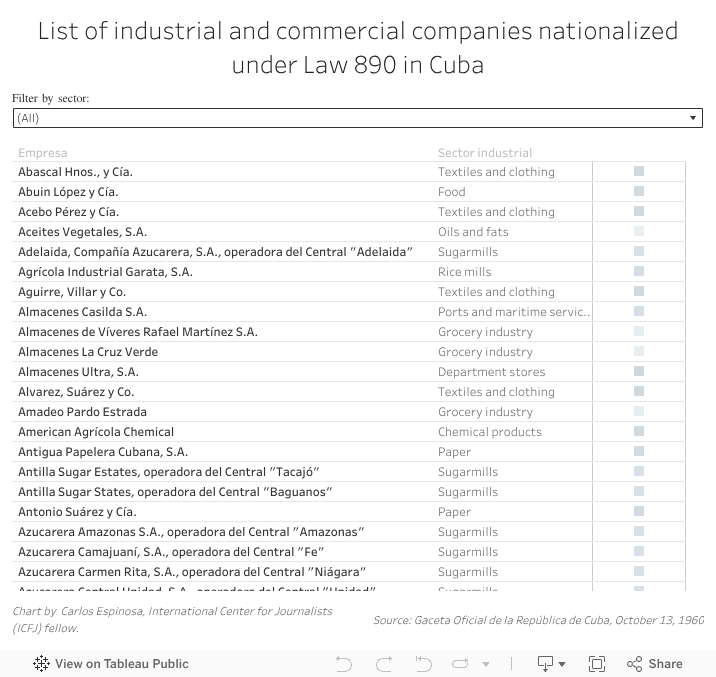
In October 1960, Castro’s government approved Law 890 to nationalize “through compulsory expropriation... all industrial and commercial companies,” as well as factories and warehouses.
“Every government has the right to expropriate its citizens, but it has to compensate those citizens adequately,” said Nick Gutiérrez, president of the National Association of Cuban Landowners in Exile who advocated for the implementation of Title III of the Helms-Burton Act.
“Unfortunately, the subsequent legislation [establishing compensation] never came,” he said.
As justification for the harsh measure, Law 890 states that many of the country’s large private companies “have followed a policy contrary to the interests of the Revolution,” and that it was necessary to “adopt formulas that definitively liquidate the economic power of the privileged interests that conspire against the people.”
Businesses from chocolate factories and flour mills to 11 of the country’s most popular cinemas appear on the list of 381 companies that Law 890 considered “will never be able to adapt to the revolutionary reality of our country.”
The law ordered the takeover of 105 sugar mills, 18 distilleries (among them those of José Arechabala, the original producer of Havana Club rum), and six alcoholic beverage producers, including the Ron Bacardí company.
Bacardí has not yet filed a lawsuit under the Helms-Burton Act, but sent a statement to el Nuevo Herald warning that “it will not hesitate to challenge all people and companies that carry out commercial activities, use or benefit from our illegally confiscated properties in Cuba.”
“Bacardí, like many others, is a company that lost all its Cuban properties due to illegal confiscation without compensation,” the statement said. “We support the right and ability of affected people to seek justice and prevent further trafficking in stolen property.”
In October 1960, the government also nationalized the Cuban banking system, which Banco Nacional de Cuba absorbed. Among those expropriated was Banco Núñez, the second largest on the island, with 22 branches and valued at $8 million. The government allegedly offered its founder, Carlos Núñez Pérez, $10,000 as compensation, court documents show.
By 1968, when Castro outlawed the rest of small businesses in private hands, almost the country’s entire economy came under state control, from foreign trade to the street sale of fritas.
The economy never recovered from forced nationalization.
Follow Nora Gámez Torres on Twitter: @ngameztorres
This story was originally published October 26, 2020 at 7:15 AM.