OAS leadership race is not about U.S. vs China in Latin America, Trump envoy says
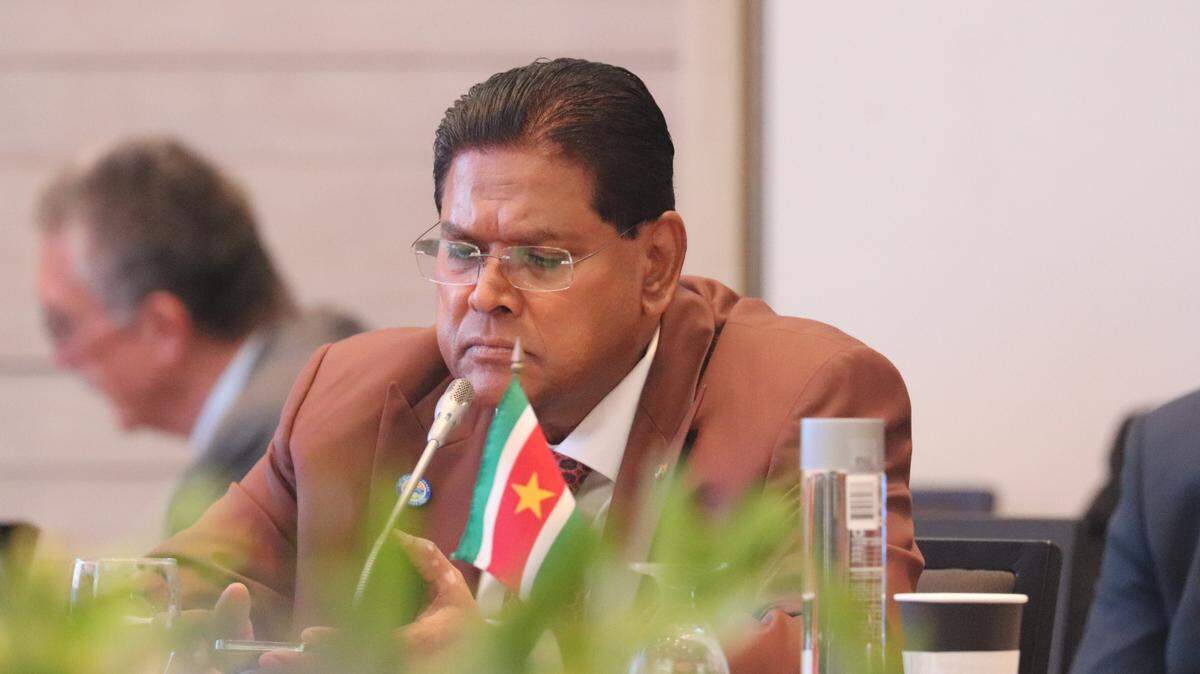
When Chandrikapersad “Chan” Santokhi assumed the presidency of South America’s only Dutch-speaking nation five years ago, he told the country’s congress that despite its gold and oil reserves, the nation “was on the brink of a financial abyss.”
The pandemic and years of economic mismanagement by former military strongman Desi Bouterse had placed Suriname in a debt trap.
Its creditor was none other than China, the lender to poor countries whose growing footprint in Latin America and the Caribbean was ushering in new roads and housing, but also draining government coffers with the high interest rates on their loans.
Now as Santokhi seeks reelection— and his foreign minister, Albert Ramdin, vies for the top job at the Organization of American States — the country’s economy is growing, inflation is receding and public debt is on the decline, according to the International Monetary Fund.
“I think it’s a real success story,” said Mauricio Claver-Carone, President Donald Trump’s special envoy for the Americas.
Claver-Carone is so high on Suriname’s success he says recent suggestions that the tiny country on the northeast corner of South America has become a sort of Chinese colony are not only annoying but “absolutely false.”
The suggestion is being invoked in the race for the leadership of the OAS, the Washington-based regional entity for hemispheric dialogue whose effectiveness has become a matter of debate amid a series of deepening regional crises. Opponents of Ramdin have been suggesting through social media posts and a recent Newsmax column that both he and Suriname are proxies for China, which according to the Newsmax piece wants to “control the OAS and only Trump can stop it.”
The assertion is misleading and is falsely framing the election as a geopolitical battle between the United States and China for control of the multilateral organization, Sir Ronald Sanders, Antigua and Barbuda’s representative at the OAS, wrote in his latest column on Caribbean News Global. Sanders said the U.S., which is a member of the OAS, has a direct influence on its decisions, but Beijing is only an observer with no say.
Making the race about the geopolitical rivalries “is entirely detached from reality and distracts from the fundamental issue at hand: the selection of the most capable candidate to lead the OAS Secretariat,” Sanders said.
Two official candidates
A former deputy secretary general at the OAS, Ramdin is running against Paraguay Foreign Minister Rubén Ramírez Lezcano. While the two are the official candidates, a third unofficial recently entered the race, Arnaldo André, the foreign minister of Costa Rica.
Suriname is geographically in South America, but it is part of the Caribbean Community bloc CARICOM, which has united behind him with its 14 OAS votes. Ramírez, meanwhile, has been openly projecting himself as siding with the U.S and suggesting he has the support of President Trump, even though the U.S. has not endorsed any candidate, and it’s not clear if it will.
Both Paraguay and Suriname are U.S. allies, although Paraguay officially recognizes Taiwan, while Suriname, which switched over a decade ago under Bouterse, recognizes China.
That distinction has made its way into the OAS leadership race, which will be decided on March 10 in Washington, but it doesn’t belong, Claver-Carone said.
“They’re two pro-American candidates that are running for secretary general of the OAS and whoever wins among those two is going to be an ally of the United States,” he said. “It’s not a race between a U.S. ally and a China ally. That’s a false narrative.”
Santokhi, Suriname’s president, agrees.
“Our foreign policy today is a balance where we engage on the basis of Suriname’s development interests and internationally agreed objectives of peace, security and sustainable development” he said in a statement to the Miami Herald. ”The notion currently suggesting that Suriname’s ambitions and activities in the Western Hemisphere are related to China are incorrect, unfounded and malicious.”
Suriname’s foreign policy, he said, is based on values and norms globally recognized and part of several conventions on international law and humanitarian principles. “Our goal is to be a respected and valuable member of the global community,” he added.
Santokhi said when his administration took office in July 2020, it “inherited a loaded and burdened financial economic situation with a debt portfolio” close to $4 billion, which was approximately 150% of the country’s GDP.
“Since then we have engaged all creditors, including the official creditors like India and China, to restructure the debt successfully,” he said. “We also inherited a poor and dubious presence internationally. Within months we restored at the highest levels diplomatic and political relations with Suriname’s historic and traditional political allies, like the Netherlands, France, neighboring countries and the United States.”
If anything, Suriname is an example of how the Trump administration can go head-to-head with Beijing by working with leaders who are open to the help. That’s exactly what happened with Suriname, Claver-Carone said, when the country was drowning in debt to China.
Trump administration rescue
“People who know the history know what has taken place over the last four or five years and the challenges,” he said.
In 2020, when Claver-Carone was National Security director during Trump’s first term, Suriname was on the verge of bankruptcy, with over $500 million in Chinese debt and $200 million in arrears. Growth was negative 16 percent and inflation was rising.
“It was a bankrupt economy run by corrupt political actors, people with law enforcement issues who literally handed the country over to China,” Claver-Carone said, referring to Bouterse, who died in December, a year after he was sentenced to 20 years in prison for the murders of 15 opponents of the military government in 1982. After the verdict, the former dictator vanished and wasn’t heard from again until his death at age 79.
Bouterse’s loss in Suriname’s 2020 elections offered an opening in the country’s politics that the one-time dictator had dominated for decades. After an opposition landslide victory, Santokhi, a former police chief, was elected president by the country’s congress.
In Washington, the moment was viewed “as a historic opportunity,” Claver-Carone said, recalling the decision by the Trump administration to invest in helping Suriname get out of “its China debt trap.”
It wasn’t easy, Claver-Carone said — the Chinese refused to renegotiate the debt. “They didn’t want to let the country go.”
But with Santokhi and Ramdin leading the way, the debt was eventually restructured and the International Monetary Fund was brought in with a set of economic reforms aimed at reducing government spending and debt.
Even after he moved from the White House to the Inter-American Development Bank, Claver-Carone said, Suriname remained a top priority.
Today, instead of a sinking economy, Suriname is projected to see a 3% growth in GDP. The IMF has also noted that the country’s reforms have helped increase investor confidence, which has led to new investments in its oil industry by the French, not the Chinese.
“Thanks to the work we all did together Suriname today, as opposed to five years ago, is a pro-American country that’s on the right path economically, that’s growing, that’s bringing in foreign investments that’s non-Chinese,” Claver-Carone said.
That said, Trump’s envoy added the U.S. is not picking sides on the OAS leadership.
“This is a race between obviously Paraguay, which is probably one of the best allies we have in South America... but Suriname is also a very important U.S. ally,” Claver-Carone said.
The administration, he noted, remains “highly skeptical of the OAS because of its inefficiencies, bureaucracy,” while recognizing that “this is the best opportunity” a Caribbean nation has ever had” to lead the OAS since its founding in 1948. “It’s historic.”
Last week as the 15-member Caribbean Community regional bloc closed out its regional summit, Barbados Prime Minister publicly reaffirmed the bloc’s unified endorsement of Ramdin for the post. The bloc represents 14 votes of the 34 members that will cast ballots.
“We appreciate that and it’s not insignificant to us,” said Claver-Carone, who plans to visit the Caribbean region some time in March with Secretary of State Marco Rubio. “It doesn’t mean that we believe, trust or want to invest in the OAS. We obviously believe that the OAS is broken, and it needs a lot; and I don’t know if it’s reformable, and obviously that’s a question, and I’ve had that conversation with both minister Ramdin and Minister Ramírez.”
For his part, Santokhi said Suriname “as a full-fledged, committed member of the Caribbean Community, appreciates the unanimous endorsement” by CARICOM of the country’s candidate to lead the OAS.