As convicted Suriname president seeks third term, stakes are high in vote amid COVID
Polls are open in Suriname where voters in the Dutch-speaking South American nation will see if it’s possible to hold an election without spiking a resurgence in the novel coronavirus. They’ll decide the fate of their convicted and charismatic leader who has dominated over the country’s politics for four decades.
President Desiré “Dési” Bouterse, 74, and his governing multi-ethnic National Democratic Party coalition are seeking to hold onto power in the country amid a murder conviction, corruption scandals, souring economy — and a global pandemic that has made South America the new epicenter of COVID-19 infections.
In November, a Surinamese military court convicted Bouterse (pronounced BOW-ter-say) of murder in the 1982 execution of 15 prominent political opponents during a military roundup, and sentenced him to 20 years in prison. Bouterse, who has always denied direct involvement, has appealed the judgment.
By winning a majority of seats in Monday’s general elections, he would not only secure a third-term as president but immunity from prison.
“Stakes are high at these elections for several reasons,” Albert Ramdin, the Surinamese-born former assistant secretary general for the Organization of American States, said Monday shortly after casting his vote. “The country is in a financial economic crisis due to high debt-ration, high government expenditures ... the exchange rate is going up ... purchasing power is going down, unemployment is increasing. So financially, economically, socially, it’s a real crisis.”
Speaking to the Miami Herald as a private citizen, Ramdin said Suriname’s precarious economic situation is just one of the issues facing voters in the contested general elections where there are 22 political parties on the ballot. There are also the president’s legal challenges.
“That whole situation is a major issue in the country,” said Ramdin, who is also an adviser to the recently mounted National Observer Institute. “What will happen?”
Complicating matters is COVID-19, which is surging through the region. Suriname has registered 11 cases of the deadly infection, caused by the coronavirus, and one death. Most of those who were infected have recovered, but there remains one active case, a Brazilian who recently entered the country illegally.
The country’s borders with both French Guiana and English-speaking Guyana, where a recount of the March presidential vote remains ongoing, remain closed. A curfew was lifted for Monday and Tuesday so that the vote and ballot tally can take place, and polls can remain open until 7 p.m. By 6 p.m. Monday, the voting was extended two additional hours until 9 p.m. The results are not expected for several weeks.
In addition to the local observers with the National Observer Institute, which was specifically mounted for Monday’s vote, there are observers from the local foreign diplomatic missions, including the United States and France, as well as the Organization of American States and the 15-member Caribbean Community regional bloc.
Upon arriving in Suriname, the foreign observers were all subjected to testing for COVID-19, temperature checks and quarantine. How things unfold in Suriname will pave the way for possible observer missions elsewhere in the region. Other scheduled elections include St. Kitts and Nevis on June 5; the postponed presidential vote in the Dominican Republic on July 5; and possibly Haiti later this year. Voters in Bolivia, who were scheduled to go to the polls on May 3, are also expected to vote before Aug. 2.
With the exception of St. Kitts and Nevis where all 15 COVID-19 cases have recovered, all of the other countries have community transmission raising the risks for infections and concerns among observer missions.
In the meantime, all eyes are on Suriname, where there are approximately 385,000 voters and 648 polling stations in 10 electoral districts. Ramdin said there are about 120 observers in country, including 90 from the local National Observer Institute.
“Observation is key because there are enormous suspicions about the possibility of fraud,” Ramdin said.
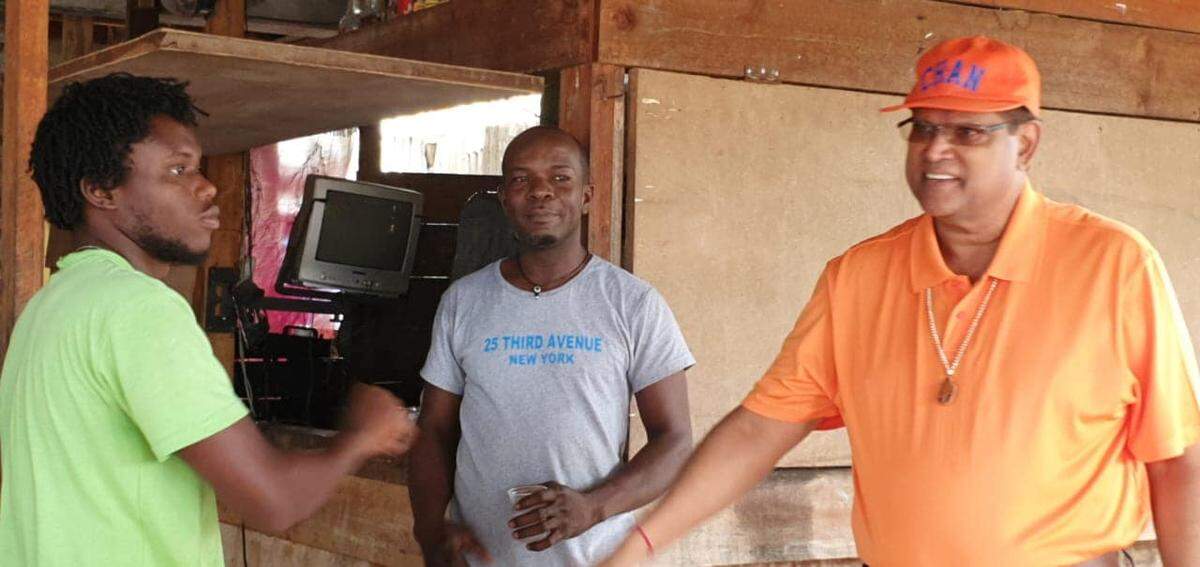
With the vote taking place not just during a pandemic but at a critical juncture in Suriname’s history, the race appears to be between Bouterse’s NDP governing coalition, which could lose its majority in parliament, and the Progressive Reform Party led by Chandrikapersad “Chan” Santokhi. Santokhi is a former Surinamese justice minister and police commissioner who once served as chair of the Inter-American Drug Abuse Control Commission.
For some voters it will come down to a question of whether they believe Bouterse, who has popularized himself among the country’s poor, can lead Suriname despite his own legal challenges. No stranger to legal problems, Bouterse has ruled Suriname despite a political career marked by a drug trafficking conviction, a stint as a dictator, and as a despot-turned-democrat who eventually won over citizens and regional leaders as a populist.
In 2010, he was elected president in a parliamentary vote and won reelection five years later. But his grip on power dates back four decades when he first seized power in a 1980 bloodless coup. He would resign seven years later under international pressure, but then briefly seize power again in 1990.
In 1999, a court in the Netherlands convicted him in absentia of drug trafficking but he avoided serving his 11-year-prison sentence because Surinamese law does not allow for his extradition. In 2015, he was hit with another political blow — this time when his son Dino Bouterse was sentenced to more than 16 years in U.S. prison after admitting he allowed the Lebanese militant group Hezbollah to use Suriname as a home base.
This story was originally published May 25, 2020 at 11:13 AM.