
Rare two-headed turtle with six legs hatches in Massachusetts nesting site
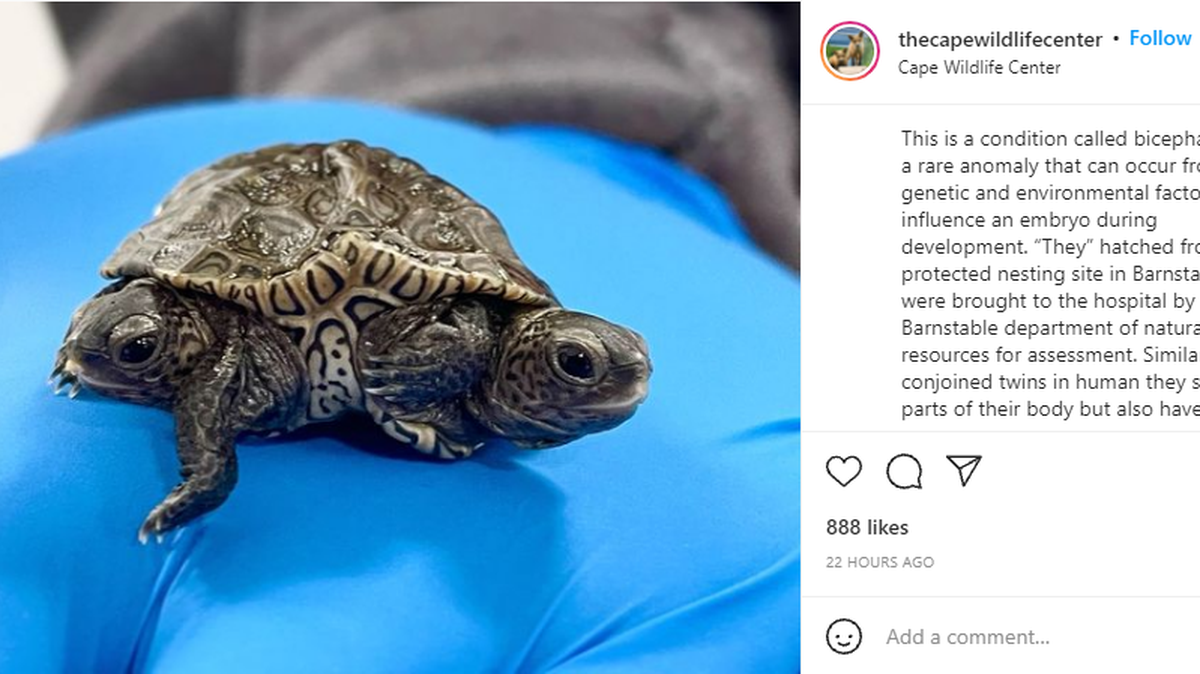
“No, you are not seeing double,” Cape Wildlife Center said on Instagram.
That’s because it’s actually a two-headed diamondback terrapin turtle with six legs, according to the Massachusetts nonprofit vet clinic.
The rare turtle hatched at “a protected nesting site in Barnstable” and was brought to the clinic for assessment just over two weeks ago, wildlife officials said.
“Similar to conjoined twins in human(s), they share parts of their body but also have some parts that are independent,” officials said.
The condition is called bicephaly, “a rare anomaly that can occur from both genetic and environmental factors that influence an embryo during development.”
“Animals with this rare condition don’t always survive very long or live a good quality of life,” the clinic said, “but these two have given us reason to be optimistic.”
Both heads are “very alert and active,” according to wildlife officials.
Each head has control of three legs while moving and swimming, and X-rays showed that the turtle has two spines “that fuse further down the body.”
Veterinarians conducted a barium test to get certain areas of the body to show up better on an X-ray and found that each turtle has a separate gastrointestinal tract, wildlife officials said.
The right side of the turtle “appears to be slightly more developed,” but they continue to eat, digest and gain weight each day.
“It is impossible to get inside the heads of these two, but it appears that they work together to navigate their environment,” officials said.
A swim test revealed that they coordinate their bodies while swimming to come up to the surface for air.
The turtle will undergo a CT scan when it’s a bit bigger, which will help vets better understand what “internal structures they share,” wildlife officials said.
One-headed diamondback terrapins live for about “25 to 40 years in the wild” — but only one to two percent of hatchlings “make it to adulthood,” according to BBC Wildlife Magazine.
They can be found in “salt marshes, wetlands, mangrove swamps, estuaries, lagoons and tidal creeks,” the magazine said.
.png)