Régine, whose global disco empire taught Miami how to party like superstars, died at 92

When Frank Sinatra, Sammy Davis Jr. and Liza Minnelli needed to unwind in class together after a 1988 Miami Arena concert they billed as The Ultimate Event, they knew they needed the ultimate place and the ultimate hostess. They found both in Régine at her namesake Régine’s nightclub atop Coconut Grove’s Grand Bay Hotel.
And with three of the century’s premiere talents in her room on the Grand Bay penthouse commanding attention, the sophisticated Régine made sure not to forget that one of her Miami friends had something to celebrate, too. But Julio Iglesias could not join his peers in person. So Régine dashed off to make a phone call to wish the Spanish crooner a happy birthday in San Francisco.
That was the ever attentive Régine — one name only like Cher and Madonna because, really, who needs the bother of two when the world knows you by one fabulous handle?
Régine, who also ran Jimmy’z, a nightclub tucked inside The Forge in Miami Beach, died in Paris at age 92 on May 1, according to her granddaughter Daphne Rotcage.
The first disco
Régine was credited with creating the world’s first disco, back in the 1950s. Her chain of dance clubs, including those in Miami, New York, Los Angeles, Monte Carlo, Rio de Janeiro, São Paulo, Saint Tropez, London, Düsseldorf, Cairo and Kuala Lumpur, helped define 1970s and 1980s glamour and gave Miami a visual setting as richly lavish as on TV’s “Dynasty.”
“With enormous fanfare, she opened her New York club in 1976 on the ground floor of Delmonico’s Hotel, at 59th Street and Park Avenue. She moved into the hotel’s penthouse suite,” The New York Times announced in her obituary.
It was penthouses all the way, including in Miami where her club Régine’s in the five-star Grand Bay Hotel was the place to be for Madonna, Michael Jackson, John Travolta and Luciano Pavarotti and for those with the gelt, glam and gumption to mingle among them. Not to mention, pay $220 a bottle for the disco’s signature bubbly, Dom Pérignon. (That would be about $577 today, adjusting for inflation.)
“Régine’s in Miami was the most of everything,” Régine told the Miami Herald in 2000. “People went there to spend money like crazy. When I opened, I offered exclusive memberships for $1,000 each. Right away I had 3,000 members. There were a lot of nouveau riche in Miami. Cubans, South Americans. Yes, some of it may have been drug money, but every period has that.”
The velvet rope
Régine created the concept of the velvet rope and bottle service long before Studio 54 in New York became world famous for these amenities in the late-1970s. And she did so decades before long-gone glam nightclubs like Liquid on South Beach’s Washington Avenue revived the concept locally in the 1990s.
Terry Zarikian directed public relations for Régine’s in the former Grand Bay and was the club’s executive director. The memories he can share could fill 10 seasons of a “Dynasty” reboot, but such a series would lack the love he still feels for his beloved Régine.
The pair first met in 1976 when the doorman at Régine’s Manhattan disco told Zarikian he could enter but only if he was properly dressed, wearing a tie.
This attire requirement was no small thing, Régine told a Miami Herald reporter inside Jimmy’z in 2000.
“One time at Régine’s in New York, the doorman turned down Mick Jagger because he wasn’t wearing a jacket,” she said. “He was in sneakers and jeans. He called me the next day, ‘Régine, I was turned down. I have a jacket now. Can I come?’ We were very good friends. I would have made an exception for Mick Jagger.”
Zarikian picks up his story.
The opulent Régine’s
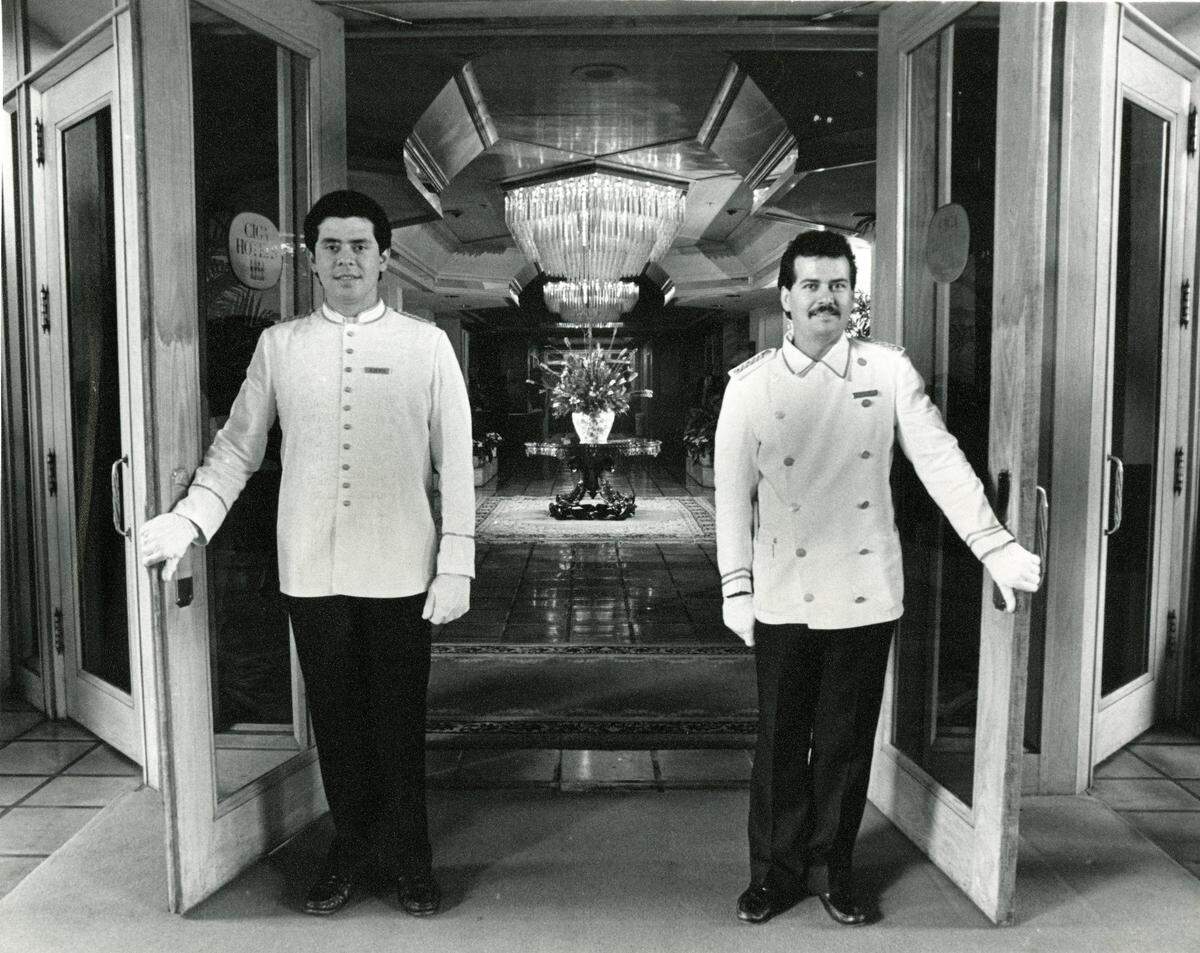
In 1986, a decade after they had met, Zarikian had closed his upscale restaurant, L’Alouette, in Bay Harbor Island. Régine’s husband at the time, Roger Choukroun, had been to L’Aloutte and convinced developers Woody Weiser and Donald Lefton, who had opened The Grand Bay in 1983, that it “would be a good idea” to talk with Zarikian and offer him a job on a trial basis, he remembered.
“September 1986, on my first night at Régine’s, she looks at me and immediately orders me, ‘Terrie, take good care of my club. You need to bring all the celebrities who are in town and show them how to party.’ She turned around and left me frozen by the tone of her voice.”
The club’s membership director Sheila Murray took a stunned Zarikian by the hand and filled the other with a martini. “Here, this will make you feel better,” she told him.
Minutes later, the grand dame asked that Zarikian join her at her table.
He was ready. He had a beautiful arrangement of her favorite white flowers and a bottle of champagne. He made the chocolate display pop like a firecracker and reveal dragée, the French version of Jordan almonds.
“Since that day, our relationship became solid,” Zarikian said.
Weekly themed parties had to top Régine’s opening night black tie affairs a few years earlier that saw Julio Iglesias, Gina Lollobrigida, Jackie Gleason and Ursula Andress drinking champagne from Moët & Chandon champagne coupes towers.
In 1986, Régine celebrated her 30 years in the nightclub business with “the most glamorous party Miami had ever seen,” Zarikian said.
“Frédéric Chandon, the Count Chandon de Briailles, and his wife flew from Paris and joined Sharon Stone, who wasn’t famous then, but Régine asked me to, “Take care of her Terrie, she is going to be a BIG star!’ Régine’s secret plan was to introduce Stone to Iglesias. Sly Stallone came with Brigitte Nielsen, just before their separation, and the decor created by Erté, mysteriously disappeared.”
Zarikian surmises that the night cleaners mistakenly thought it was leftover decor that they could take home.
When Woody Weiser died in 2011, the Herald’s obituary noted that Régine’s was said to have sold more champagne than any other establishment in the United States.
Régine and Jimmy’z
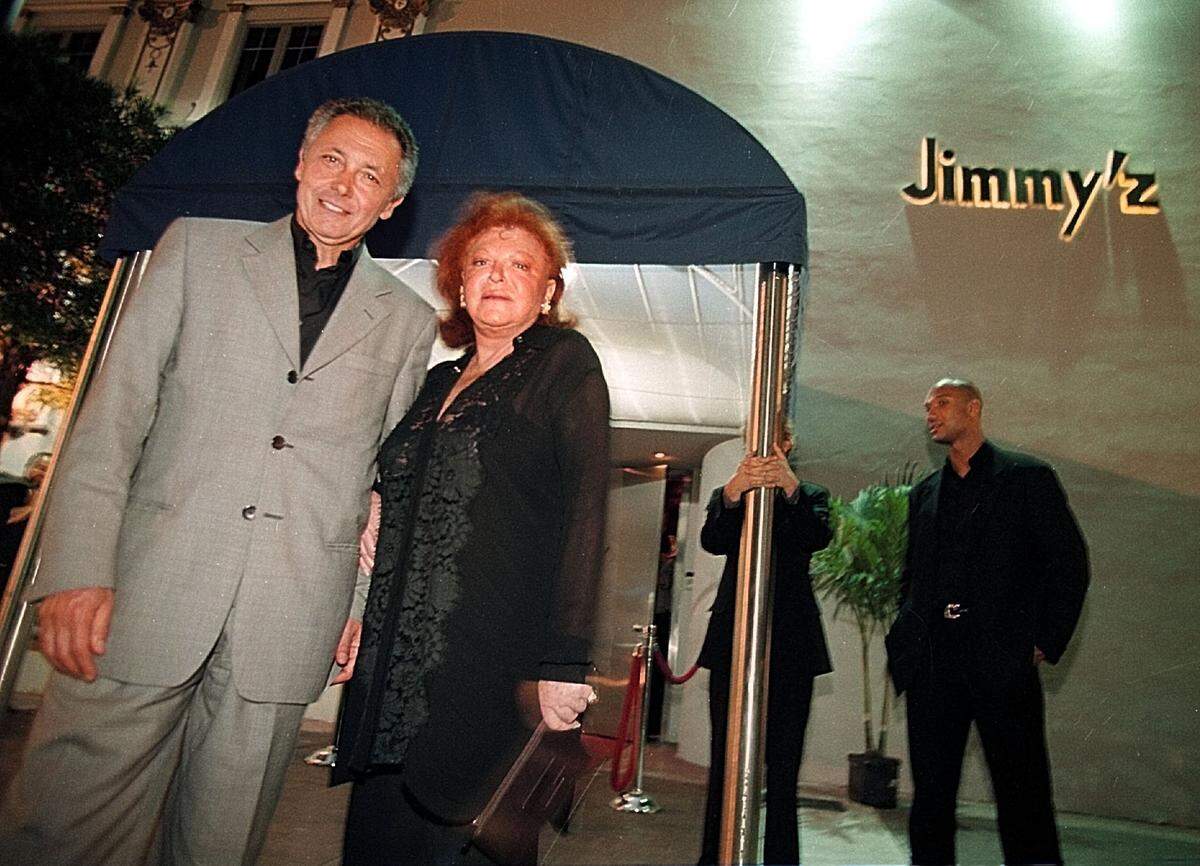
Régine managed similar feats at Jimmy’z into the 2000s when she partnered with the Forge’s owner Shareef Malnik.
“I was a fan of Régine long before I met her having viewed her from afar in my youth when celebrating at Régine’s in New York and Jimmy’z in Monaco,” Malnik said in an email to the Miami Herald.
“Then one day she approached me to collaborate on opening Jimmy’z at the Forge. We negotiated and drafted a contract along with her then-husband, Roger, in one full day at her home in Harbor Island while she plied me with salami sandwiches on toasted French bread with French mustard made by her hand which we washed down with champagne. The rest was history, we had an eight-year run together bringing what only Régine could bring: her signature, world class, Parisian joie de vivre in Miami,” Malnik said.
Life during World War II
Régine was born Rachelle Zylberberg in Etterbeek, Belgium, on Dec. 26, 1929, to Jewish emigrants from Poland during the Great Depression, according to the New York Times.
Régine was abandoned in infancy by her unwed mother, who departed for Argentina, and left alone at 12 when her father was arrested by the Nazis in France. She was hidden in a convent in Provence to escape the Holocaust.
Seventy years later, at Jimmy’z, the sartorially resplendent and red-haired Régine expressed one lasting sorrow.
“Many years later, I had a club in Argentina. She was in Argentina also. I never went to see her,” Régine told the Herald in 2000. “She called me in the hotel where I was staying. She told me my name in Yiddish was Regina. That was the first time I heard that. But I didn’t want to see her. I was an idiot. I didn’t give a chance to this woman to explain herself. She died at the age of 92. I found out later. When you want to ignore something, you can.”
After World War II, Régine sold bras in the streets of Paris. She “vowed to become rich and famous someday,” The Times noted.
Régine’s concept
Régine was a barmaid at the Whisky-A-Go-Go in Paris in 1953. There, in a flash of inspiration to keep the crowds going between lulls when the music stopped every time a jukebox loaded the next song, Régine came up with the concept of the discotheque.
She brought in record players, not one but two turntables, so a DJ could play uninterrupted music. But Régine didn’t stop there.
“It is where I invented the first dance floor,” Régine, then 70 and still partying to the wee hours of 5 a.m., told the Herald at Jimmy’z.
“We put in linoleum flooring from the kitchen, and I put a little grease on it so people could slide. I took the jukeboxes and destroyed the mechanics so that I could play whatever record I wanted, and go from one turntable to the other one, like mixing. The first mixing, I did in 1953. I took out the regular light bulbs and put in colored bulbs, and I would switch them on and off with the music. The first disco lighting,” Régine said.
Her first club, Chez Régine, opened in Paris and spun records in 1957. Financial backing came from members of the Rothschild family who followed Régine at the Whisky. Brigitte Bardot and Rudolf Nureyev were regulars.
Acting and singing
South Florida’s Régine’s and Jimmy’z are gone. The original Grand Bay Hotel was demolished in 2013.
Régine had other talents she could tap. She had a small part in the 1976 movie, “The Seven-Per-Cent Solution.” Régine also had a European hit single with her French version of Gloria Gaynor’s disco classic, “I Will Survive,” in 1978.
“But more memorable was her six-month residency in Washington, D.C., at the age of 81,” Zarikian said. That’s when, in 2011, Régine was cast in the musical “Follies,” playing the role of coquette Solange La Fitte.
“I went to the opening night and, with butterflies in my stomach, witnessed that she forgot the lyrics,” Zarikian said. “But she sang along with the tune and, flirting with the audience, she got a standing ovation. That’s my Régine, fearless as ever.”
Survivors, services
Régine’s survivors include her granddaughter Daphne Rotcage. She was predeceased by her son Lionel Rotcage in 2006. A private funeral will be held Monday in Paris.
This story was originally published May 7, 2022 at 3:54 PM.