Supreme Court weighs whether Trump can end Haitian TPS. South Florida is watching
Supreme Court justices pressed the federal government Wednesday about whether the president’s racist remarks about immigrants should factor into legal challenges to the Trump administration’s terminations of Temporary Protected Status for Haitians and Syrians, in a case that will have significant consequences for South Florida, the heart of the Haitian community in the U.S.
During oral arguments on Wednesday, the Trump administration rejected the notion that comments from President Donald Trump and other officials about Haitians and other immigrants should drive the court’s analysis in this case. In his presidential campaign, Trump falsely said that Haitians eat cats and dogs and said that immigrants were “poisoning the blood of our country.”
“The Court should conclude that the statements are unilluminating,” said U.S. Solicitor General John Sauer, who represented the administration. Justice Ketanji Brown Jackson pointed to a lower district court judge who found in February that “racial animus” had likely played a role in the termination of TPS.
The oral arguments follow the Trump administration’s emergency request asking the high court to let it end TPS for Haitians and Syrians after several lower courts have upheld the protections. The Supreme Court consolidated the two cases. There are over 355,000 people from both nationalities, nearly all of them Haitian, with TPS. READ MORE: ‘A death sentence.’ Pastors demand TPS extension for Haitian nationals
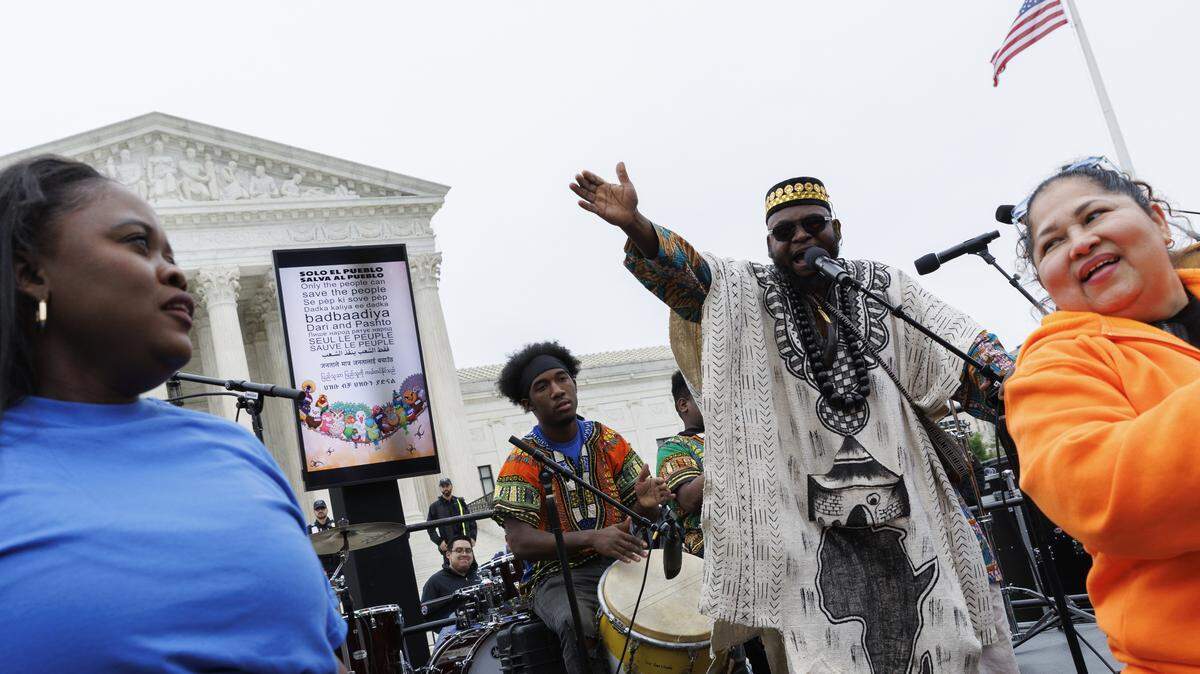
The case is being followed closely in South Florida. On Sunday, dozens of community leaders, advocates, religious leaders and local residents held a rally demanding that the government keep TPS for Haitians in place. There were over 145,000 Haitians with TPS in Florida as of March 2025. If Haitians are left without their protections, they would lose their right to work and could be deported to Haiti.
Maryse Balthazar, a Haitian TPS holder who has lived in Boynton Beach for the past 10 years, and has been in the U.S. for more than 16 years, said the possibility of losing protections would leave her with no clear legal path forward in the country.
“We will be at the mercy of deportation because it’s too late for me to apply for asylum,” she said. In the United States, asylum seekers must generally apply within one year of their last arrival, unless they can demonstrate extraordinary circumstances for the delay or changes in personal or country conditions.
Balthazar said deportation would force her to rebuild her life from scratch. “It would be like I’m starting back my life at 56 years old.” She said the uncertainty extends beyond legal arguments into daily survival. She works as a certified nursing assistant and said she pays nearly $2,800 a month for a three-bedroom apartment. She lives with her family, including her 30-year-old son, who also has TPS, and her 19-year-old daughter, who is a U.S. citizen.
Balthazar said maintaining TPS requires applicants to remain in good legal standing. “To have your TPS renewed, you have to stay away from U.S. law enforcement radar,” she said. “They do a background check on you before they give you TPS.”
She said TPS holders should be given a chance to remain in the country if they follow the law. “When you stay like a law-abiding citizen, I think you should have a chance,” she said. Balthazar described TPS recipients as working, paying taxes, and trying to live quietly. “We respect the law and do the right thing,” she said. “We go to work, pay tax, make a living. We don’t bother anybody. I don’t even know if my neighbors know my name.”
If the Supreme Court accepts the Trump administration’s argument that courts don’t have the authority to review the TPS decisions, the president could use the ruling to end TPS for other countries. If the Supreme Court rejects the administration’s argument, Venezuelans, Haitians, and other TPS beneficiaries could use it to continue arguing for their protections in court.
Temporary Protected Status is a federal program that gives immigrants from countries in turmoil and are already in the United States deportation protections and work permits. The Department of Homeland Security Secretary has the authority to designate a country for the protections. There is a periodic review every 6, 12, or 18 months of country conditions where the Secretary decides whether to keep or cancel the protections.
In considering the emergency requests from the Trump administration, the Supreme Court is evaluating whether they can hear the case’s merits, whether Trump officials followed proper procedures in ending the protections, whether federal courts have jurisdiction to review the administration’s action on TPS, and whether racial animus played a role and should be considered as a factor in the case. Sauer told the justices that TPS law, as written by Congress, has a broad bar against judicial review, and that lower courts have been making “foreign-policy laden” judgments.
Justice Sonia Sotomayor pressed him on issues of due process, Justice Brett Kavanaugh asked why Congress would have barred review by the courts as broadly as the government asserts, while Justice Clarence Thomas asked about the role of Congress in limiting executive power.
Gregory Pipoly, the lead attorney for the Haitian plaintiffs, told the justices that administration shut down TPS for Haitians because of racial animus towards non-white immigrants. He argued that the Trump administration ended TPS protections for a group of countries that are “all non-white.” At the same time, he said, Trump created a separate humanitarian pathway that primarily benefited “white and only white South Africans.”
Justice Samuel Alito pressed Pipoly on the claim that the administration is targeting non-white countries.
“If you put Syrians, Turks, Greeks, and other people who live around the Mediterranean in a lineup… are they all non-white?” he asked. “How about Turks?” Trump administration policies are not targeting European countries. Alito appeared to mention Southern European nations where tan skin is deemed to be more common.
“I honestly haven’t considered what racial component I would sort Turks in,” Pipoly replied.
Alito continued: “How about Greeks?… About Southern Italians? ... How about Spaniards?
Pipoly answered that over a century ago, Italians and Spanish nationals were not considered white. “Our concept of these things evolves over time,” he said.
Government attorneys disputed the racial characterization, defending the administration’s authority to set and terminate TPS designations based on foreign policy considerations rather than race.
Experts say that any decision from the high court could also affect more than 1.3 million other immigrants in limbo, including Venezuelans. The Supreme Court in October let the Trump administration move forward with its terminations of TPS for Venezuela while litigation is ongoing. An appeals court in January upheld a lower court’s ruling, but the Supreme Court ruling is still in effect. Florida had about 230,000 Venezuelans with TPS as of March 2025, according to the Congressional Research Service.
Faith in Action, a group of religious leaders and clergy across the country including Miami, filed a brief in support of keeping the protections in place. Among its members who filed the document to the high court is Rev. Dr Keny Felix, senior pastor of Bethel Evangelical Baptist Church in Miami and president of the Southern Baptist Convention National Haitian Fellowship.
“As a pastor who serves Haitian families every day, I know what is at stake in this case. These are not statistics — they are our congregants, our neighbors, our brothers and sisters in faith. Haiti is in crisis by every measure, and sending families back there now would be a death sentence,” Felix said in a statement.
Haiti first received TPS designation after a devastating earthquake killed hundreds of thousands of Haitians and destroyed Port-Au-Prince in 2010, during the first Obama administration. Trump tried to end the protections during his first administration but faced challenges in court. President Joe Biden expanded the Haitian protections after another earthquake, the assassination of President Jovenel Moĩse and extreme gang violence.
When it moved to end TPS for Haitians, the administration said there were no extraordinary conditions barring Haitians in the U.S. from returning safely and that it was not in American interests to keep the TPS designation for Haiti going.
However, the State Department currently as a “Do Not Travel” advisory for Americans considering going to Haiti.
According to the International Rescue Committee’s 2026 Emergency Watchlist, Haiti continues to face one of the world’s worst humanitarian crises. It found in a recent report that 73% of households in Haiti report feeling unsafe where they sleep, that 60% of households do not have their children in school because of violence, and that 75% of households are unable to afford health services.
Viles Dorsainvil, a Haitian TPS holder and plaintiff, described a personal journey shaped by escalating violence in Haiti and uncertainty in the United States.
He said during a press conference that he first left Haiti in 2020 after serving as a young pastor, when he began receiving threats and extortion demands.
“I started to receive some letters from the hoodlums asking me for money that I don’t have,” he said, adding that his mother urged him to leave because “she understood that I was in danger.”
Dorsainvil said he arrived in the United States shortly before Haiti’s president was assassinated, a moment he described as deepening the crisis in his home country. He recounted that his younger brother, a medical school graduate, later told him that relatives had been kidnapped while traveling to Gonaïves and that “there is no future” in Haiti, prompting him to bring his brother to the U.S.
Once in the United States, Dorsainvil said he worked as a case manager in Ohio while continuing to follow developments in Haiti and the immigrant community. He referred to the 2024 presidential campaign when Haitian migrants living in Springfield, Ohio were falsely accused of “eating pets,” saying, “When I was contacted and people were asking me questions, I didn’t know what to say.”
He said the experience pushed him to speak publicly and become involved in litigation over TPS policy. “If you don’t tell your story, folks will tell a story about who you are not,” he said.
Dorsainvil, who co-founded a Haitian Support Center, said he later became a plaintiff in coordination with civil rights attorneys, describing the decision as a responsibility to the broader community.
“We do it for ourselves. We do it for the community. We do it for all the TPS holders,” he said.
This story was originally published April 29, 2026 at 2:58 PM.