
U.S. citizen has fought seven months to free husband; ICE claims ‘flight risk’

Angela Della Valle has been crisscrossing the country since August, fighting for the release of her husband of 23 years from immigration detention.
In Florida alone, he was transferred about a dozen times to various immigration detention centers, including Alligator Alcatraz, hastily erected last summer by the DeSantis administration in the middle of the Everglades.
Angela, 49, a U.S. citizen, hoped her husband, Carlos Della Valle, a Mexican immigrant with no criminal record who has been living and working in the United States for nearly 30 years, would have been released by authorities by now.
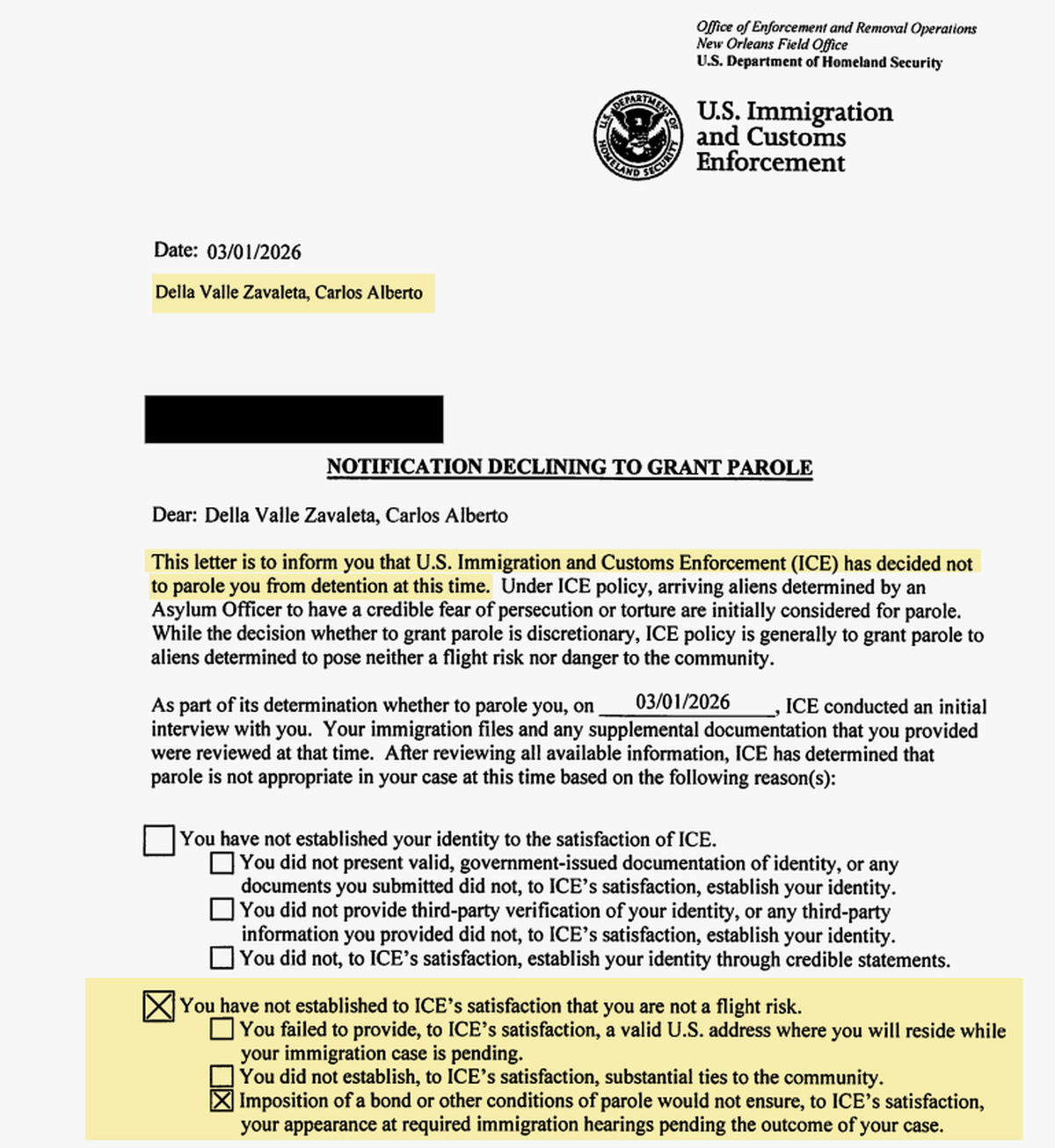
On Monday, however, U.S. Immigration and Customs Enforcement denied his humanitarian parole request, which would have let him be released into her custody while his case moved through the courts. ICE officials said Carlos, 50, had “not established to ICE’s satisfaction” that he was “not a flight risk.”
ICE’s ruling put Carlos closer to being deported back to his home state of Guerrero, Mexico, where he fled after he said he was assaulted multiple times by local drug cartels for refusing to join. Angela does not understand why Carlos was considered a flight risk when immigration officials have his passport.
“This is the guy who turned himself in to ICE and then has endured prolonged detention willingly,” she said in an interview with the Herald.
In his parole petition, Angela submitted nearly three decades of evidence that Carlos paid taxes and contributed to his community. It didn’t matter.
The Della Valle family exemplifies the anguish that American families with spouses who are undocumented face under Trump’s administration’s immigration crackdown. Known as mixed-status families, they’re living under the prospect of their loved ones being detained indefinitely or deported.
There is no comprehensive tracking of mixed-status households. In 2024, the Department of Homeland Security estimated that 765,000 non-citizens who have been living in the United States for more than 20 years without lawful immigration status are married to a U.S. citizen.
U.S.-born son
Many have U.S.-born children. Angela and Carlos have a 20-year-old son, Alessandro, a junior at the University of Pittsburgh, who was born in the United States.
Royce Murray, the former assistant secretary for border and immigration policy, said she was not surprised that Carlos’s parole petition was denied. Under the Biden administration, ICE focused on removing and detaining people who posed a risk to the public, taking into account factors like how long they had been in the country.
Under the Trump administration’s mass deportation mandate, ICE arrests and removals are driven by quotas and using prolonged detention to pressure detainees to self-deport, she said.
“If your goal is to get as many people to leave as possible, keeping someone in detention when they have an established life here and really aren’t [a] flight risk seems to be designed to pressure people to leave, to just give up,” Murray said.
Carlos crossed the U.S. southern border at Douglas, Arizona, in 1997 and was deported. He crossed again. Reentering the country after being deported is a felony under U.S. law, punishable by up to two years in jail.
In 2024, the family was returning from a Christmas vacation when Carlos was apprehended by immigration officials at Cyril E. King Airport in St. Thomas, U.S. Virgin Islands. A judge released him on bond.
After a two-day trial in August 2025, a jury in Charlotte Amelie, St. Thomas, found Carlos not guilty of reentry into the United States. He was a free man, but still in the country without legal immigration status.
The next morning, he turned himself in to immigration officials in St. Thomas for detention. In November, an immigration judge in Louisiana reinstated his deportation order and denied his asylum claims of returning to violence in Mexico.

Though ICE denied Carlos’s parole petition, the agency said he could submit more documentation and request a redetermination. Angela says their lawyer is working with the agency to get more information that might sway ICE to reconsider the case.
“It’s not like a completely closed thing, but it’s obviously very ludicrous,” she said.
At the same time, they are appealing the Louisiana judge’s decision and asking for another humanitarian parole from the United States Citizenship and Immigration Services.
In response to questions from the Herald about why Carlos was labeled a flight risk, a Department of Homeland Security spokesperson provided the same statement as when the Herald first reported this story in January.
The statement said the Trump “administration is not going to ignore the rule of law” and that “the United States is offering illegal aliens $2,600 and a free flight to self-deport now.”
“We encourage every person here illegally to take advantage of this offer and reserve the chance to come back to the U.S. the right legal way to live the American dream,” the DHS spokesperson said.
Marrying U.S. citizen only works if you enter country legally
One of the biggest misconceptions Americans have about couples like Angela and Carlos is that they have been here for decades and have never tried to change their status, without understanding how complicated the immigration system is, said Ashley DeAzevedo, executive director at American Families United, a nonprofit that works with U.S. citizens with undocumented spouses.
“The unfortunate narrative that we see in movies and on TV, that marrying a US citizen automatically cures your problems, is just simply untrue,” DeAzevedo said.
Marrying a U.S. citizen does provide a pathway to citizenship, but only if you entered lawfully.
In December, American Families United released a report based on a survey of more than 200 of its members. The survey found 80 percent of respondents said they had been discussing leaving the country since January 2025, up from less than half the prior year. The families surveyed had been together for more than a decade.
DeAzevedo said it is almost impossible for couples like Angela and Carlos to adjust their status. There is no pathway for these families unless Congress acts.
Lobbying Congress
The advocacy group has been lobbying House and Senate members in Washington to pass the Dignity Act, which would alleviate the hardship faced by mixed-status families experiencing separation.
U.S. Rep. Maria Elvira Salazar, a Miami Republican, introduced the bill in July to provide a legal pathway for immigrants who had been living and working in the U.S. for years and are not criminals.
“No American family should have to wake up every day fearing they will be torn apart. Yet that is the reality of Carlos and Angela, and thousands of other American families are living today,” said Salazar, who is running for re-election in November and has been criticized for not pushing back harder on Trump’s aggressive approach to immigration.
Salazar said the bill, which has not moved forward for a vote, allows “immigration authorities to provide targeted relief for spouses of U.S. citizens, making sure that families like Della Valle stay.”
Some of the families that American Families United works with have decided to preemptively leave the country, afraid their spouses’ detention has no end in sight.
For Angela, her path is clear. She is prepared to keep fighting and to exhaust every legal option to keep her family together.
“We’ve come too far, we are not looking back at all,” Angela said.
This story was originally published March 13, 2026 at 12:12 PM.