
She wanted to speak against an ICE deal with Miami-Dade. She ended up in jail instead
The last words Camila Ramos uttered on her feet at Thursday’s Miami-Dade County Commission meeting were: “I’m trying to understand the process. You’re ejecting me?”
Three plainclothed county deputies had her by both arms at the time as she resisted being pulled away from her spot waiting to tell commissioners to reject a proposed Immigration and Customs Enforcement agreement with county jails.
While a vote was scheduled for that morning, commissioners decided to indefinitely delay the decision. The board’s chair, Anthony Rodriguez, warned Ramos and others in the audience that if they chose to speak on the issue Thursday, they’d forfeit the public’s right to address commissioners on the agreement in the future.
As Rodriguez spoke, Ramos ended up on the floor of the chambers in the process of a violent ejection that had her dragged by both wrists as she went limp and told officers: “I deserve to know the process. … Let me go. I can stand, and I can be quiet.”
Members of the audience began chanting: “Let her go.” Quickly, the chant switched to “Let her speak.”
At one point, an officer suggested Ramos could leave voluntarily. “Can you walk outside?” he asked while she was on the floor. But multiple officers continued to move her toward the doors, and video showed a hand on her hair at one point.
“Stop!” Ramos said as she was carried out of the chamber doors. “I just asked a question.”
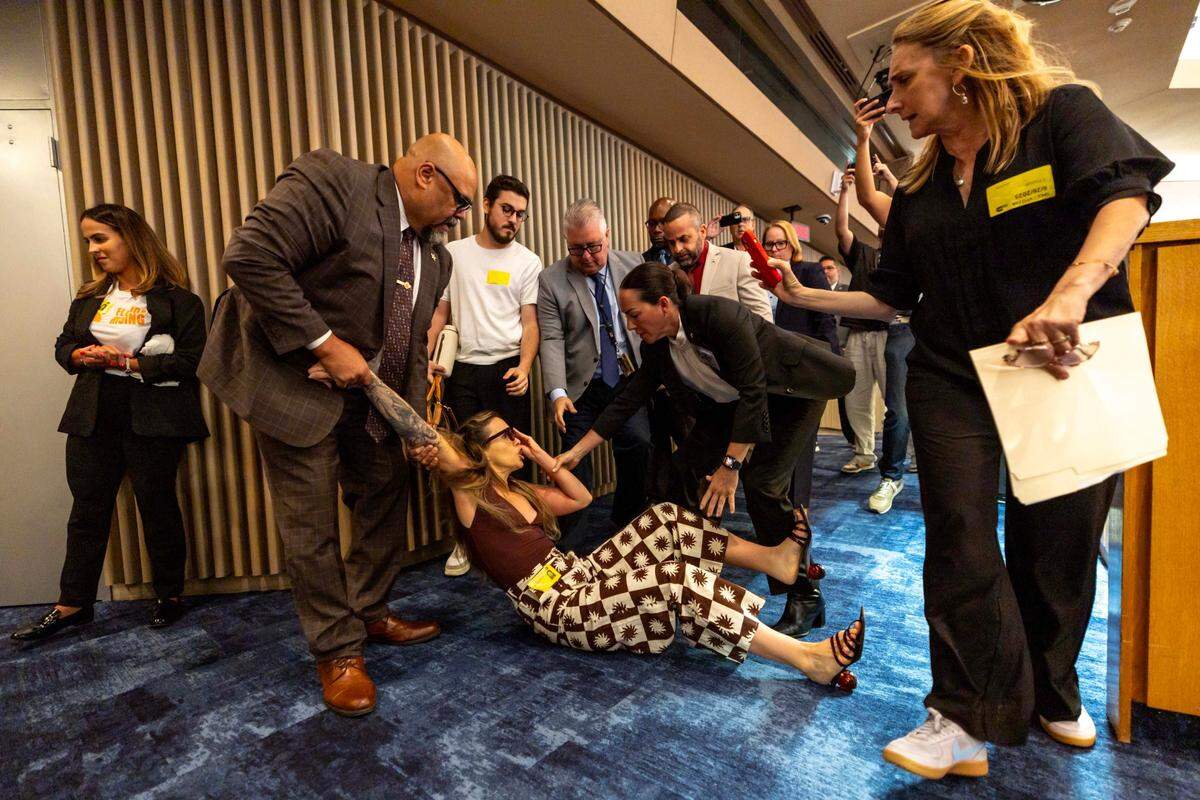
The morning incident led to Ramos, 36, being led out of the Stephen P. Clark Center in handcuffs and put into a waiting squad car along with another person who had a confrontation with deputies outside the chambers, Z Spicer.
Commission chair: ‘We will have order in this chamber’
Ramos is a real estate agent from El Portal who once owned the popular All Day coffee shop in Miami after moving here from Cuba in the 1990s and becoming a competitive barista, according to online biographies.
She was already standing near the microphone reserved for the public when Rodriguez gave his instructions and there were some murmurs of objections from the audience. “There won’t be the ‘yelling questions to the dais’ thing,” said Oliver Gilbert, a former board chair. Rodriguez added: “We will have order in this chamber.”
At the same time, Ramos could be seen in a tense exchange with the plainclothed deputies who serve as sergeants-at-arms in the commission chambers under Sheriff Rosie Cordero-Stutz.
“I can’t breathe,” Ramos said as deputies, including uniformed officers, placed her in handcuffs on the carpeted floor outside the doors of the commission chambers. She was led out of the lobby on her own feet while cuffed, then led upstairs to county offices shortly after 10:30 a.m.
The arrest report alleges that Ramos struck a deputy “with a closed fist in the face” while still in the chambers. During the mayhem, a plainclothes deputy could be heard accusing Ramos of hitting her. Ramos responded that she didn’t — or that if she did, she didn’t mean to.
As Ramos ascended a commission escalator in cuffs, her husband, Juan Ball, watched her go. He said he was baffled at the entire situation.
“My first reaction was: Why is it being deferred? Everybody was told it was either going to be approved or disapproved today,” he said later. “She had a beautiful message to share.”
Shortly after noon, she and Spicer emerged in cuffs from a county freight elevator and were led to a waiting sheriff’s car outside the building in downtown Miami.
Ramos was charged with battery on an officer and resisting an officer with violence, both felonies, while Spicer, 25, was charged with a misdemeanor, resisting an officer without violence. County records show both were being held at the Turner Guilford Knight jail on Thursday afternoon.
Spicer is listed as a community organizer for Catalyst Miami, an advocacy group originally founded by Mayor Daniella Levine Cava in the 1990s before she left nonprofit work to successfully run for the County Commission in 2014.
A scrapped vote on a Miami-Dade ICE jails agreement leads to chaos
The last time Miami-Dade commissioners witnessed that kind of a chaotic moment was in early 2017, also ahead of a decision on how much county jails should cooperate with federal immigration agents under President Donald Trump. At the time, a divided commission voted to extend by two days the detention of inmates booked on local charges but also sought for deportation. The extra time gives ICE agents a chance to take the inmates into their custody. Declining the detention requests — known as detainers — had Miami-Dade labeled a “sanctuary” jurisdiction by the Justice Department, and accepting them lifted that designation.
The agreement on the agenda Thursday included new provisions for the county to be compensated for those extended stays, as well as restrictions on releasing jail records that opponents claimed could make it difficult to track inmates once they were targeted by ICE. The administration of Levine Cava, a Democrat who voted against the 2017 agreement when she was a county commissioner, asked commissioners to approve the new agreement and said the records concerns were unfounded.
Levine Cava said Florida law now requires her to ratify the new provisions in the ICE agreement. “This is not something about which I have a choice,” she told the audience. “This is the law. ... It doesn’t mean it is the wish of this body.”
Gilbert said it was a mistake to use the modified ICE agreement as a proxy for more general criticisms of the Trump administration’s aggressive deportation effort. “I know this is an emotional issue that’s sweeping the country and sweeping South Florida. It’s very important to us,” said Gilbert, a Democrat. “But none of that is before us.”
The removal of Ramos began when commissioners moved to cancel the controversial vote and allow Levine Cava to ratify the deal herself. Rodriguez, the Republican chair of the commission, told the audience that the item was about to be indefinitely deferred.
“I have quite a few speakers registered to speak,” Rodriguez told the audience. Then he told the crowd that Florida law gives them the right to still address commissioners before the deferral vote, which eventually passed by a wide margin. But he added a warning: If a single person spoke on Thursday, they would trigger the public-comment session for everybody, meaning any future vote on the item would happen without the public being allowed to address commissioners again.
“You will be granted one minute to speak,” he said. “But if you do speak, then the public hearing will have been had. If this item were ever to resurface, you will not have an opportunity to speak then.”
Florida Rising, an advocacy group that helped organize people to oppose the ICE agreement, said the public was not treated fairly at the meeting.
“There was confusion and misleading messages from the chairman,” said Sergio Otalora-Montenegro, deputy communications director for Florida Rising. “The commissioners are trying to wash their hands and avoid taking any political responsibility.”
In a statement after the meeting, Rodriguez said he was trying to make clear to the audience that if people chose to speak Thursday, they’d have to remain silent if the item came up for a vote later in the year.
“The purpose … was to allow the public to speak at the time when the item would actually be discussed and being considered by the board — which was not today,” he said.
A future vote on the contentious agreement is unlikely: A committee hearing on the item was canceled earlier this month after too few commissioners showed up to participate. While there was a nearly full dais on Thursday, commissioners jumped on a suggestion by Gilbert just to let Levine Cava’s March signature on the ICE agreement stand and not have the agreement ratified by the board.
Geri Bonzon-Keenan, the county attorney, told commissioners the agreement is already in effect and didn’t need a board vote. “There’s no need to approve this item at this point,” she said.
The deferral debate came after Rodriguez quickly won approval — without the chance for public comment — on a last-minute item to give Levine Cava temporary authority to approve all state and federal agreements required to keep Miami-Dade in compliance with applicable law. Rodriguez included a provision making the power retroactive to March, when Levine Cava signed the ICE deal in question. That cleared the way for Gilbert’s deferral motion, which passed with a lone no vote by Commissioner Roberto Gonzalez, the Republican who sponsored the ICE agreement item.
Ultimately, opponents of the item opted to take up Rodriguez on his original offer to speak before commissioners ahead of the deferral vote. They urged commissioners to reject the ICE deal. “Please stand up for those who most need it,” said Silvia Muñoz, a member of Cuban American Women Supporting Democracy.
“Our people are scared,” said Jose Dominguez, a community organizer in the Miami area. “I think they have a good reason to be afraid. They don’t trust you.”
Marcelo Balladares urged commissioners to join the fight against the Trump administration’s mass deportation effort.
“Where is the line? When will you stand up for our community?” he said. “And I’m talking about more than an Instagram post.”
Miami Herald staff photojournalist Danny Varela contributed to this report.
This story was originally published June 26, 2025 at 7:17 PM.