
‘It’s painful.’ Venezuelans torn over Trump as his deportation agenda disrupts lives
The friends gathered at El Arepazo in Doral were not there to talk politics. They had more pressing matters: a Champions League soccer game.
All Venezuelans, all American citizens and all loyal Real Madrid fans, the men share many things in common. They like to get together at the popular restaurant to watch their team. And when Madrid isn’t playing, they root for Barcelona to lose.
And they try to avoid the elephant in the room: President Donald Trump.
The president, who owns a resort in the city, home to the largest concentration of Venezuelans in the country, has made Venezuelan immigrants high-priority targets in the early days of his promised mass-deportation sweeps. His administration is fighting in court to be able to deport hundreds of thousands who fled Venezuela’s economic and political turmoil, and hastily sent dozens of Venezuelans to an infamous El Salvador prison based on questionable evidence that they are members of the violent Tren de Aragua gang he claims has invaded the United States.
READ MORE: Administration: ‘Many’ Venezuelans sent to El Salvador prison had no U.S. criminal record
Trump’s immigration policies have generated a strong reaction in “Doralzuela,” where most voters supported him in the 2024 election. But Venezuelan-American voters in Doral and in other Florida enclaves who sided with Trump appear to be standing by their vote — even if some are having second thoughts as friends and family are threatened with deportation.
As he watched the soccer game, Miguel Uzcátegui, a 74-year-old Venezuelan-American and registered Republican, said it’s too early — just over 100 days in — to judge the Trump administration. But he does have his concerns, especially with the deportation of Venezuelan men to El Salvador.
“I’m very legalistic, and this is where I disagree with him,” said Uzcátegui, a petroleum engineer who fled Venezuela in 2001. “He’s attacking legal problems through illegal means. He’s bending the law.”
While Hispanic voters swung hard toward Trump in Miami-Dade County in November, the president’s efforts to revoke legal status for so many Venezuelans has made the community something of a bellwether for how Latinos are reacting to the president’s mass-deportation agenda.
A new Florida International University survey of Venezuelans across Florida is beginning to bring those feelings into focus.
Most Venezuelans agree when it comes to Temporary Protected Status protections, the survey from FIU’s Jack D. Gordon Institute for Public Policy found. About three of every four respondents — a group including naturalized U.S. citizens and non-citizens —disagreed with Trump’s efforts to end TPS and a Biden-era humanitarian program that allowed people in the United States to sponsor temporary stays for Venezuelans and other immigrants.
But among the relatively small group of respondents who agreed with ending TPS and humanitarian parole (10 and 11%, respectively), most were naturalized U.S. citizens who are eligible to vote. And they do vote. Over 87% of the respondents who agreed with ending humanitarian parole said they voted for Trump.
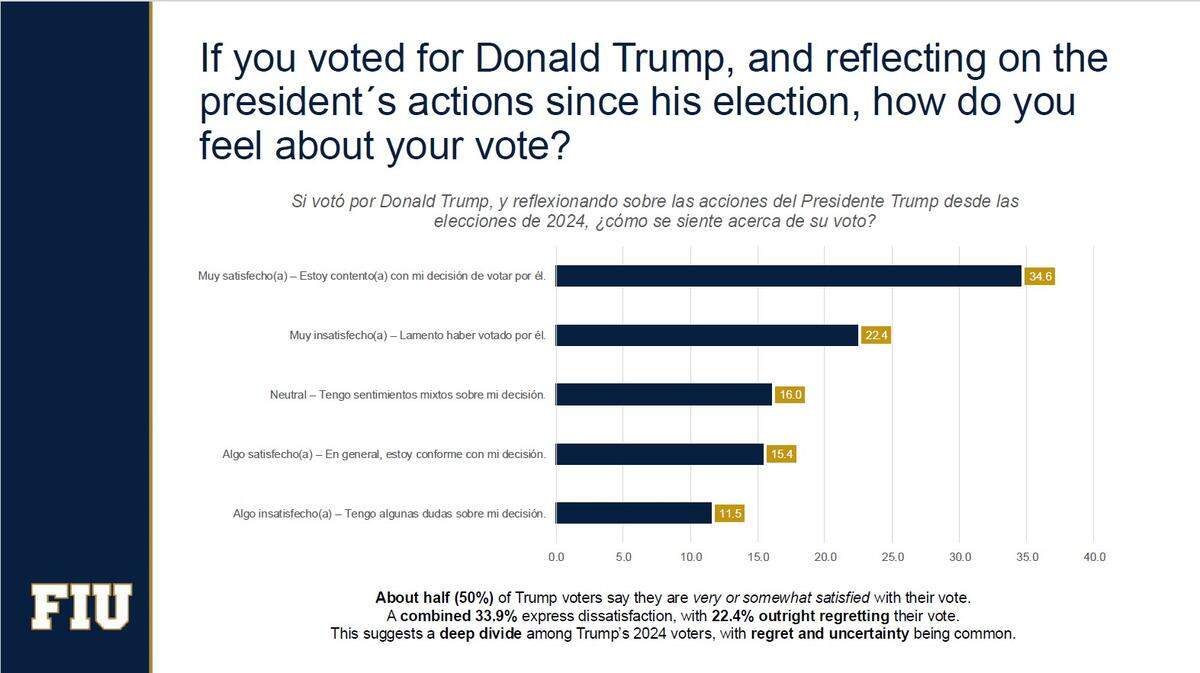
Some Trump voters — roughly one-third — said they were disenchanted to some extent with the president. But half were either “very satisfied” or “somewhat satisfied.” Venezuelan immigrants who have been in the United States for longer are more aligned with Trump’s policies while newer arrivals tend to be more critical of the president, according to the survey.
“For those who are not naturalized, their fate, in large measure, depends on the actions of those who are naturalized,” FIU Professor Eduardo Gamarra, who conducted the survey, told the Herald. “And those who are naturalized are OK with their vote.”
From the streets of Doral
Walk around Doral and you’ll hear strong opinions, at least from those who are willing to share them.
“Now every Venezuelan is a criminal, according to the government,” José, one of the friends gathered at El Arepazo, said sarcastically. “We’re all members of the Tren de Aragua.”
José, a 72-year-old Venezuelan-American and registered Democrat since his son was deployed to the Iraq War, asked not to have his full name published to avoid backlash for speaking out against Trump. A chemical engineer who left Venezuela in 1989 with his wife and three children, he said he and his son, a “Trumpista,” reached the same agreement that José made with his fellow Real Madrid fans at El Arepazo: No politics talk.
At Downtown Doral Park, Ian, a 39-year-old Kendall resident born in Venezuela, said he stands by his vote for Trump, but hopes the government will take a more nuanced approach to TPS. Still, Ian stressed that TPS is temporary by definition and said that being allowed in the U.S. is a privilege, not a right.
“There’s some bad people that came in, that’s why we escaped our country, because there were bad people there,” Ian, a U.S. citizen who declined to give his last name, said about TPS. “It’s a little sad that good people are suffering because of the bad people. But how are you going to correct that unless you have one of us saying, ‘This looks like a bad person, take them out. This looks like a good person, leave them in.’ It’s complicated.”
Ian generally approves of the administration so far and said most Venezuelans would agree.
At a local computer repair shop, 52-year-old Javier Portillo said he would have voted for Trump if he could, “despite the crazy things he’s doing.” Portillo, who has lived in the United States since leaving Venezuela 15 years ago, is ineligible to vote because he is not a citizen. He has applied for his green card.
“I’m an immigrant. I feel for immigrants. But Trump is working for his citizens. A president should focus on his citizens first and then immigrants,” Portillo said in Spanish. “What has happened at the border the last four years has been so grotesque, so difficult that this administration has to find a way to put a stop to it. It’s painful, it’s hard, but it’s a measure that has to be taken.”
Venezuelans are a significant demographic in Florida. Over 44% of all residents of Venezuelan origin in the United States live in the state — many of them in South Florida. Over the past two decades, the country has experienced a dramatic surge in its Venezuelan population, driven by a mass exodus from a country devastated by a humanitarian crisis under Nicolás Maduro’s authoritarian rule. According to U.S. Census data, the number of people of Venezuelan origin living in the United States skyrocketed by 950% between 2000 and 2024—from just 95,000 to more than 903,000.
More than 600,000 Venezuelans hold TPS, making up 66% of the Venezuelan community in the United States. Venezuelans are also significantly less likely to be naturalized citizens than immigrants overall: in 2023, only 15% of Venezuelan immigrants had U.S. citizenship, and just 18% of Venezuelans in the United States were born in the United States, according to the U.S. Census.
In Doral, Trump beat former Vice President Kamala Harris by 23 points. He flipped Miami-Dade — where half the population was born in another country — red for the first time since 1988.
Whether someone regrets their vote for Trump has a lot to do with whether they are affected by his immigration policies, Gamarra said his survey shows. Many said they hadn’t.
“These are individuals who regret voting, but only if they’ve been affected by TPS, whether they have a family member who’s been affected by the TPS decision,” Gamarra told the Herald. “But those of us who are immigrants and who are now citizens, we don’t have an immigration problem. So sometimes that empathy collapses after a couple of years.”
For those who work with Venezuelan migrants directly, the situation feels deeply complicated.
Patricia Andrade is the president of the Venezuela Awareness Foundation and founder of Raices Venezolanas, a non profit organization created in 2016 to support Venezuelan families fleeing the country’s humanitarian crisis. She said she often advises TPS holders and humanitarian parolees to update their status in order to remain in the U.S. legally and permanently as soon as possible, since those deportation protections are meant to be temporary. “Parole isn’t meant to last for life,” she said. “People need to be responsible.”
But transitioning from one legal status to another is far from easy. Many Venezuelans in the United States are asylum seekers—a process that can eventually lead to permanent residency for those approved. However, with a backlog of more than 3 million asylum cases, many face years of uncertainty before even receiving an interview. In the meantime, the majority of these Venezuelan rely on TPS to remain in the country.
One of the reasons cited by the Department of Homeland Security for ending TPS for Venezuelans is the claim that conditions in Venezuela have improved. However, these claims stand in stark contrast to on-the-ground realities. The country is home to the second-largest displacement crisis in the world after Syria, and Maduro’s disputed reelection last year only deepened concerns over democratic legitimacy.
Andrade rejected the Department of Homeland Security’s justification for ending TPS. “That’s not true. Venezuela is not doing well. It’s worse,” she said.
As someone who has been to the border before, Andrade believes the problem stems from border authorities’ failure to properly screen Venezuelan migrants.
“That’s where the mistake started,” she said in Spanish. “We’re now paying the price for that lack of filtering. It’s really hard for me to see this, but I hope this passes soon — that a better path is found for Venezuelans to emigrate.”
Emotional responses
Conducted more like a focus group than a formal poll, the FIU survey released Monday revealed diverse opinions, but laid bare how raw emotions are on the issue of deportations, said Gamarra. Three in four respondents took the time to write down their feelings, with some pouring out essays onto the page. One woman, who was hesitant to answer political questions, told FIU researchers the survey was like “pouring salt in our wound.”
Among all participants, a little more than half of whom were naturalized, over 90% supported expanding legal avenues for Venezuelan migrants in the United States.
But while some 60% of respondents said they believe Trump’s deportation of Venezuelans to El Salvador does not comply with U.S. law, nearly all Trump supporters — over 91% — believed deportations have been carried out legally.
Some survey respondents expressed skepticism in written answers about the Trump administration’s claims that the men shown on videos in shackles on El Salvador’s CECOT prison are Tren de Aragua gangsters — allegations based on evidence that some court documents have suggested include innocuous tattoos.
“Tattoos alone aren’t proof,” one respondent wrote. “Even if someone is a criminal, they still deserve due process. How certain are we that everyone being labeled as Tren de Aragua actually is?”
READ MORE: ‘Crime of tattooing’: Why experts say body ink is no way to ID Venezuelan gang members
The data from the FIU survey—though not statistically representative—offers insight into community sentiment and aligns with what Venezuelan American political analysts, commentators, and activists say they’re observing within their own circles.
“There are mixed reviews,” said Raul Stolk, the publisher and general director of Caracas Chronicles.
Much of Trump’s support from Venezuelan voters stems from his “maximum pressure” strategy against the Maduro regime, Stolk said. By comparison, many Venezuelans saw the Biden administration as too “soft” on Maduro and associate the Democrats with socialism, he said. (When asked if the U.S. government should initiate direct negotiations with Maduro’s government, a whopping 74.8 percent of survey respondents said “no.”)
Stolk said some Venezuelans don’t necessarily feel betrayed by Trump, but they feel confused. Perhaps, he said, some Venezuelans may be more amenable to Democrats, a possibility hinted at in the FIU survey. Still, those who continue to support Trump are “making excuses” to justify immigration policies they don’t agree with, Stolk said.
“I don’t feel like there’s going to be a change where now Venezuelan Americans are going to be Democrats,” said Stolk, who is critical of Trump. “Basically, what I see is a lot of people defending Venezuelans but in the language of the Trump administration.”
Liz Rebecca Alarcón, a progressive Venezuelan-American commentator and media outlet founder, said she has noticed support for the president wane since he took office.
Now that she lives in Doral, Alarcón said she can’t go outside without overhearing a conversation about someone who has been affected by Trump’s immigration policies. Even her dry cleaner, a Venezuelan man, told her he regretted his vote for Trump and has been enraged by his actions, she said.
“Everyone around the city is worried, talking about it, concerned for someone, and still incredulous that it will actually happen,” she said. “So I say there are mixed feelings. Because I, as a Venezuelan, did not vote for this administration, but those who did support it, I think, are scared right now and also in disbelief that the things that have been threatened to happen will actually happen.”
This story was originally published May 9, 2025 at 5:30 AM.