Venezuelans sue Trump administration, claiming racial bias, unlawful revocation of TPS
A group of Venezuelan migrants have sued the Trump administration in federal court, claiming that the government’s termination of deportation protections for Venezuelans is unlawful, politically motivated, racially biased, and part of a broader pattern of discrimination against non-European non-white immigrants.
The suit, filed in San Francisco, names Homeland Security Secretary Kristi Noem, the Department of Homeland Security and the U.S. government for revoking Temporary Protected Status, or TPS, for hundreds of thousands of Venezuelans. The National TPS Alliance, along with seven Venezuelan plaintiffs, is seeking the restoration of the 18-month extension granted by the Biden administration on Jan. 17, which would protect 607,000 Venezuelan TPS holders from losing their legal status and facing the threat of deportation.
The stakes are high: As the clock ticks down to an April 2 deadline, more than 350,000 Venezuelan TPS holders face the imminent loss of their legal status and employment authorization. By September, another 257,000 will also be affected. For many of them, the deadline not only means the loss of jobs and security, but also the looming threat of deportation to Venezuela, the country they left fleeing political repression and economic collapse.
Read more: Decision to end Venezuelan TPS is ‘frivolous’ and can be defeated in court, report says
“The Secretary’s decisions were also motivated, at least in part, by racial animus, violating the Fifth Amendment. This is evident from Noem’s own words when announcing her decisions, calling Venezuelan TPS holders ‘dirtbags,’ a racist comment made by the official responsible for the decision” the lawsuit said. “Worse still, this statement is just one of many racist remarks made by Noem, Trump, and others in the administration, aimed at demonizing and marginalizing nonwhite immigrants, especially the Venezuelan TPS community.”
Venezuela has seen an exodus of more than 7.8 million people, over a quarter of its population, over the past decade, with close to a million residing in the U.S. For many of them, returning to Venezuela is not an option, as it would mean facing an unsafe and unstable existence. The National TPS Alliance represents more than 84,000 Venezuelan TPS holders across all 50 states and the District of Columbia.
The lawsuit directly targets the Department of Homeland Security’s decision to end TPS for Venezuelans, saying there is no evidence behind the key justification for the termination — that many Venezuelan migrants are members of feared prison-born gang known as the Tren de Aragua.
Venezuelan TPS holders have become indispensable to the U.S. workforce, contributing significantly to healthcare, education, and agriculture, according to the lawsuit. They are doctors, teachers, engineers and volunteers who have supported their local communities while paying taxes that sustain the country’s social safety net, the suit says. But now, the lawsuit adds, they find themselves in an uncertain limbo, forced to make agonizing decisions: return to Venezuela, live undocumented in the U.S., or flee to a third country.
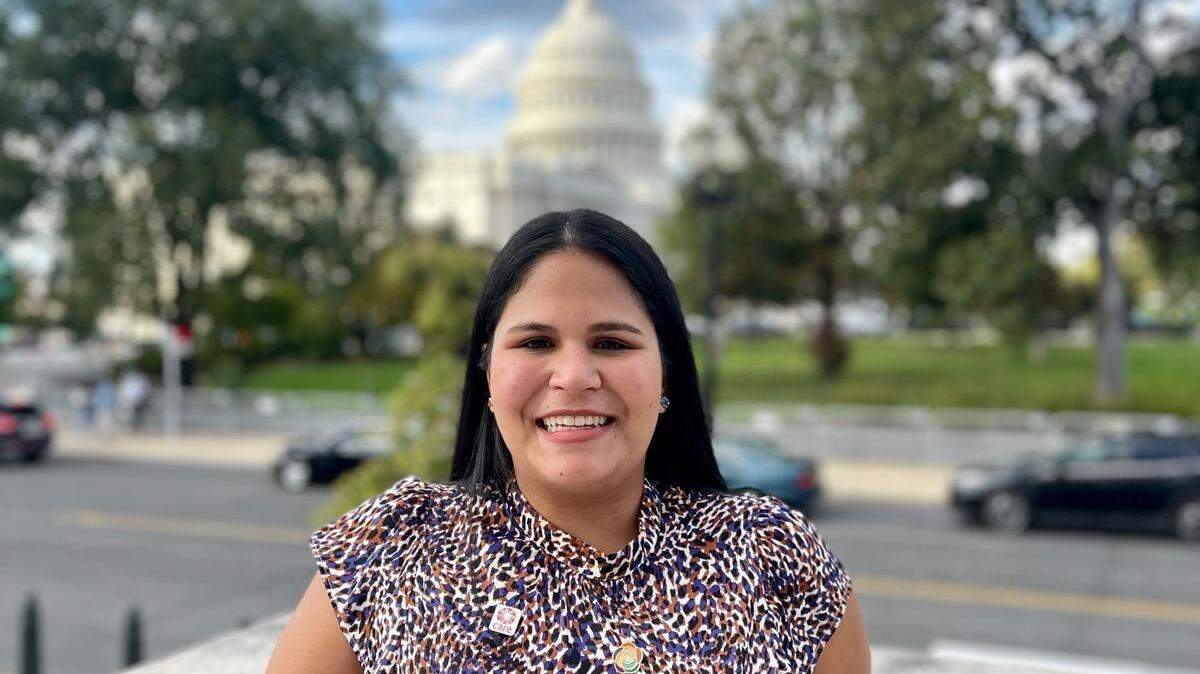
One of the Venezuelan plaintiffs, Cecilia González Herrera, 25, from Kissimmee, Florida, arrived in the U.S. eight years ago with her parents. She said her parents belonged to a political party targeted by the Nicolás Maduro regime, and González Herrera was involved in the anti-government student movement. She and her family are TPS holders and have sought political asylum in the U.S..
González Herrera, who is studying Political Science and Latin American Studies at the University of Central Florida in Orlando, said she feels a responsibility as a human-rights activist to fight for herself and her community.
“I am not afraid. We, the workers, the honest people, the contributors to this country, are not afraid.,” she said. “The concern is the reality, the anti-immigrant climate, which we fight daily. We are prey to a simple political narrative—a narrative of stigmatization, built on isolated incidents within the community. There’s a xenophobic and hate-driven agenda, labeling every immigrant as criminals.”
González Herrera, who advocates for voting rights at a national civil-rights organization, said she knows the importance of an independent justice system, something that is non-existent in Venezuela. “I feel privileged to live in a democracy and in a country where I can demand accountability when there are violations of procedures,” she said.
Adelys Ferro, a Venezuelan-American advocate from South Florida and the executive director of the Venezuelan American Caucus, an organization that advocates for TPS, filed a sworn statement as part of the lawsuit in support of TPS holders.
In her statement, Ferro emphasized the importance of TPS for Venezuelan immigrants, underscoring how it has allowed them to contribute significantly to local economies and communities across the country. TPS has provided stability for Venezuelans, she said, allowing them to work. She added the decision to revoke TPS threatens not just the legal status of hundreds of thousands of Venezuelans but also the security and well-being of their families.
“Many Venezuelan TPS holders have more than one job, pay their taxes, and take pride in doing everything right and legally,” Ferro said. “Many Venezuelan TPS beneficiaries do not consider staying in the United States without documents as an option, but nor do they consider the possibility of returning to Venezuela under a repressive and criminal dictatorship.”
The Trump administration’s decision to end TPS has thrown the lives of hundreds of thousands of Venezuelans into disarray.
“Many of them are suffering from anxiety attacks, panic attacks, depressive crises, and serious health issues caused by the stress and uncertainty they have been living with since the threats to eliminate the benefit began,” she said in her sworn statement.
The other six Venezuelan plaintiffs in the federal case are located in California, Texas, Tennessee and New York. Along with Florida, the four states are home to more than 392,000 Venezuelans, close to half of the entire population of 903,000 Venezuelans in the U.S. Of that number, 607,000 have TPS.
The lawsuit was filed by the ACLU Foundation of Northern California, the Center for Immigration Law and Policy at UCLA School of Law, the ACLU Foundation of Southern California and the National Day Laborer Organizing Network.
“During President Trump’s first term, every federal district court to consider the question found ‘evidence that President Trump harbors an animus against non-white, non European aliens,” the lawsuit says, in reference to an attempt by the president to end TPS for other countries, including El Salvador, Haiti, Sudan, and Nicaragua, in 2017 and ‘18.
For many Venezuelan TPS holders, the stakes are profound, Ferro said in her statement to the court: small business owners are unsure whether to sell or shut down their businesses, employees face losing their jobs and livelihoods, students worry about losing financial aid, and families are terrified of deportation. She said some business owners, who took out substantial loans to establish themselves, are now unsure whether to lay off employees or close down their operations altogether.
The lawsuit argues that “withdrawing hundreds of thousands of people from the workforce [Venezuelans] will strain the social safety net and have economic repercussions on citizen and noncitizen communities alike.”
The suit asks the court to immediately halt the termination order and maintain Biden’s extension in effect until the judge can rule on the merits of the claim.
“We didn’t commit a crime or offense,” González Herrera said. “It was betting on a better, safer life.”
This story was originally published February 20, 2025 at 1:17 PM.