
‘We stopped that’: Trump administration revokes deportation protections for Venezuelans
The Trump administration is revoking a recent Biden-era extension of temporary deportation protections for hundreds of thousands of Venezuelans in the United States, according to an unpublished Department of Homeland Security document the Miami Herald has obtained.
During an interview with the Fox News program Fox and Friends on Wednesday morning, Homeland Security Secretary Kristi Noem confirmed that she has rescinded an 18-month extension of Temporary Protected Status for Venezuela that President Joe Biden made days before leaving the White House. That extension had been announced by Biden’s Homeland Security Secretary, Alejandro Mayorkas. The New York Times first reported the roll back on Tuesday night.
“Before he left town, Mayorkas signed an order that said for 18 months, they were going to extend protection to people on Temporary Protected Status, which meant they were going to be able to stay here and violate our laws for another 18 months,” Noem said. “We stopped that.”
TPS is a federal program that shields people from countries in turmoil from deportation and grants them work permits. There were 505,400 TPS approved recipients from Venezuela as of December 2024, according to the Congressional Research Service.
The decision could have devastating consequences in Florida, the state with the largest population of Temporary Protected Status recipients in the country. Almost 60% of the state’s TPS beneficiaries are from Venezuela, according to federal figures.
“I feel powerless and angry that I can’t help my family. This is a country of immigrants—why are they attacking us? My family has committed no crime. They’re tearing us apart,” said B. Diaz, a Venezuelan woman who lives in South Florida and who requested to use only her last name out of concern for her family’s safety. She arrived in the U.S. under parole in 2022 and applied for TPS in 2023.
At John I. Smith K-8 Center, an elementary school in Doral, many Venezuelan students and their parents were anxious and uncertain over the roll back.
One mother of a fifth and a sixth grader, all TPS holders, contemplated not going to work Wednesday morning at the warehouse of an international clothing company. But her husband had reassured her that she had to continue living her life – including going to work and going to the grocery store to buy food for their family. Her family of four has been living in South Florida for around four years, having left Venezuela to find better opportunities for themselves and escape political prosecution. The Herald is not identifying them by name because the family fears for their safety should they lose their status.
The husband, 43, says he was involved in protests and marches in Venezuela that opposed Nicolas Maduro’s government. He said that at one point his car was burned by government supporters, and he had friends who were killed.
He says that there is no future forhis family in Venezuela. He added that understands that some immigrants are criminals who do not work and contribute to society. But for working families such as his own, he hopes they will be able to stay in the United States and not continue to live in a political limbo where policies are changing so rapidly it becomes anxiety-inducing to stay up to date.
“I am worried I might have to go back to Venezuela,” the father said. “I am worried about the future of my children.”
U.S Rep. Maria Elvira Salazar, a Miami Republican, said in a statement to the Herald that “Venezuela’s Dictator Nicolas Maduro jails, beats, rapes, and kills anyone who speaks against him,” and that’s why she “supported TPS for Venezuelans fleeing political persecution.”
“There is a simple solution to this: Maduro has to go! Trump is the only force to get him out. Once Maduro is gone — there will be peace for Venezuelans,” U.S Rep. Maria Elvira Salazar, a Miami Republican, said in a statement to the Herald. “Maduro must go and this will allow Venezuelans to safely return to live with freedom in their homeland.”
The Department of Homeland Security is able to designate protected status after a review of conditions in the country involved. Previously, war, environmental disasters, and internal conflict have all led to TPS designations. But the protections are temporary, and they can end unless Homeland Security extends them.
Earlier this month, the Biden administration renewed the 2023 Venezuela TPS designation from April 2025 through October 2026, citing the humanitarian, economic and political crisis in the South American country. The decision was similar to successive decisions the administration had also taken regarding TPS status for Haiti in order to protect up to a half million Haitians from being returned to a country in peril.
The Biden administration first designated Venezuela for Temporary Protected Status in March 2021, making more than 320,000 individuals eligible to apply. That designation was expanded to include an additional 472,000 eligible Venezuelans in 2023. The designation of Venezuela for TPS status had been widely celebrated in South Florida, home to one of the largest communities of Venezuelans in the United States.
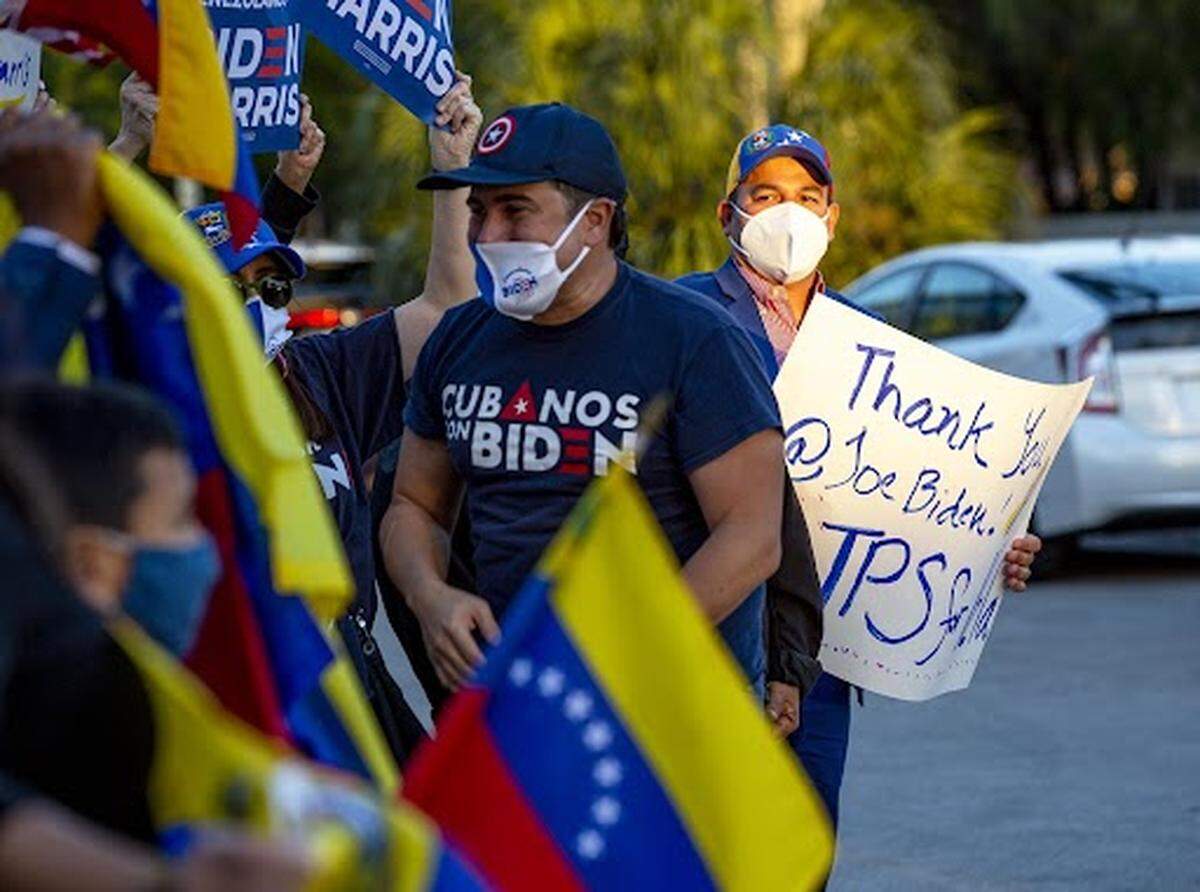
Mayorkas’s extension had made it possible for Venezuelans under both designations to renew their TPS status through October 2026. Noem’s decision reverses the TPS expiration’s date to how they were prior to Mayorkas’ announcement.
Under the 2023 designation, Venezuelans can hold TPS status through April, according to an unpublished federal register notice, while those under the 2021 designation will have it through at least September. Noem will now have to determine by February and July, respectively, whether to extend them. Meanwhile, many are still waiting for documents from the federal government after applying for the protection.
The Homeland Security document says Mayorkas made a decision on something that Noem should determine and that he had conflated the 2021 and 2023 designations into one in the extension announcement.
“They’re basically saying this was a kind of novel approach. I don’t know why they thought it was a novel approach. It wasn’t much different than what they did with Haiti, which is having successive designations, and the fact that they’re saying because it’s a novel approach, that’s not a basis to revoke” TPS, said Ira Kurzban, a Miami immigration attorney. “The basis to revoke TPS is based on the change conditions in the country, which she doesn’t even address in the revocation. And so, to me, the issue really is that there is no basis in law to do what they’re doing.”
Kurzban is among several lawyers who sued Trump the last time he tried to end TPS for certain countries. During his first term in the White House, Trump targeted TPS designations for Haiti, El Salvador, Honduras, Nepal, Sudan and Nicaragua for termination. However, those terminations were heavily litigated in court for years and ultimately failed.
Wednesday’s development is certain to be challenged in the courts. Kurzban said he and other lawyers have been preparing to stop the administration in the courts. He believes that President Trump will also go after Haiti’s TPS status as well, considering his promise to deport Haitians as he was campaigning for the presidency.
“They want to do away with TPS and then are just using this as cover. They realize that in cases like Venezuela and Haiti, they cannot say they’re changed conditions. Obviously, in both circumstances, the conditions are worse than they were when the designations were given initially,” Kurzban added.
The Venezuela decision is part of a broader assault the new administration has launched on dismantling the U.S. immigration system, he said.
“This part of it is saying, ‘Oh, we’re not going to give any temporary protection to people,’ even though the law and Congress exclusively provided for it,” said Kurzban. “So it’s no surprise in a way, but I think we’ve been preparing for this a long time in the event that he got elected, and certainly been preparing as soon as he got elected, so we’re ready to fight these issues.”
The Biden administration resumed direct deportations to Venezuela in October 2023. Venezuelans leaders and immigration activists sharply criticized the deportations, saying that given the political situation there, it would put returned migrants in extreme danger.
But the United States has not been able to send back a flight there for a year. Tom Cartwright, an independent analyst who tracks ICE deportation flights, found that the suspension of flights came after the federal government announced it would re-impose sanctions on the South American country. The Trump administration has been exploring the possibility of deporting Venezuelans with gang affiliations and criminal histories to a third country, including El Salvador.
The announcement to roll back TPS protections for hundreds of thousands of Venezuelans is part of a flurry of executive actions that Trump has taken during his first weeks in the White House that are aimed at radically reshaping the U.S. immigration system. Through executive orders, Trump has attempted to limit birthright citizenship, declared a national emergency on the U.S.-Mexico border, and canceled a parole program that benefited over a half-million Cubans, Nicaraguans, Venezuelans, and Haitians.
Do you have questions about Trump revoking TPS for Venezuelans in the U.S.? Fill out the form below. If you can’t see the form, click here to fill it out.
This story was originally published January 29, 2025 at 9:24 AM.