July 4th broke world heat record. So far, it’s Miami’s hottest year and a sign of the future
READ MORE
Sizzling South Florida
Extreme heat is already leaving South Florida sweating. How will we adapt to the warming world?
Expand All
It’s not just you, Florida really has gotten hotter recently.
In the last fifty years, South Florida has experienced a lot more heat. Days are hotter than they used to be, there are more hot days than ever and nights, in particular, are far warmer than they were last century.
All of that is tracked by meticulous records from the National Weather Service and NOAA, and scientists have chalked up the majority of that change to unchecked, human-caused climate change. That change is felt all around the globe — not just in sunny South Florida.
On Monday, the U.S. National Centers for Environmental Prediction found that the world experienced the hottest global average day since at least 1979, a record that lasted until Tuesday, when it was broken again. Other global models with records going back to 1940 also flagged Tuesday as a record-breakingly hot day. With the dog days of summer firmly ahead of us, it’s likely that record will be smashed a few more times this year.
Read More: On the front lines of extreme heat in South Florida. ‘You feel like you’re suffocating.’
“That’s crazy scary to see. We’re not even at the hottest point of the year yet and it’s already hotter than it’s ever been any other year,” said Brian McNoldy, senior research associate at the University of Miami’s Rosenstiel School of Marine and Atmospheric Research.
It’s just a one-day global record, but it’s also a sign of things to come in South Florida and around the world.
On Wednesday, Miami-Dade was under yet another heat advisory — a warning against the danger high heat poses — as temperatures soared to a feels-like high of 105.
So far, 2023 has already been Miami’s hottest year on record, McNoldy said. We’ve broken 15 daily peak temperature records — seven since June 1 alone. And that doesn’t even count the dozen or so records broken that measure humidity.
“The combination is just brutal,” he said.
While climate change is the biggest reason why temperatures are higher than normal, a natural global weather phenomenon called El Niño also gets some of the credit — although not much. El Niño is best known to Floridians as a weather pattern that dulls the Atlantic and leads to fewer hurricanes, but it also traps more heat in the atmosphere and makes other parts of the globe far hotter than normal.
However, El Niño is just getting started for the year, and McNoldy said he doesn’t believe it’s strongly contributing to the record-breaking heat — yet.
“As El Niño continues to form this year, that’s going to help these records keep jumping out above the average,” he said.
The transition to El Niño from several years of the opposite phenomena, La Niña, is expected to release even more ocean heat into the atmosphere later this year and next year.
Zeke Hausfather, a research scientist with Berkeley Earth, said that could put 2023 and 2024 in the running for the hottest years on record. But he noted that climate change is not expected to warm the planet to new heights every single year in a row, although that’s where the trend line over time is headed.
“Think of it as a line going up over time with wiggles around it,” he said. “That rate of warming globally has been largely unchanged since 1970. On top of that, there’s natural variability, and the biggest sources of variability is La Niña and El Niño.”
With the latest El Niño shaping up to potentially be “the biggest in history,” Hausfather said, that leaves conditions ripe for continuing to set global temperature records.
How South Florida feels the heat
As more greenhouse gasses clog the atmosphere, the planet is getting hotter, but not every corner of the globe is experiencing the heat in the same way.
Unlike other places in the U.S. that experience extreme heat in the form of heat waves, like Seattle or Boston, Florida has seen the dial slowly cranked up on its chronic, near-year round year.
And outdoor workers, who are most susceptible to the dangers of extreme heat, say they can feel it.
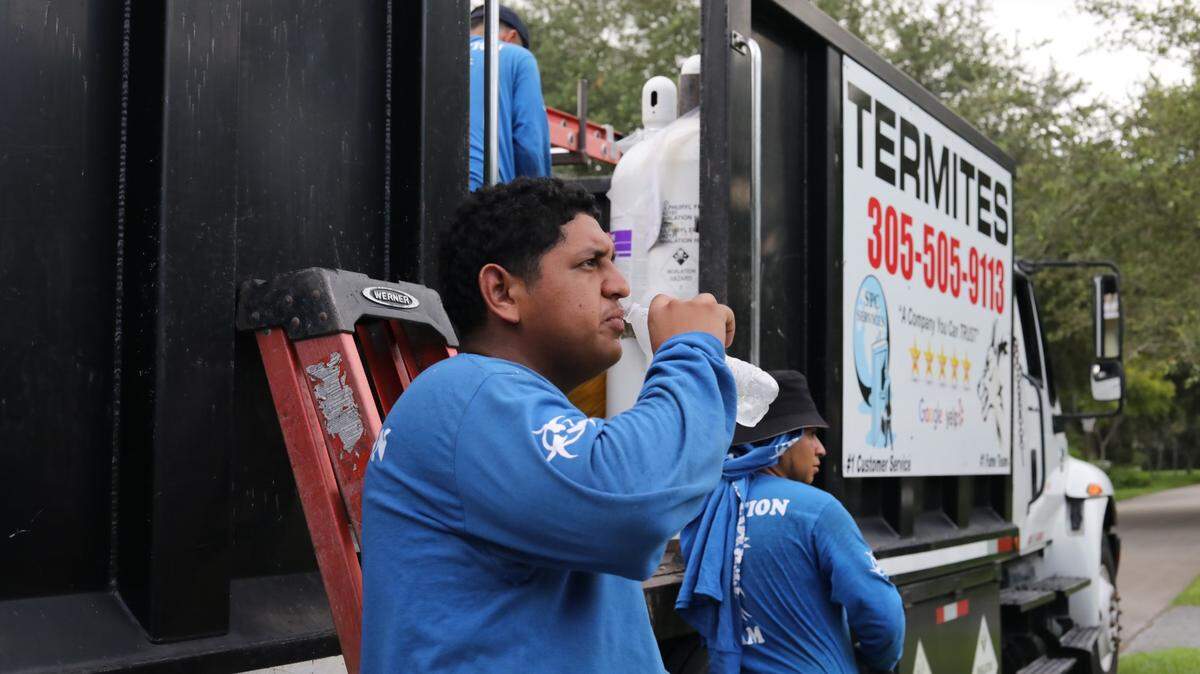
Roger Gonzalez, who’s been in the termite tenting business since 1981, said his team chugs as many cold drinks as they can on summer jobs and takes breaks whenever possible, whatever it takes to survive the day.
“I’m going crazy here. It gets worse every day,” he said. “Imagine being on top of a roof, a metal roof, with a tarp. You know it’s going to get 100-something degrees. It’s not an easy job.”

In South Florida, where it’s already pretty hot and has been for hundreds of years, one of the easiest changes to spot from past decades is in the number of sweltering days the region experiences every year.
In 1960, Miami-Dade registered an average of 85 days a year when it was hotter than 90 degrees. By 2022, that jumped to 133 days — a full third of the year.
“For basically four months of the year, pretty much, we’re in the soup,” McNoldy said.
Climate predictions suggest it could rise to 187 days a year by 2050 if world governments don’t quickly act to shift away from fossil fuels and cut carbon emissions.
But perhaps the most dramatic shift in Miami is how hot it feels at night.
In the 1950s, the average heat index (a combination of heat and humidity known as the ‘feels like’ temperature) at 6 a.m. in Miami was 77 degrees, according to a database McNoldy maintains. In the 2010s, it was 84 degrees.
“That’s a humongous difference,” McNoldy said.
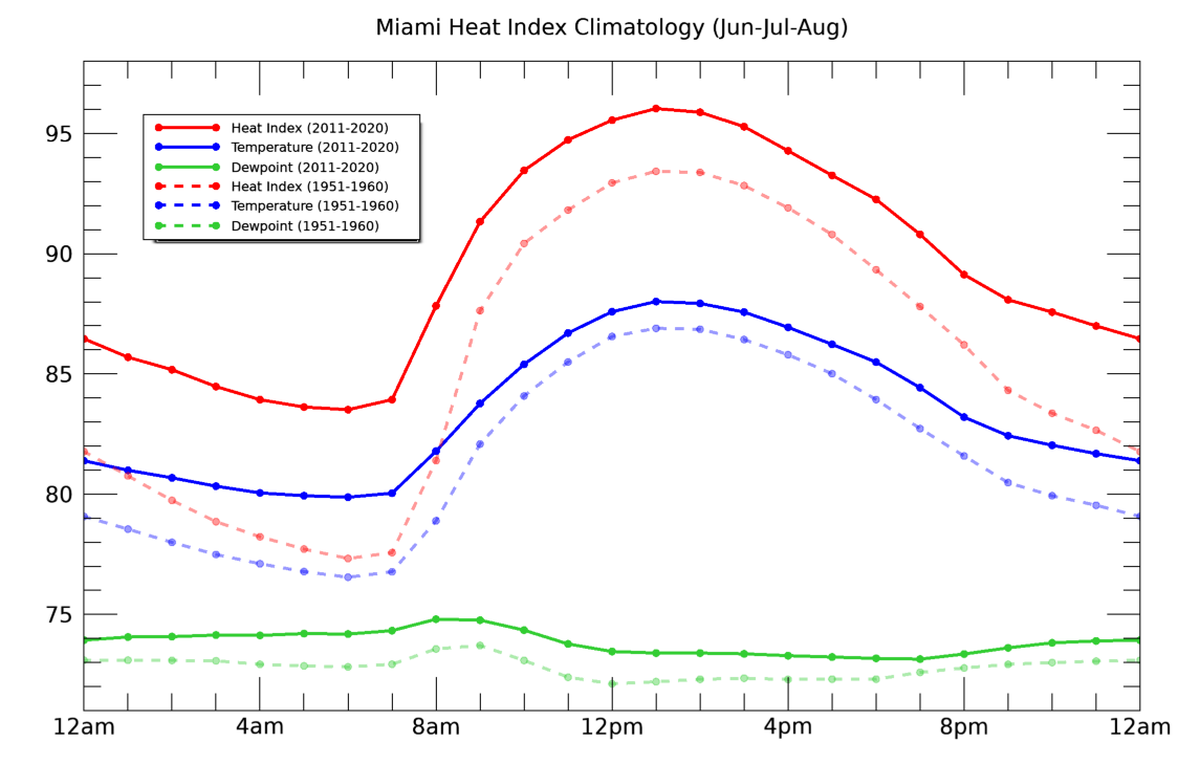
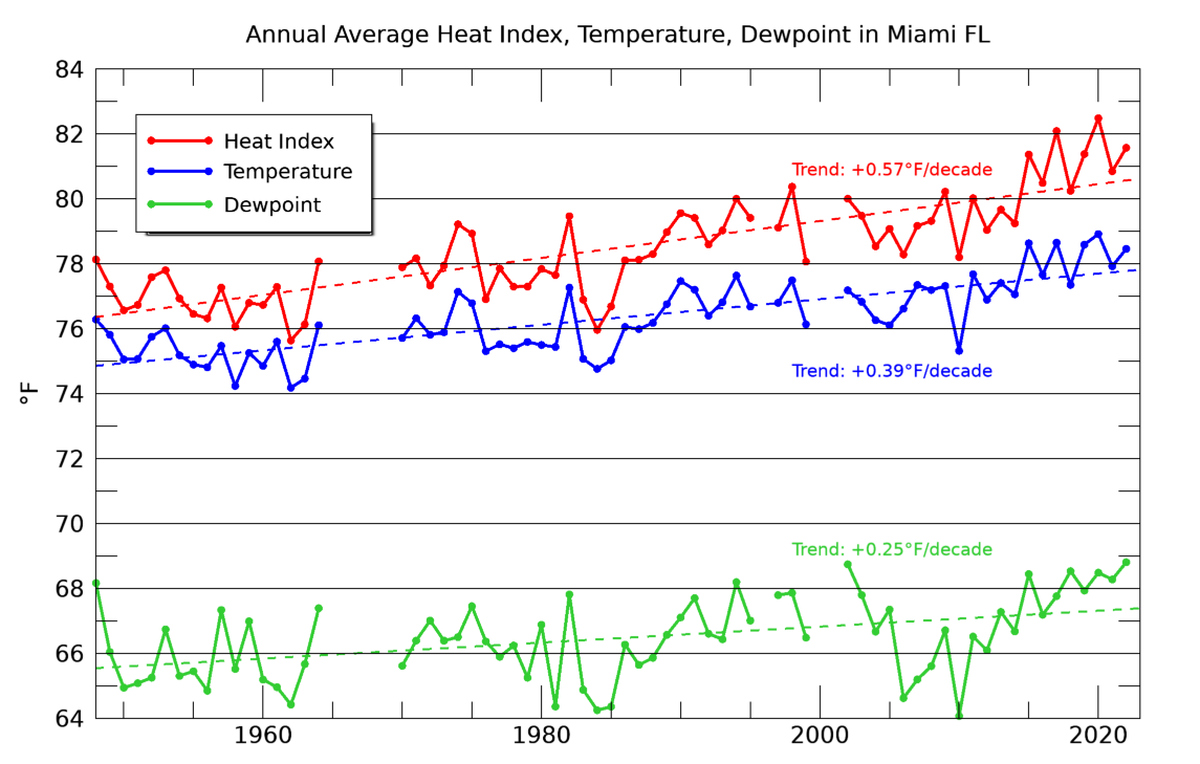
The heat index is a better way to look at this, McNoldy said, because it takes into account the relatively small increases in temperature over the years and the relatively small shifts in humidity — a factor known as the dew point — and puts it into a metric that matches how it actually feels outside.
“You nudge up the temperature some, nudge the dew point some, the heat index goes up a lot,” he said.
Since 1970, the average low temperature in Miami from June to August rose about 1.7 degrees, from 76 degrees Fahrenheit to just under 78 degrees, according to NOAA records.
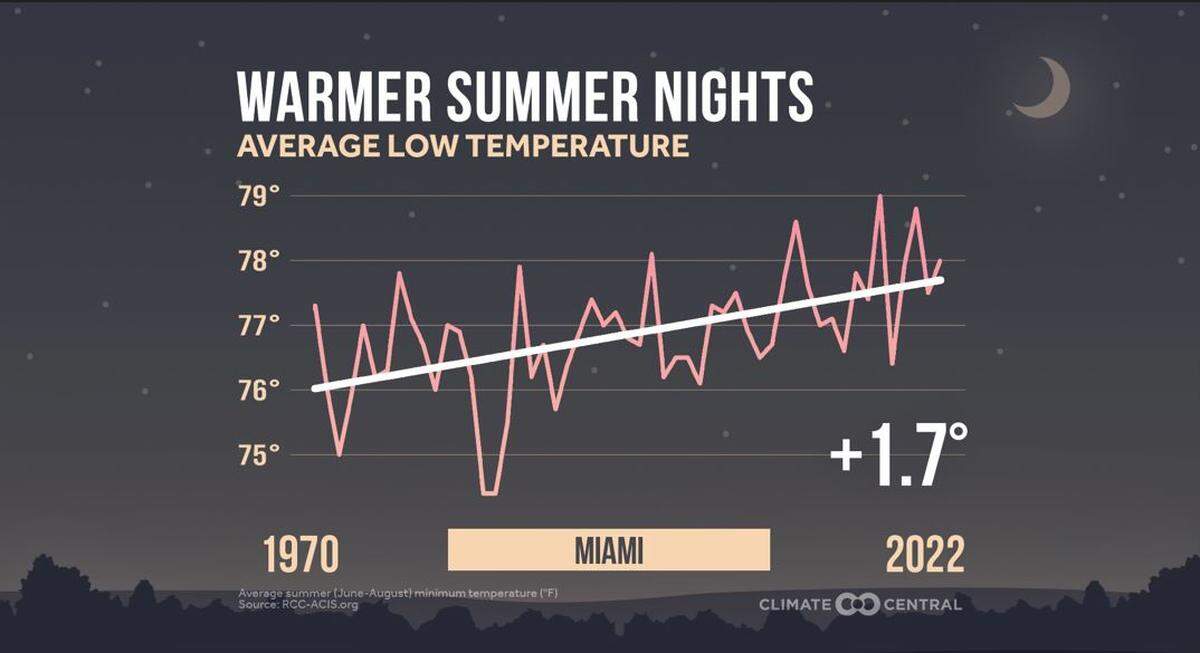
“It’s not just us, it’s happening at pretty much all locations, the lows are warming at a much greater rate than the highs,” McNoldy said.
In fact, the rest of the nation saw an even greater increase — 2.6 degrees — in the same time frame. But scientists say that’s probably because Miami is already so hot. In 1970, our average low was 76 degrees, while the US average low was 58 degrees.
Without swift, worldwide action on culling emissions, those numbers are expected to continue to climb.

And while most Miamians will feel that impact first through their power bill, the more than 100,000 people who make up the region’s outdoor workforce are already sweating it.
Read More: In Florida, the heat can kill. But there are no laws to protect its many outdoor workers
Olivia Gordon, a mail carrier for the United States Postal Service, said she’s been working for the last seven years in a non-air-conditioned truck on a route that will see her walking up to 12 miles a day in the sun.
The heat is so bad, Gordon said she’s been looking for a new, indoor job to get her out of the sun, despite the fact she loves her career and the union that supports it.
“It gets hotter every day,” she said. “The rain doesn’t help because then it just gets hotter after that.”
Climate coverage from Miami Herald reporter Ashley Miznazi is funded by the Lynn and Louis Wolfson II Family Foundation in partnership with Journalism Funding Partners. The Miami Herald retains editorial control of all content.
This story was originally published July 5, 2023 at 2:29 PM.