Miami-Dade hit with first heat advisory day — and it’s only June. What will summer hold?
READ MORE
Sizzling South Florida
Extreme heat is already leaving South Florida sweating. How will we adapt to the warming world?
Expand All
The National Weather Service issued its first heat advisory for Miami-Dade County Wednesday under an experimental new set of rules for warning the public about heat.
Forecasters expect the heat index — a number that combines temperature and humidity readings to estimate how hot it feels in the shade — to hit 105 degrees for at least two hours Wednesday across Miami-Dade County.
That’s the new threshold for issuing a heat advisory in Miami-Dade. Local officials had been arguing for years that the old threshold for heat advisories — a heat index of 108 degrees — was too high and failed to warn the public about dangerous temperatures that kill 34 people in the county and hospitalize hundreds more each year.
Last month, the NWS agreed to lower the advisory threshold in Miami-Dade County this summer as an experiment to see if it would help prevent local heat illnesses and deaths. If it works, NWS officials said they may spread the changes across South Florida.
Warnings to keep cool
For Jane Gilbert, the county’s chief heat officer, Wednesday’s forecast wasn’t a surprise. She knew at least one would happen this summer, but the mid-June timeline worried her.
“Because it’s an early onset heat advisory we collectively are not as accustomed to the heat and it’s a little more dangerous,” she said. “It’s all the more reason for people to take note and take precautions.”
Under the county’s original action plan, a heat advisory would trigger a few things: a media advisory from the county warning residents to keep safe, outreach efforts for the homeless population and extended hours at “cooling centers,” places like libraries and community centers.
Leila Khalil, a spokesperson for the Miami-Dade Public Library System, said even before the Main Branch Library at 101 West Flagler St. was designated as an official cooling center, people would often come inside just to cool off. Especially during Florida summers.
Inside most libraries, there are now posters detailing how to stay safe from extreme heat, she said.
Throughout the day, people would shuffle in and out of the library, some donning umbrellas and towels to protect their heads from the sun.
“How many places can you come in, read a book, use a computer and enjoy the air conditioning?” Khalil said. “And it doesn’t cost anything.”
This time, Gilbert said, the county decided to skip the outreach and extended cooling center hours efforts since the heat advisory ends at 7 p.m. when these spaces will still be open under their regular schedules.
The county issued a media advisory around noon with tips on how to beat the heat.
Gilbert warned Miami-Dade residents to stay out of the heat as much as possible, take breaks and drink plenty of water. Residents can find the nearest free, publicly air-conditioned library or community center on the county’s parks website.
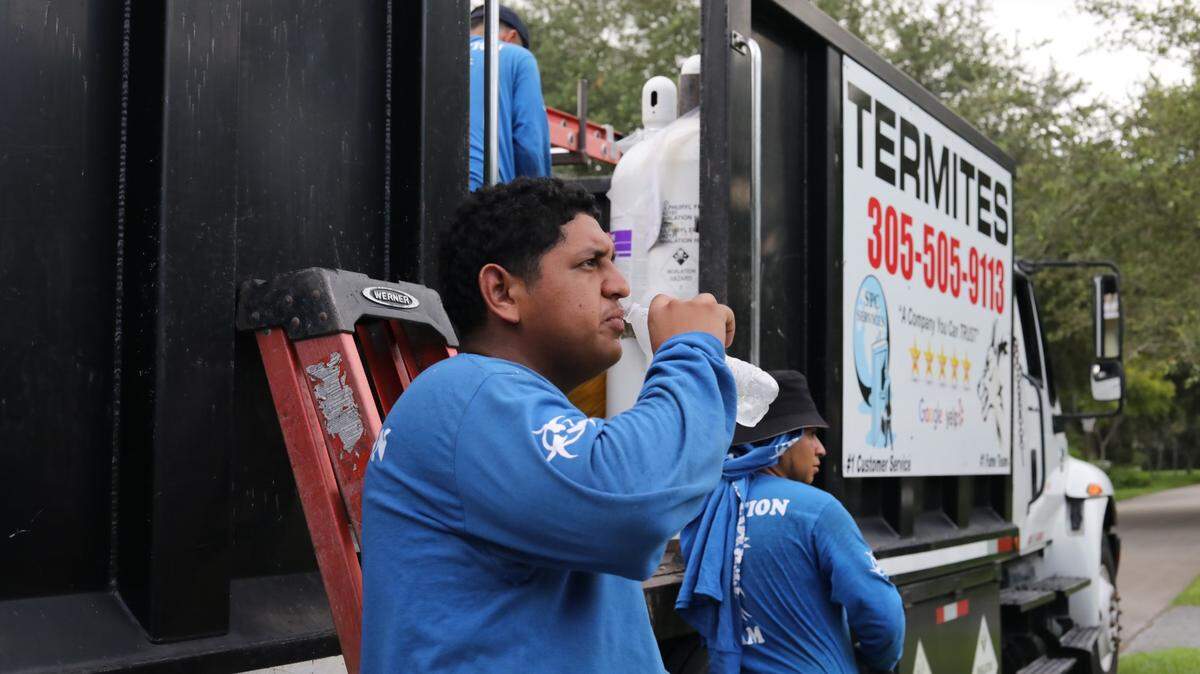
The county also advises residents to try not to do any hard work or exercise outside in the heat of the afternoon. But that may be harder for Miami-Dade County’s more than 100,000 outdoor workers, who have no legal protections requiring their employers to let them drink water or take breaks in the shade on dangerously hot days.
The first, but not the last advisory
Gilbert said residents should expect to hear this new heat warning a few more times this summer.
“In last decade, we’ve hit this threshold around 6 times in the summer. Every summer’s different. There could be more than that,” she said. “It looks like we’re going to be hitting it through Friday.”
Wednesday, winds blowing warm, dry air from the southwest and a lack of cloud cover and cooling rain finally pushed temperatures high enough to trigger an advisory under the new rules, according to Chuck Caracozza, a meteorologist in the NWS Miami office.
Miami-Dade isn’t expected to get a break any time soon. “It’s going to be pretty hot here for the rest of the week,” Caracozza said. “It may actually get even hotter here, because it looks like it’s going to get even drier.”
That means the county may see more advisories later in the week. The NWS will decide each day whether to issue another advisory, depending on the forecast.
Relief may come at the beginning of next week, when winds may shift and bring more moist air and rainfall from the east to cool things down, Caracozza said. “But that’s still very uncertain,” he added.
Miami-Dade County’s hottest days are becoming more common, according to a county report published in December. Days with temperatures over 90 degrees used to only come for about a quarter of the year in Miami-Dade. Today, 90-degree days make up about a third of the year. By 2050, they’re expected to make up the majority of the year.
While scientists are sure that climate change does contribute to long-term patterns of higher temperatures, it’s trickier to gauge how much an already warming atmosphere is contributing to day-to-day weather patterns.
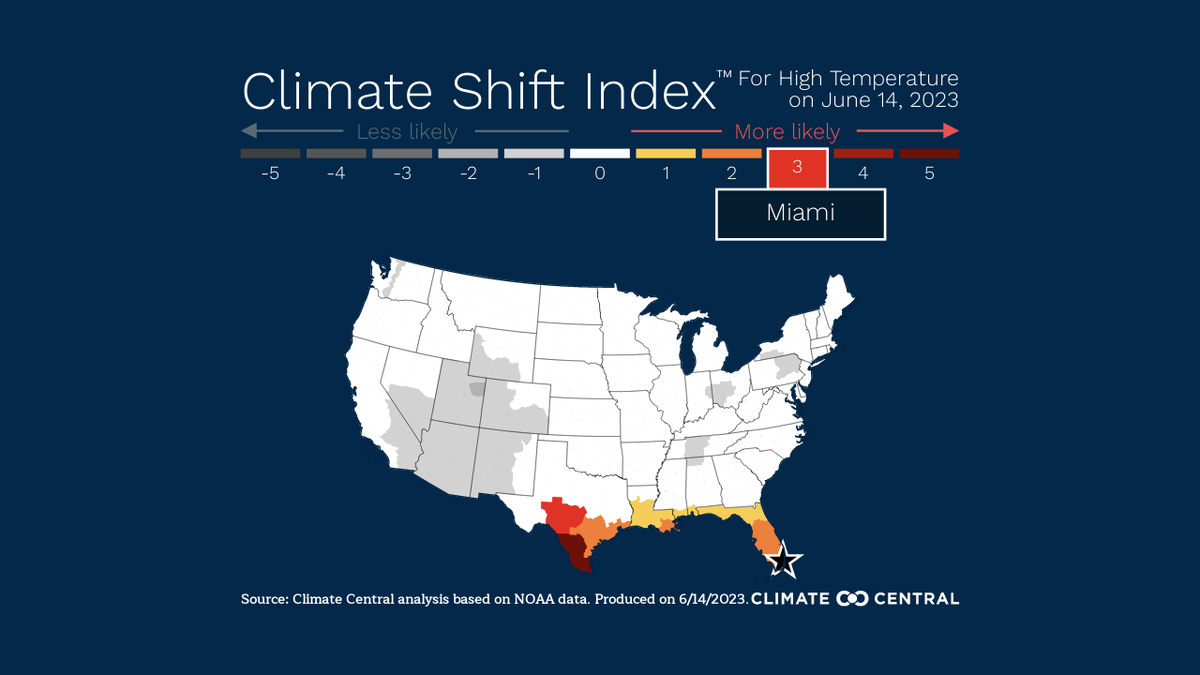
But by at least one group of climate scientists’ count, Miami’s latest stretch of hotter days could be influenced by global warming. Climate Central ranked Wednesday’s high temperatures a 3 on its climate shift index, a spectrum of how likely a specific weather event is to occur thanks to climate change. The index goes from -5 to 5.
How does Broward handle the heat?
Broward is also expected to scorch this week, but unlike Miami-Dade, it’s not part of the official pilot test of the new, lower threshold from the National Weather Service.
Still, Broward blasted out a social media alert to its residents around noon urging everyone to keep safe in the heat.
Jennifer Jurado, Broward’s chief resilience officer, said the county is still working on its long-term strategy for dealing with heat. They’ve already mapped out the more at-risk parts of the county and have plans to plant more trees and reinforce cooling centers in the most vulnerable neighborhoods.
As part of that strategy, Broward issued a community survey on extreme heat. So far, Jurado said they have about 140 responses.
“What are people experiencing and given that, where can we be a better resource and partner to help address these challenges in our community?” she said. “And if it’s getting hotter and there are more days like this, how are we going to address those needs?”
This climate report is funded by Florida International University, the Knight Foundation and the David and Christina Martin Family Foundation in partnership with Journalism Funding Partners. The Miami Herald retains editorial control of all content.
This story was originally published June 14, 2023 at 2:53 PM.