
Can mangroves save Miami? ‘Living shorelines’ a sea rise solution struggling to take root
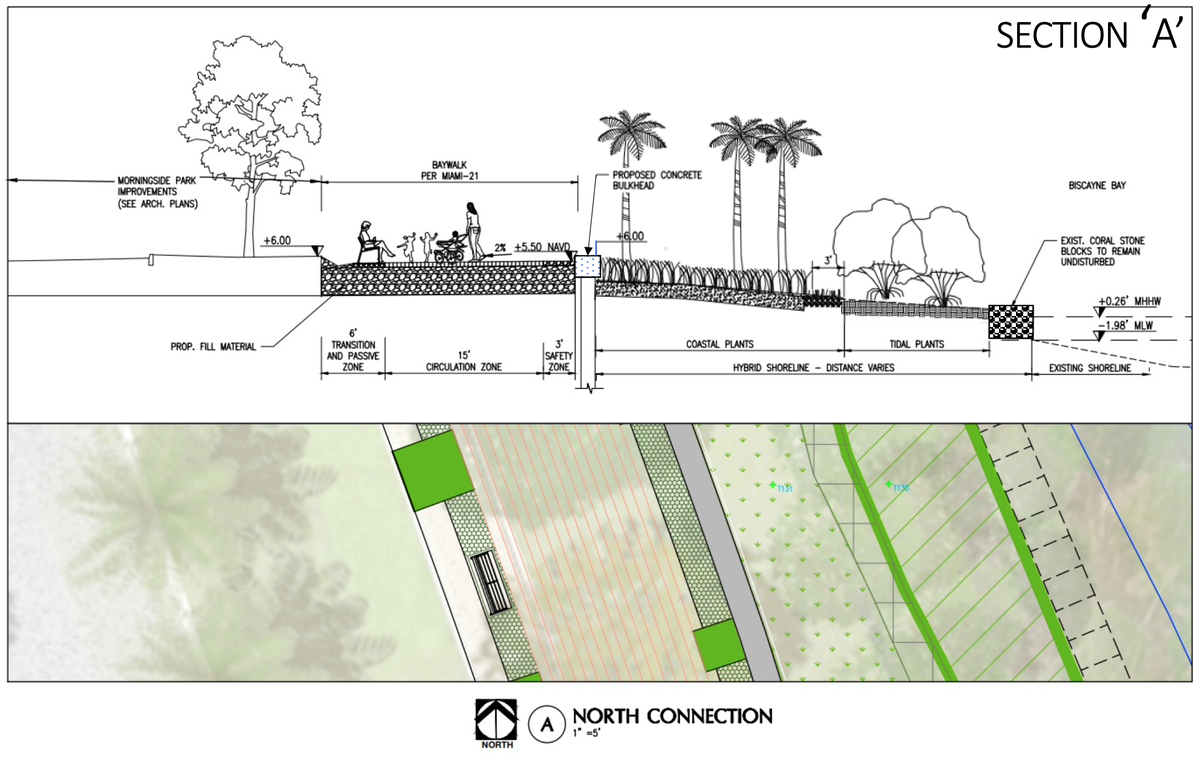
At first, a revamp of Miami’s picturesque Morningside Park seemed like a perfect chance to try a promising strategy to protect Miami’s coastline from looming sea level rise. Dubbed a “living shoreline,” it involves planting mangroves along the shore instead of just installing a higher seawall.
“Morningside really stuck out as a great opportunity,” said Rod Braun, climate strategy director for The Nature Conservancy, which found grant money to help the city pay for the overhaul of the popular bayfront park.
Mangroves are an ecological powerhouse that provide nursery habitat for fish, capture the carbon dioxide that leads to global warming and protect the coast from the battering of in-coming waves. Plus, people seem to endorse the idea of more natural coastal protection — at least in theory. When the federal government, for instance, proposed a coastal protection plan featuring a massive concrete wall along Biscayne Bay and through neighborhoods from Brickell to North Miami, the public comments leaned heavily toward living shorelines instead.
But in Morningside — like in most other coastal spots in Miami-Dade where similar projects have been proposed — the mangroves never materialized. After years of contentious public meetings and arguments with neighbors who didn’t want to restrict their view or lose a square foot of the 42-acre park, the city scrapped the mangroves.
A test for the future
As South Florida grapples with the imminent rise in sea levels, the conversation about what the community — and its coastline — could look like in the future is a fraught one. Living shoreline projects on the mainland coast, like road raising in Miami Beach, serve as small-scale tests of both how committed local governments are to sea-rise protection and how cooperative residents will be with potential solutions.
Down the road, the necessary projects promise to only get more complex and more expensive.
The county’s environmental agency has actually had great success with mangrove replanting on the artificial islands in Biscayne Bay, in part because there’s no one there to complain. But along the urbanized coast, it’s been a different story.
Living shoreline concepts have been rejected at Alice Wainwright Park, Albert Pallot Park, Maurice A. Ferré Park and the First Miami Presbyterian Church, despite the fact that several were supported by grant money with a time limit attached.
Ironically, in most of those cases, said former city of Miami Chief Resilience Officer Jane Gilbert, the mangroves were axed because it was too difficult to get permission from the county’s environmental permitting agency.
“In every case, the project was either dropped or changed back to a traditional seawall because the permitting timeline didn’t fit the grant,” she said. “To be able to permit something with a living shoreline would take too long, so we couldn’t get the funding.”
Permitting woes
Spencer Crowley, Florida Inland Navigation District commissioner, said it’s more difficult to install a living shoreline in Miami-Dade County than anywhere else in the state. Other places, like Palm Beach County, have plenty. And his organization, FIND, often helps pay for them.
“It boils down to the fact that [Miami-Dade’s Department of Environmental Resources Management] does not facilitate living shorelines, that is an absolute truth that may be disputed by DERM,” he said. “I’ve never had a project where they facilitate living shorelines. That’s different than saying they oppose it.”
Representatives from Miami-Dade’s Department of Environmental Resources Management said it’s not that they don’t like the concept of living shorelines, or mangroves. DERM points to the mangrove restoration projects it’s been doing for decades on spoil islands and natural areas around the county, like Virginia Key.
The issue, the agency says, is that mangrove projects clash with efforts to protect Biscayne Bay’s bottom life and seagrass. Unlike other major water bodies in Florida, Biscayne Bay has tough restrictions about what can be built next to and particularly on the bay bottom.
And the fact is that when developers and cities talk about living shorelines, they often want to do something that regular seawalls don’t — encroach into the waters of the bay.
Biscayne Bay’s seagrass is dying at an alarming rate, leading to fish kills, poorer water quality and less carbon storage. Lisa Spadafina, Chief of DERM’s Natural Resources Division, said the agency isn’t interested in losing precious seagrass space in favor of mangrove projects that could require dredging and filling coastal areas.
“You don’t want to lose one habitat for another,” Spadafina said.
But if developers instead wanted to back up and convert some of their dry land into a living shoreline, DERM would be more accommodating, Spadafina said.
Living seawalls as retreat from sea rise
That’s a big if. And it gets into a concept that is touchy in a community where waterfront real estate is an extremely expensive commodity. It’s called “retreat”— forcing people or homes to move back from the waterfront as sea levels rise. It’s in Miami-Dade’s official sea rise strategy, and it’s mentioned in Miami’s, too.
But unsurprisingly, when presented with a real-life opportunity to retreat from the water by building a green space buffer — and give up precious square footage — developers and cities usually aren’t interested.
Crowley points to Miami’s Edgewater neighborhood, where condos are built right up to the water’s edge. The only options for a living shoreline in spots like that would be tearing down the condo or building into the bay.
“For them to say they support living shorelines but only if it’s built into the land, it creates a situation that you can never comply with, certainly in developed areas,” he said.
He wonders if it’s worth the sacrifice of a small chunk of nearshore seagrass habitat for a project that could potentially benefit the whole bay.
The Army Corps of Engineers, one of the two other agencies that has to give permission for a living shoreline, created a shortcut to speed up permitting for the projects nationwide, cutting permitting time to about nine months instead of three years. Crowley said he wants to see something similar in Miami-Dade.
“If they say, ‘Oh, we like living shorelines here,’ and don’t change the permit process, nobody’s going to do it,” Crowley said. “Even if people want to do the right thing, most people will take the path of least resistance and do a seawall.”
Despite the hurdles, some urban living shoreline projects have been permitted and even built in Miami-Dade. In November, Miami Beach broke ground on a revamp of Brittany Bay Park on Indian Creek. The waterfront park already has mangroves leaning over its seawall, and the new design keeps that living shoreline element, along with a seawall.
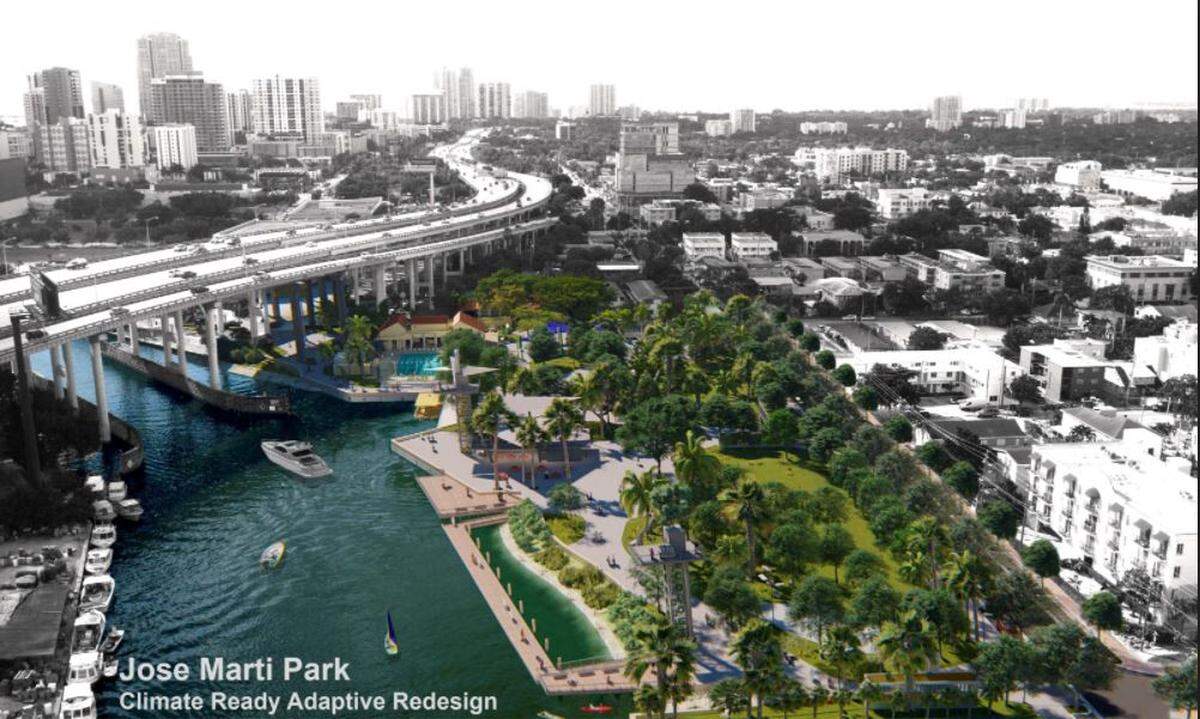
Another living shoreline, this time along the Miami River, is planned for Little Havana’s José Marti Park. The park is being redesigned to better handle sea level rise, including a living shoreline full of mangroves. Planners added a floating boardwalk around the mangroves to preserve the view for residents.
Miami Beach has even floated the idea of building one along the Julia Tuttle Causeway.
New approach in the works
DERM is currently at work on a state-funded “guidance document” that will explain exactly what is and isn’t allowed when building a living shoreline. The aim isn’t to simplify the process, just to explain it better.
“This will hopefully reduce the number of proposals that suggest replacing seagrass with mangroves,” said Josh Mahoney, an environmental resources project supervisor at DERM who often works on the living shorelines proposals.
That number is pretty small to begin with, he said.
“I’m not aware of one instance in which we’ve received any application of someone wanting to do this on their property,” he said. “Not from developers, not from private homeowners, not a one.”
But the county’s own Biscayne Bay czar thinks that attitude needs to change. She endorses the idea of more mangroves on the coast.
Getting the public interested in living shorelines needs to happen, and soon, said Irela Bagué, the county’s chief bay officer. That means explaining why mangroves are a good idea, and also being honest about the realities of sea level rise.
For instance, Bagué said that most coastal homeowners need to realize that they won’t be blocking their waterfront view by planting mangroves, because sooner or later they’re going to have to elevate their homes at least a story.
“We already know that there are areas we’re going to have to give back to nature anyway,” she said. “If I’m paying millions of dollars for a bay view today, I don’t want my bay to look like pea soup in the future lined by gray walls. I’d much rather look at some natural benefits.”
This story was originally published April 13, 2022 at 6:00 AM.