Miami losing another chief resilience officer. What’s left of the climate change department?
Miami’s top climate change position is going empty — again.
Alan Dodd, Miami’s chief resilience officer and head of public works, announced his resignation this week. He took over the resilience position just a year ago in addition to his public works duties after the city’s first CRO, Jane Gilbert, left.
Dodd, who did not respond to requests for comment, submitted his resignation in a letter obtained by the Miami Herald via public records request. In it, he offers no explanation for leaving but said it was “an honor” to work alongside the resilience and public works staff.
City Manager Art Noriega told the Miami Herald he considers the position crucial in preparing the city for the impacts of climate change. He said he’ll miss Dodd’s experience that blended public works with resilience knowledge.
Noriega said he plans to immediately start a national search for the city’s next chief resilience officer. He said he’d be open to restructuring the city’s departments depending on the next CRO’s skillset — even a realignment that would satisfy activists’ calls to let the city’s resilience team stand on its own.
“I don’t have any issue with tailoring the department’s structure to the best candidate,” he said.
Dodd’s departure is the latest setback for the tiny department charged with a massive undertaking — adapting one of the most vulnerable cities in the world to the extreme heat and rising tides caused by climate change.
In 2018, under City Manager Emilio Gonzalez, the city tried to combine the resilience department with public works, which led to an outcry from advocates for climate action in the city. They worried that combining the departments would bury the resilience team’s mission in bureaucracy and send a message that the city wasn’t prioritizing its climate response.
The move would have also potentially cost the city hundreds of thousands of dollars from Rockefeller Foundation’s 100 Resilient Cities, a now-defunct climate change organization.
Then came COVID-19. In the 2020 budget crunch, new city manager Art Noriega combined the departments after all, slashed funding for the yet-to-be filled deputy chief resilience officer position and chose not to re-fill the chief resilience officer position after Gilbert announced she was leaving to spend more time with her family.
Gilbert has since been hired by Miami-Dade County as its first-ever chief heat officer, a grant-funded position.
Instead of hiring someone new, Noriega named Dodd, head of public works, the new CRO. His deputy in public works, Chris Bennett, was also named the city’s deputy chief resilience officer.
Under the latest budget, the department is down to two staffers and an administrative position. The city is not refilling a third staff position, which was grant-funded for the last year. In the fiscal year 2018, the city paid for five full-time positions in the department.
Under Dodd, the city released the results of several long-term projects that will inform the city’s climate future, including a greenhouse gas report that found the city needs to slash emissions 60% by 2035 to meet its targets. To achieve that, Miami would need to get 100% of its power from clean energy sources like solar and nuclear power by 2035, a goal that the city’s main utility, Florida Power & Light, does not share.
The city also released a stormwater master plan, a comprehensive guide to infrastructure investments Miami must make if it hopes to survive the several feet of sea rise expected by 2060. The plan points out that even if the city spent $4 billion installing pumps and pipes to dry out the city, some neighborhoods are not salvageable.
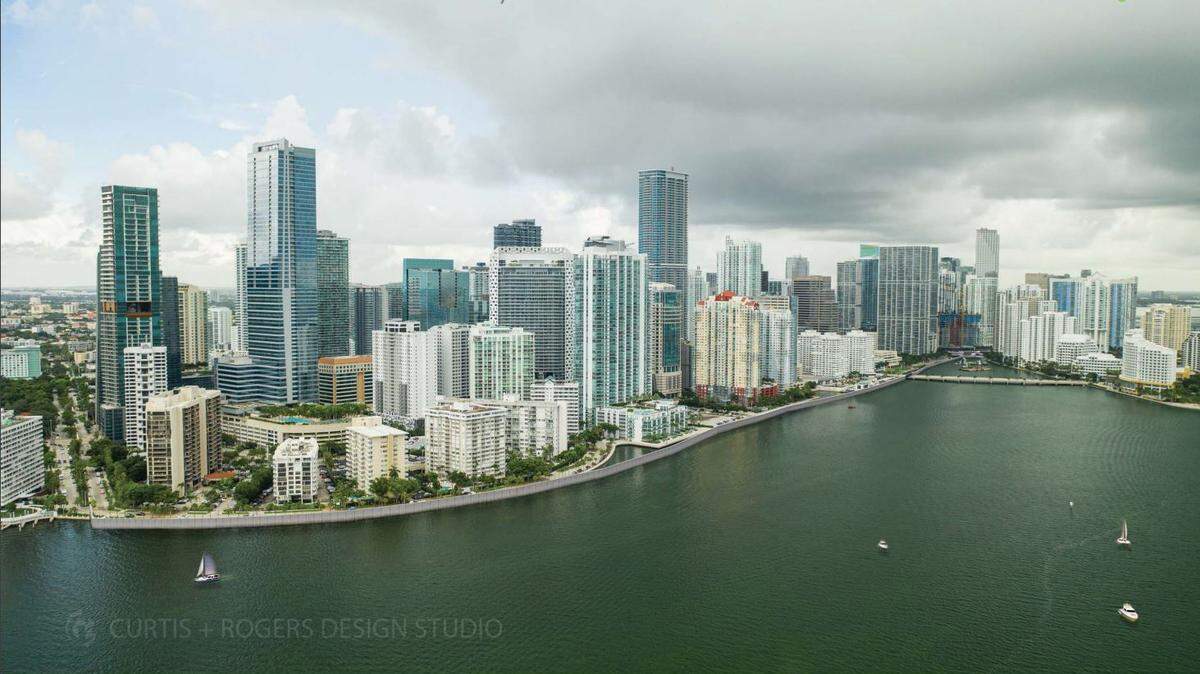
Dodd’s background with the Army Corps also helped the city navigate its involvement with the Corps’ Back Bay Study, a $3 million evaluation by the federal agency on the best way to protect coastal Miami-Dade from storm surge. The latest iteration of the plan calls for elevating thousands of homes, floodproofing thousands of businesses, planting some mangroves and building an up to 20-foot wall around the coast.
Miami politicians, along with Miami-Dade County and several developers, proposed an alternate arrangement to the Corps — a natural plant-studded dirt barrier around the city along with slightly shorter walls. No final decision has been reached, but the county is set to decide whether to approve or reject the plan in the coming months.
Dodd’s resignation is the latest in a string of high-level changes in the city’s administration since late 2020. In October, three department directors resigned in the span of a week. Since then, another six department directors have resigned, including administrators overseeing Miami’s code compliance, zoning, solid waste and parks departments.
About a third of the city’s senior administrative leadership has turned since Noriega became city manager in February 2020, weeks before the COVID-19 pandemic upended daily life. Sometimes, newly hired city managers install their own leadership teams and make other personnel shifts. Changes under Noriega’s administration may have played out slowly over 17 months because all attention was turned to the pandemic. The departures are also framed by the sometimes contentious environment in Miami City Hall, where commissioners have berated public servants in public meetings.
This story was originally published August 20, 2021 at 10:04 AM.