
How a Girl Scouts bill exposed Jackson charity executive’s $7M fraud

READ MORE
Betrayal of Trust
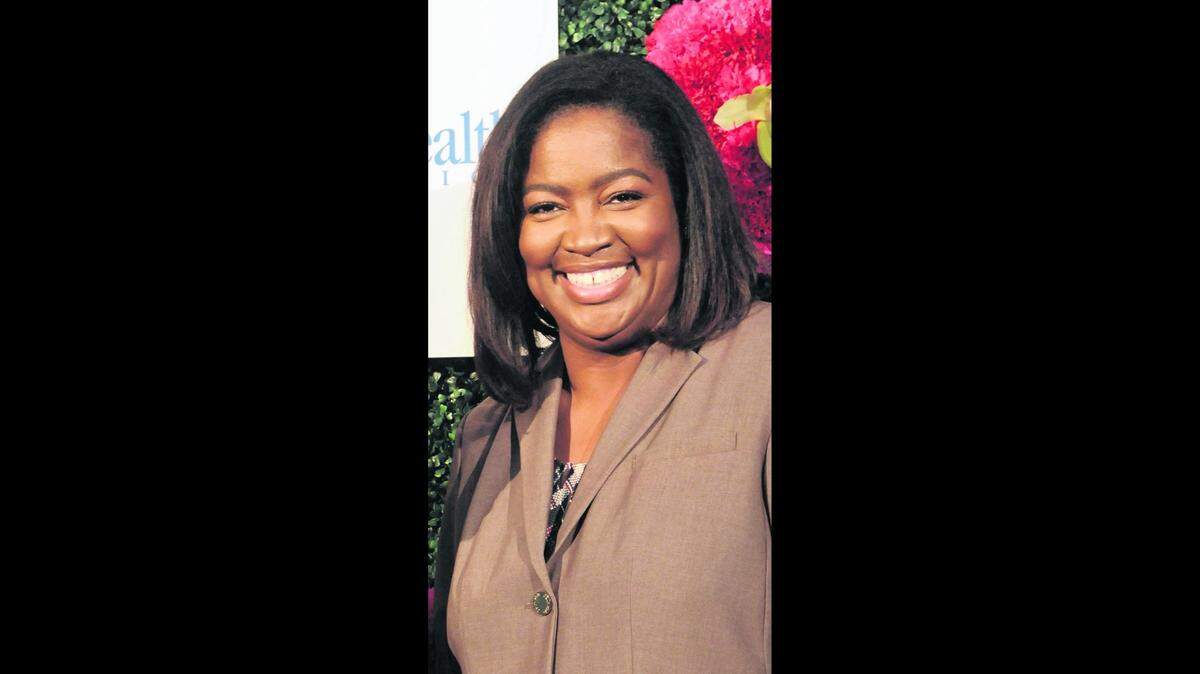
Former Jackson Health Foundation COO Charmaine Gatlin pled guilty to bilking millions in charity funds. A look at the investigation.
Expand All
Time was running out for Charmaine Gatlin. For years, she had doctored bills to steal millions of dollars from her employer, the fundraising arm for Jackson Health System, Miami-Dade County’s only public hospital system.
As the Jackson Health Foundation’s chief operating officer, she realized it, too. The nonprofit was going through a corporate reorganization that by the end of 2024 would lock Gatlin out of her unlimited access to donors’ funds and end her kickback schemes.
But rather than play it safe, Gatlin double-downed as she approved hundreds of fabricated invoices, further laying the groundwork for her firing as the Foundation’s second-in-command and reckoning in federal court. She got caught in spite of the Foundation’s flawed system of checks and balances that had given her sole authority to sign off on expenses and payments up to $100,000.
READ MORE: She embezzled millions from Miami’s public hospital charity. Here’s how she did it
The Foundation’s newly minted CEO Flavia Llizo discovered her theft — but not because of a shady invoice. Rather, Llizo said she suspected Gatlin was lying when she claimed she personally paid for a $10,000 donation to the Girl Scouts of Tropical Florida in the Foundation’s name.
It turned out that Gatlin didn’t foot the bill for the Foundation’s sponsorship; the charity did. Her lie prompted Llizo and other Jackson top executives to dig deeper into Gatlin’s spending habits, uncovering a thicket of falsified invoices for millions of dollars over a five-year period. As part of that, Gatlin raided donors’ funds meant to care for Jackson’s sickest patients, from children to burn victims.
“She was smart,” said Llizo, who was named the Foundation’s CEO in October 2024, just two weeks before Gatlin was placed on suspension. “It was her betrayal of the authority and the permission that she was given [to approve expenses and payments] that did this. It wasn’t the lack of control.”
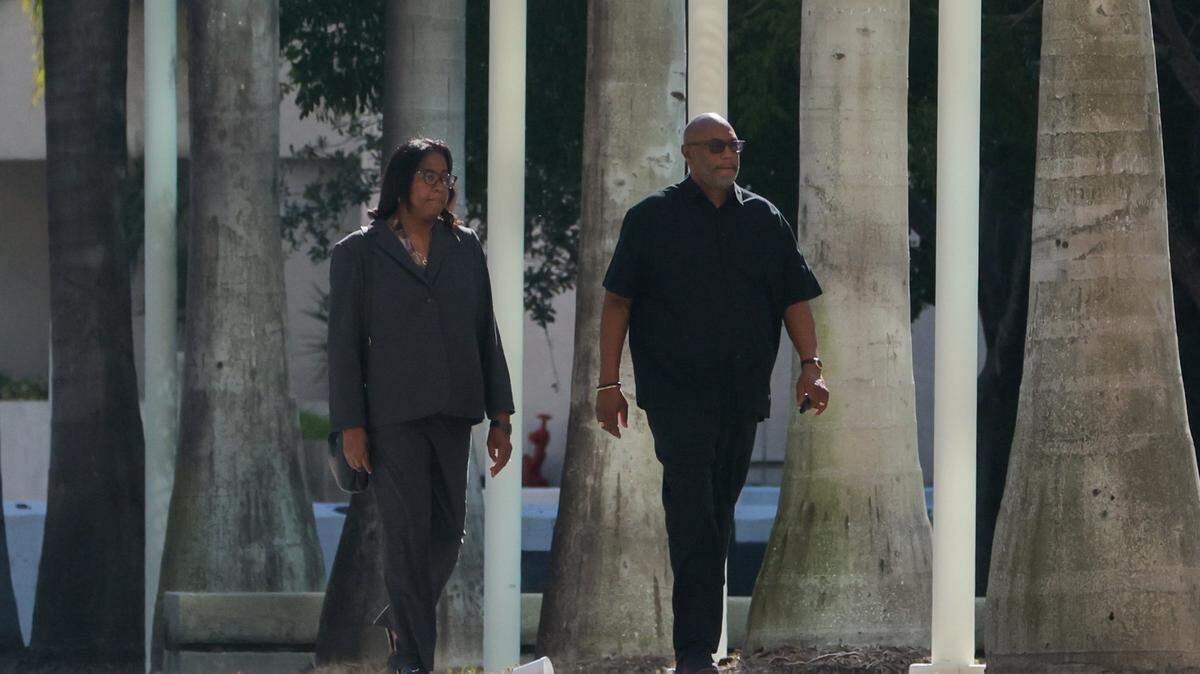
By early November 2024, Gatlin, 52, was out of an executive job that was paying her almost $300,000 a year and facing an FBI investigation. In September, she pleaded guilty to a wire-fraud conspiracy and was sentenced to six years and eight months in prison on Wednesday in Miami federal court.
READ MORE: Ex-Jackson exec who stole millions from charity sentenced to more than six years

A prosecutor in court Wednesday said she approved about $7 million in Foundation payments for falsified invoices between 2019 and 2024, while she pocketed more than $1 million in kickbacks from a Georgia audiovisual contractor, due to be sentenced on Monday, who did no work for the charity.
The Foundation, with less than 20 employees, a $4 million operating budget and $12 million in annual donations, took a big hit. It remains to be seen whether Gatlin — who was hired by the Foundation a decade ago after working for a mentoring nonprofit in Atlanta — will ever pay back any of the lost funds, as required under her sentencing.
“She did not just harm Jackson Health System and the Foundation. She also hurt real people, with real needs, who depend on Jackson for care, compassion, and survival – people like the 8-year-old girl receiving chemotherapy, the father waiting for a lung transplant, the teacher undergoing rehabilitation after a traumatic brain injury,” Jackson Health System CEO Carlos Migoya told a judge at her sentencing hearing on Wednesday.
In court papers, Assistant U.S. Attorney Elizabeth Young said “there is no sign that Gatlin will be prepared … to make a meaningful restitution payment to Jackson’s foundation.”
Stole funds for burn victims
Young portrayed Gatlin as a serial thief of the charity’s funds, even raiding $55,000 in restricted Foundation donations for Jackson burn victims purportedly to pay for 10,000 first-aid kits that the hospital didn’t need or request.
“During this scheme, Gatlin had expensive cars, large credit card charges, and a [rental] home in Weston, despite knowing full well that donors often earmarked the money she stole for needed patient care such as treating burn victims,” Young wrote in the court filing.
“Emails provided by Jackson show the medical staff shocked to find the burn-victim fund depleted when they were organizing a camp for burn victims,” Young noted, adding that as Gatlin was stealing that money in 2022, she asked one of the Foundation’s Miami vendors to buy a Louis Vuitton loop handbag — around $3,000 — for a family member.
“This is the one she wants,” Gatlin wrote to the vendor.
Fraud hurt Jackson’s reputation: Hospital CEO
Both Llizo and Migoya said in an interview with the Herald that because the Foundation was a small, independent nonprofit arm of the public hospital network, Gatlin was trusted with nearly complete authority to make decisions on operating expenses and payments — without anyone watching over her.
That loose oversight changed in the fall of 2024 after the once-independent Foundation was incorporated into Jackson Health System, which has a team of financial officers and employees overseeing all revenue and expenses. Now, all Foundation payments require two signatures of approval by the charity’s CEO and the health system’s VP of finance.
“Small businesses rely on the trust of the people they put in power,” Migoya said in the interview. “Sometimes they’re the business owner. … But sometimes they’re [the] key employees … like in this case. This theft did not happen in one year. This happened over a great number of years, and it was integrated into the expenses.”
“The biggest loss is not the money, it’s the reputation” of Jackson and the Foundation, he said.
Nonprofit and financial analysts contacted by the Herald said Gatlin should never have had the sole authority to approve expenses up to $100,000. That gave her the opportunity to hide costs in fake invoices submitted by a close circle of vendors who collaborated with her in fleecing the charity’s funds.
‘Too little oversight’
This type of fraud “is as old as the hills,” said Robert Knechel, director of the University of Florida’s International Accounting and Auditing Center in the Warrington College of Business.
“Too little oversight, too much authority invested in one person, and too much trust,” he said.
Mark LeClair, professor emeritus at Fairfield University in Connecticut who is an expert on fraud in the nonprofit sector and recently wrote a book, “Foul Play in the Nonprofit Sector: Analyzing Corruption in US Charities,” said Gatlin had too much power to approve expenses up to $100,000 on her own.
“Way too high in an organization that size,” LeClair said, pointing out that for small organizations like the Foundation, the spending cap for the COO should be about $5,000.
“You should not have the ability, without a second signature, to spend large sums of money,” LeClair said. “It’s just bad practice.”
Knechel and LeClair questioned how the Foundation could have been audited multiple times and nobody caught her deceptions and embezzlement.
Llizo said Gatlin’s illicit spending was not noticed in financial statements because she hid the “bulk” of her spending by classifying it as “programmatic” – funds used for Jackson’s medical programs. She classified things in a way that “wouldn’t stand out as a red flag to anyone.”
For her part, Gatlin admitted to the crime in a factual statement as part of her plea deal. She wrote a long letter to U.S. District Judge Beth Bloom and spoke briefly during her sentencing hearing on Wednesday. But Gatlin, a University of Florida graduate and mother of three, has not commented throughout this saga to the Herald.
“I tried to be a good person,” but “I was under a lot of stress,” Gatlin said, referring to a series of childhood and adult hardships that she cited in her letter to Bloom. She added, however, that she wasn’t trying to make excuses for stealing from the Foundation.
Her defense attorney, David Howard, said it was “undoubtable that her conduct was egregious.” But he tried to downplay her leadership role in the billing scheme with the Foundation’s vendors in the hope of lessening her time in prison.
“It was not a scheme organized by her,” Howard said at her sentencing.
Judge Bloom, however, strongly disagreed: “How could any of this have not taken place without her involvement? There are many vendors, but it all ties back to Ms. Gatlin.”
The Girl Scouts’ slip-up
Curiously, Gatlin’s downfall wasn’t sparked by an audit — suspicions weren’t raised as costs mounted. In fact, it’s possible Gatlin could have gotten away with her falsified billing scheme if she hadn’t accelerated her spending during her final months at the Foundation.
The scrutiny began after Gatlin made an ill-timed lie to Llizo about who was really paying the $10,000 sponsorship of the Girl Scouts.
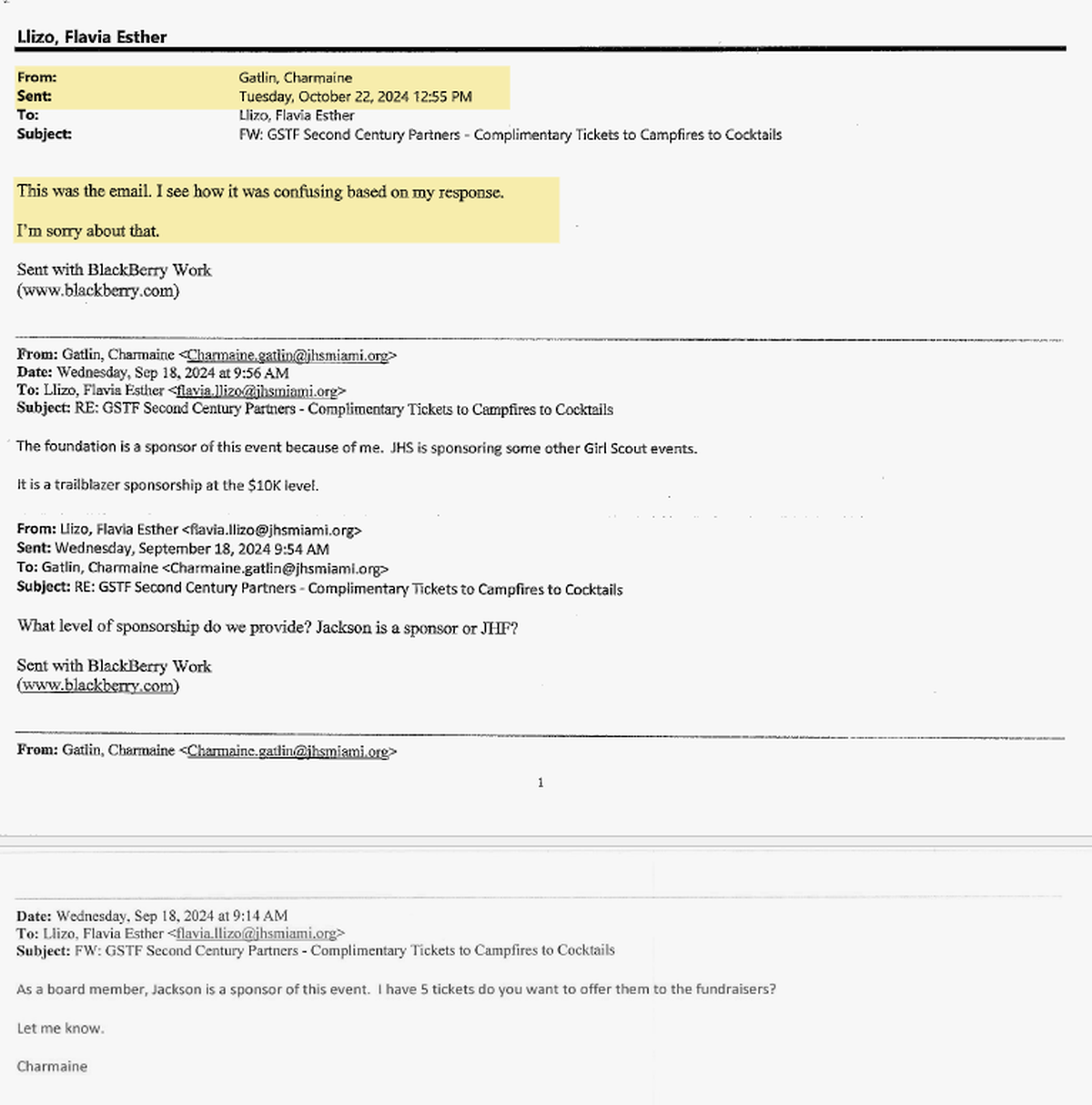
Her deceit, like much of Gatlin’s fraudulent invoices, are recorded in emails the Herald obtained through a public records request. In the emails, Gatlin told Llizo that she had five tickets available for the Girl Scouts’ annual fundraising “Campfires to Cocktails” gala and asked if she wanted to offer the seats to other fundraisers.
Gatlin, in the September 2024 email, said that “as a board member, Jackson is a sponsor of this event.”
In the interview with the Herald, Llizo said she questioned why the Foundation would sponsor an event that Jackson Health System was also sponsoring.
“That’s not really being good stewards of our money,” she told the Herald.
“The foundation is a sponsor of the event because of me,” Gatlin wrote back on Sept. 18, 2024. “JHS [Jackson Health System] is sponsoring some other Girl Scout events.”
.jpg "highlight-Gatlin writes to llizo 1 (2).jpg")
“It seemed really bizarre to me,” recalled Llizo, who previously served as Gatlin’s co-president and the Foundation’s chief development officer and would have been involved in sponsorship plans.
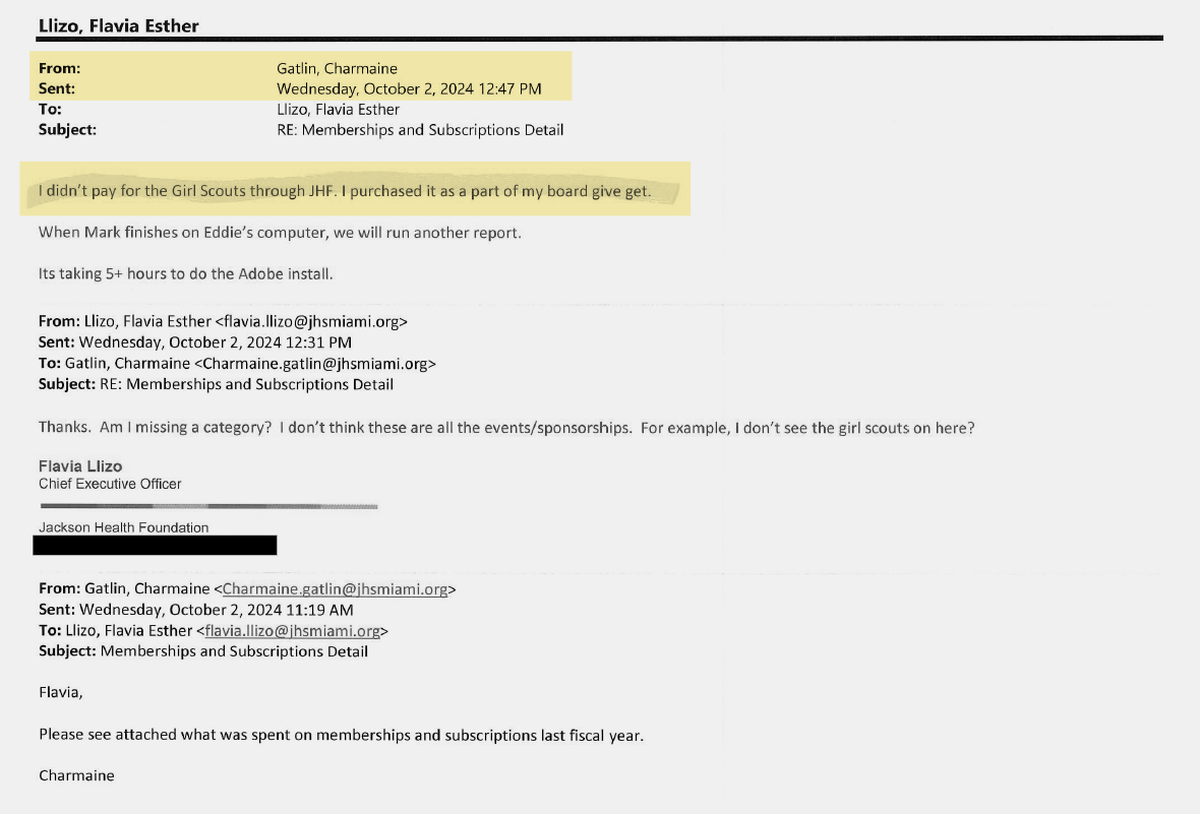
Another batch of emails showed that as Llizo was trying to gain a better understanding of the Foundation’s operating budget in her new role as CEO, she asked Gatlin for a report of all the charity’s expenses, including fundraising events and sponsorships, for the 2024 fiscal year.
As she reviewed the list, Llizo said she noticed that the Foundation’s Girl Scouts sponsorship was noticeably missing and questioned whether the report was complete.
“I didn’t pay for the Girl Scouts through JHF [Jackson Health Foundation],” Gatlin wrote to Llizo on Oct. 2. “I purchased it as a part of my board give get.”
Gatlin was a member of the board for the Girl Scouts chapter in Miami-Dade and the Florida Keys and had helped facilitate a relationship between the nonprofit, the Foundation and the hospital system. Like other nonprofits, the Girl Scouts requires board members to give a specific amount of money annually — $1,000.
Llizo recalled Gatlin telling her that she paid for the 10K Girl Scouts gala sponsorship herself, but gave the credit to the Foundation because she “didn’t want people to know she had that kind of money.”
But Foundation records showed that the nonprofit, not Gatlin, cut the check.
Llizo caught her in a lie.
On Oct. 4, 2024, Llizo asked the Foundation’s finance director for a list of all events the Foundation had sponsored in the previous year. The report did not list the Girl Scouts. Llizo still wasn’t satisfied.
“Could you tell me if we cut a check to the Girl Scouts?” she asked the Foundation’s bookkeeper on Oct. 21.
Yes, the $10,000 bill was paid two weeks earlier, the bookkeeper informed her.
Llizo confronted Gatlin again. The COO tried to shake it off, saying Llizo had misunderstood her. The Foundation was always the sponsor, Gatlin told her.
“No, I didn’t misunderstand,” Llizo replied.
After their confrontation on Oct. 22, Gatlin forwarded part of her email exchange with Llizo, telling the CEO: “This was the email. I see how it was confusing based on my response. I’m sorry about that.”
Excluded from the exchange were emails in which Gatlin claimed to have paid for the sponsorship herself. Llizo still had those messages in her inbox.
Alarms going off, Llizo also noticed other suspicious spending by Gatlin as she reviewed the Foundation’s expenses, including several vendors billing for services for non-existent fundraising events. It would turn out that the Foundation had spent $1.3 million “above and beyond” the nonprofit’s budget for the fiscal year ending Sept. 30, 2024, Llizo said.
Again, Llizo questioned Gatlin, who told the Foundation’s CEO that she had to dip into restricted funds — donated money that could only be used for specific causes in the Jackson Health System, such as the burn-victim funds — to pay some vendors for certain “special” requests.
Llizo told Gatlin she was going to speak with Jackson’s chief financial officer — then she brought her concerns to Migoya’s attention on Oct. 22.
In the meantime, Gatlin was scheduled for her annual performance review on Oct. 23.
The evaluation turned out to be anything but routine. Llizo and Migoya, joined by a human resources administrator, confronted Gatlin about her lie involving the Girl Scouts and her excessive spending of the Foundation’s funds.
Migoya told her that he was going to order a forensic analysis of the Foundation’s financial records, including retaining an outside accountant.
“You’re questioning my integrity,” Gatlin told them, according to Llizo and Migoya.
Gatlin left the meeting suspended with pay as Jackson launched its investigation.
In a statement shared with the Herald after this story was published, the Girl Scouts of Tropical Florida said it was “deeply disappointed” by Gatlin’s actions.
“While [Girl Scouts of Tropical Florida] was not implicated in wrongdoing, the exposure of this fraud through a Girl Scouts-related bill underscores the seriousness of the misconduct and the impact it has had on trusted community institutions,” the organization said.
Audit reveals rampant thievery
At her sentencing, Young, the prosecutor, said it was “unrepentant greed” that drove Gatlin to steal millions from the Foundation and spend much of the money on material things.
But it is not clear what else might have motivated Gatlin’s crime.
In her lengthy letter to Judge Bloom before her sentencing, Gatlin pleaded for no prison time, stating that she was “deeply remorseful.” But she also implied that her billing scheme was somehow rooted in unhealed childhood trauma and feeling unloved her entire life.
“What I realized during this process is that I had been crying out for help for many years, but it had gone unnoticed by many people because I hid my pain so well to focus on others,” Gatlin wrote in her five-page letter.
In the letter, Gatlin described a difficult childhood, where she was molested by a family member. She spoke about the challenges of caring for a son with autism and a husband with prostate cancer, along with the financial strain of moving to a better school district to help her daughter get into college.
She also talked about how she felt snubbed by the Foundation for not promoting her to CEO and her jealousy of Llizo. And she spoke about her goal to pay back Jackson by working two jobs.
Not mentioned in the letter: That at the same time Gatlin began her criminal activity, Broward County court records show that the Internal Revenue Service had imposed tax liens totaling $149,885 on her and her husband, Arthur, in August 2019 for failing to pay federal income taxes over several prior years.
The court records don’t show whether the couple ever paid those back taxes to the U.S. government.
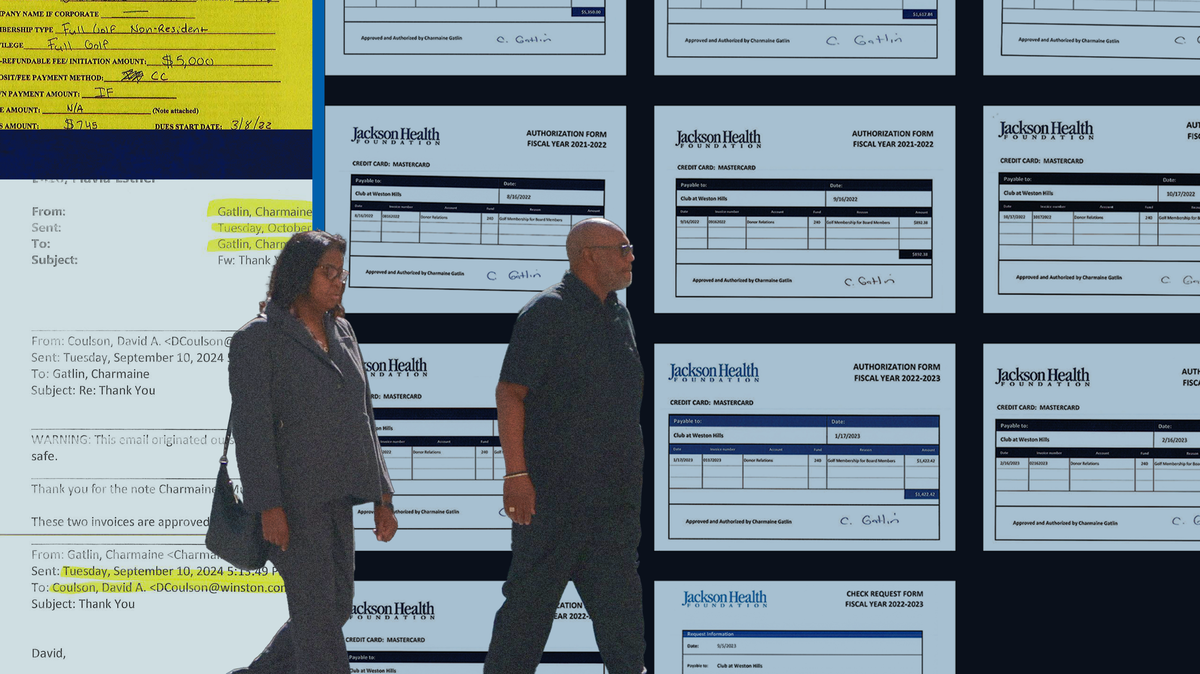
In Jackson’s audit, forensic analysts uncovered the extent of her rampant thievery from the Foundation, including spending tens of thousands of dollars on high-fashion handbags, a membership at a tony golf club for her and her husband in Weston, a rose-gold colored golf cart, and a website, video and brochures to promote her daughter’s Broward traveling softball team.
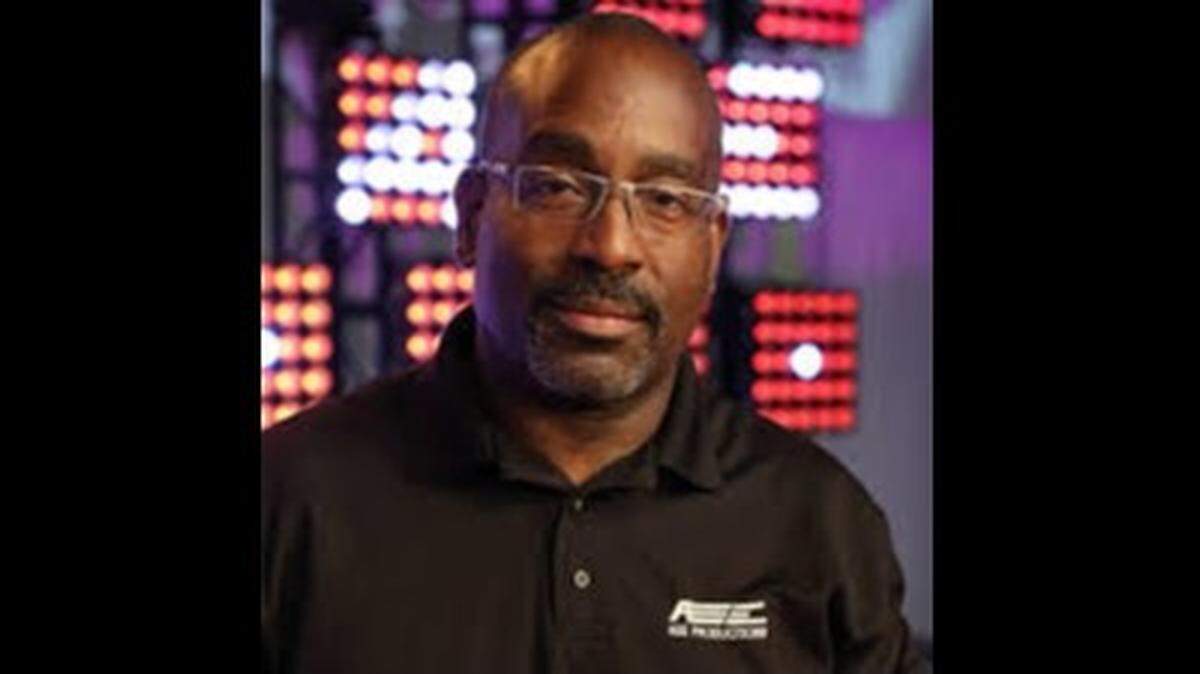
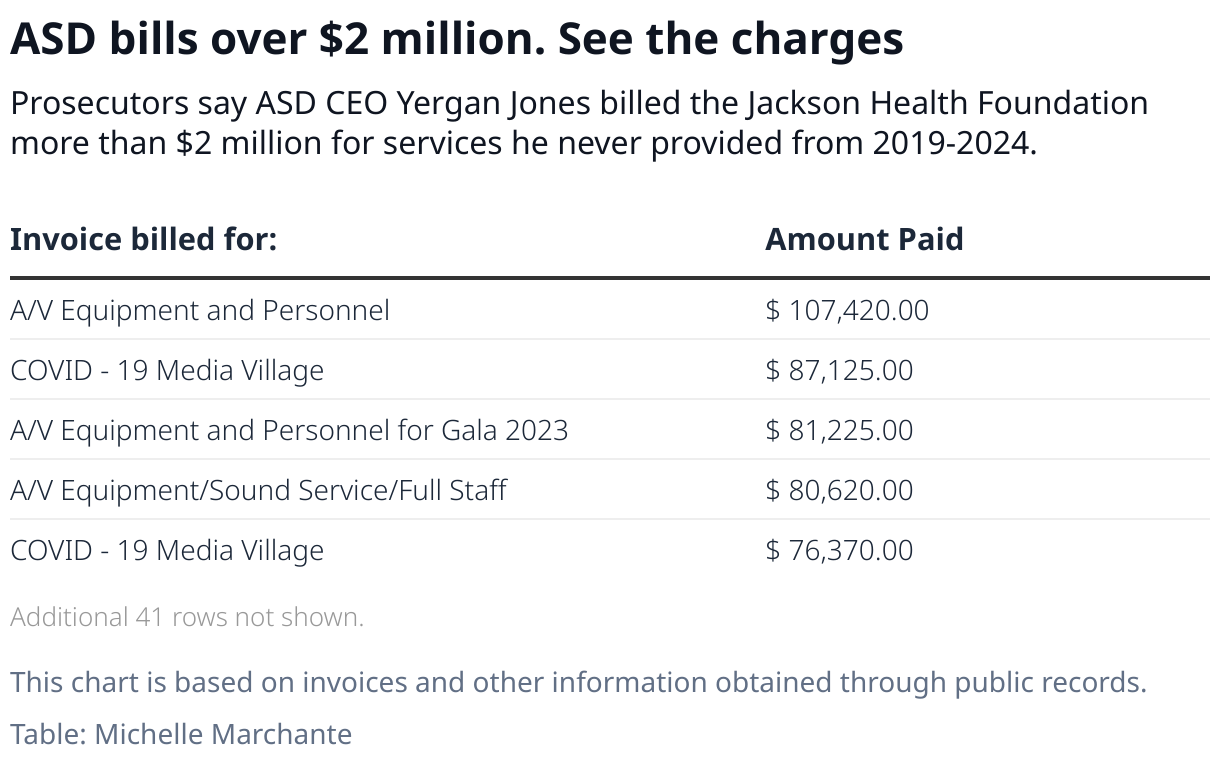
In late 2024, Jackson officials alerted federal law enforcement that Gatlin was routinely tapping into Foundation funds to pay vendors from South Florida to Georgia for completely fabricated services. Gatlin paid an Atlanta audiovisual contractor $2 million, who then kicked back $1 million to her, according to court records.
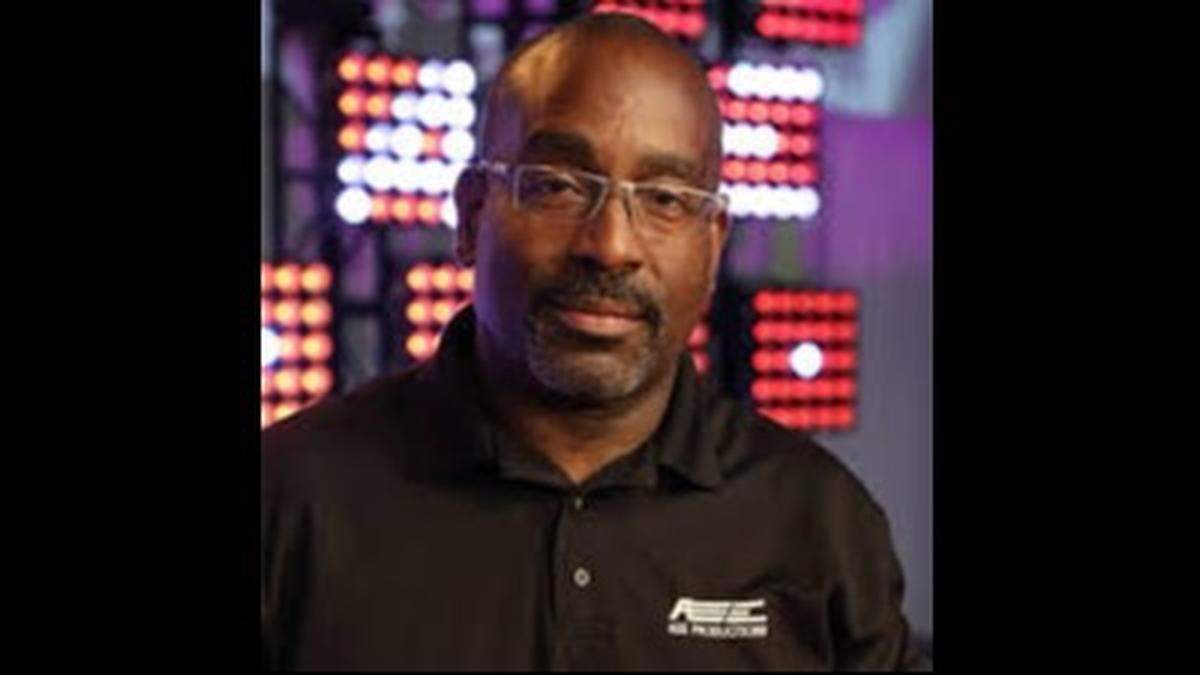
The contractor, Yergan Jones, did not do any work for the Foundation or Jackson. He also pleaded guilty to a wire-fraud conspiracy and faces sentencing on Monday, Dec. 15.
Asked by a Herald reporter whether Gatlin would have been caught one way or another, Migoya said: “No.”
“If we hadn’t bumped into those items” for the Girl Scouts and $1.3 million in suspicious expenses in late 2024, he said, “She may have not been caught, because who would have gone back to understand the invoices, to say, ‘Why were these things paid or not?’ ”
Conspicuous among the suspicious transactions: Gatlin approved about $2.9 million in payments for more than a dozen Georgia vendors with no apparent connections to the Foundation – including Jones’ Atlanta company that paid her bribes. Among her expenditures: Invoices and court records show she authorized nearly $90,000 for barbecue from her Georgia hometown of Riceboro, population 935, for meals the Foundation never ordered or received.
And as her illicit spending peaked last fall, Gatlin even forged an email from the Foundation’s board chair to pay a Miami vendor listed as a “co-conspirator” in court records more than $70,000, according to Jackson records and her Miami federal court indictment. Jackson’s audit showed the payments were for two non-existent fundraising events.
Last November, the month Gatlin was fired, the Foundation turned over its analysis of her questionable payments to the FBI, leading to Gatlin’s arrest in May at her Riceboro home near Savannah.
“To put it into perspective, the Foundation’s ‘everyday donors’ include hardworking South Floridians who give one-time gifts anywhere from $25 to $500. The millions that Charmaine Gatlin stole equates to tens of thousands of donations like this,” Migoya said during Gatlin’s sentencing.
“It will take our team years of tireless, day-to-day fundraising to fill the hole that she left behind — all so she could selfishly pad her own pockets and divert money to buy luxury purses, custom golf carts, and country club memberships for her family,” he said.
Migoya and Llizo now realize that it was only a matter of time before Gatlin’s unlimited access to the money would come to an end. The Foundation’s payroll, vendor and rent payments and other operational expenses were soon going to be handled and paid for by Jackson Health System’s more robust finance team as part of the restructuring process.
Starting a year ago, the plan was to have Jackson Health System pay for all the Foundation’s operational costs, roughly $3 million, to ensure that 100% of all charity funds would go toward healthcare causes and projects. Before the merger, the Foundation spent 15% of all donations on administrative costs.
The operational change — unbeknownst to Jackson and Foundation leaders — would also inadvertently prevent Gatlin from continuing her carefully curated and long-running scam.
“This crime could not have happened without Gatlin, as she was the only one who could sign off on the fraudulent invoices, including coaching vendors on what to write on the invoices and how to submit them in order to trick the Foundation,” according to Young, the federal prosecutor.
But the billing process would soon change with the merger between the Foundation and Jackson. The Foundation’s bylaws and policies would strengthen, requiring signatures from multiple executives to approve invoices and expenses. A barrier for Gatlin.
She began to hustle as her unchecked authority would soon be cut off. Through a public records request, the Herald obtained Jackson’s analysis of expenses and payments approved by Gatlin for dozens of vendors.
The analysis showed that Gatlin’s billing scheme with three of the vendors who were at the core of her fraud peaked in 2023 but was almost as high the following year. In fact, Gatlin’s spending with one of those vendors — Jones’ audiovisual firm ASD — increased in fiscal year 2024.
Why didn’t the Foundation, which undergoes a yearly independent financial audit, catch onto the scheme sooner?
“The answer is simple. There was an invoice. It was approved that we received the invoice, and it was approved that that was the right amount, and it was approved that delivery was done. So from an audit perspective, all of it was done,” said Migoya, who had worked for decades in the banking industry before he was hired as Jackson’s CEO in 2011.
Migoya said the Foundation’s board of directors and executive committee, of which he’s a member, only evaluates revenues and expenditures — not the daily operational expenses, including invoices and payments.
He said that responsibility lay with the Foundation’s finance director. The director was fired along with Gatlin in November 2024, but not because of any wrongdoing like Gatlin — more due to a failure to ask her tough questions about her expenses, according to Migoya.
“If you think there’s something there and you don’t believe what your boss is doing correctly, you bring it up to someone else,” he said. “And even though the Foundation is small, you could have gone to Flavia [Llizo], and even if you don’t want to go to Flavia, you could have come to me. You could have gone to the board.”
What went wrong
In the end, both Migoya and Llizo said Gatlin was able to carry out her scam for so many years by taking advantage of the small nonprofit’s operational structure.
Nonprofits are just as vulnerable, if not sometimes more so, to fraud as other small businesses, experts say.
Knechel, the UF auditing expert, agreed that the Foundation’s small size certainly made Gatlin’s scheme easier to orchestrate. He said that kind of intimate environment made it easier for her colleagues to trust her.
But, he said, the Foundation’s financial safeguards also appeared to be lacking. An organization’s “first line of defense” to protect against this type of fraud is to have “separation of duties,” said Knechel, who also serves as the Frederick E. Fisher Eminent Scholar Chair at UF.
This ensures that the same person is not in charge of “incompatible functions,” such as authorizing both expenses and payments as Gatlin did.
“Trust is a wonderful thing until it gets violated,” Knechel said, noting that this type of fraud is usually not discovered until someone gets suspicious and starts asking difficult, awkward, and eventually “unanswerable questions.”
“There’s different ways to cover these things up, but the process plays out pretty much the same,” Knechel said.
“Usually they start small, they grow, they become too big to cover up. Somebody figures out what questions they need to be asked and all of a sudden, boom.”
After uncovering Gatlin’s theft, Jackson and Foundation officials notified Coral Gables-based Verdeja & Alvarez, one of the largest accounting firms in South Florida, which had just been hired to conduct the charity arm’s annual audit for fiscal year 2024. Verdeja & Alvarez did not do the previous years’ audits.
The Gables firm, after analyzing the Foundation’s financial safeguards, responded in December with several warnings.
In a Dec. 11 letter to management, the accounting firm noted there was “insufficient review and approval of financial statements, journal entries, financial transactions, and reconciliations by a qualified individual. This increases the risk of errors or misstatements going undetected.”
The firm also zeroed in on Gatlin’s singular authority to approve both expenses and payments. It recommended that the Foundation change its system to ensure that the person entering invoices is not the same person who approves and reconciles them.
“A lack of segregation of duties increases the risk of fraud, misappropriation of assets, and unintentional errors,” the firm cautioned in the letter.
Assuring Foundation donors
Jackson officials said starting in November 2024, the Foundation began operating under the same financial system as the hospital network. This included requiring dual signatures from the Foundation’s CEO and Jackson’s VP of Finance on payment requests, with budget tracking in place for each request.
Also, requests for restricted donors’ funds must be approved by Jackson’s CEO or chief financial officer.
In addition, they said, no payments can be made in advance of goods or services received. And, wire payments are permitted only when necessary.
Migoya and Llizo said the Foundation is also working to assure donors that their charity funds will be fully protected, especially now that its coffers are secured by safeguards that are more substantial than other nonprofits of similar size.
“It will take our team years of tireless, day-to-day fundraising to fill the hole that she left behind,” Migoya told the judge at Gatlin’s sentencing hearing.
“But this is not just about the money she stole,” he said. “We’re also focused on restoring the trust of our donors.”
This story was originally published December 12, 2025 at 5:00 AM.