
Audio glitches, lousy WiFi, shirtless guests: Miami Zoom court expands despite limitations
Zoom criminal court is entering its third month in Miami, and the gaffes are amusing enough: dogs barking, a shirtless man appearing in a mirror behind a witness, a woman obliviously applying her eyelashes in a bathroom.
But for the lawyers, the limitations of holding online court are no laughing matter.
With only a handful of courtrooms set up for Zoom, calendars can be frustratingly long, and hearings move tediously as lawyers navigate microphones, camera placement and virtual “breakout rooms.” Lousy internet connections can be vexing — during one recent hearing, a prosecutor kept losing her signal during witness testimony.
Lawyers, used to the theatrics of grilling people live on the stand, find interrupting witnesses doesn’t work so well when there’s an audio lag.
“There are subtle in-person clues you can’t pick up when you’re questioning someone during an online hearing. It’s the difference between playing poker at a table versus online,” said Miami defense lawyer Philip Reizenstein, who by mistake appeared recently in an online court hearing in front of a virtual background created by one of his children: a pink-and-purple Minecraft cartoon house.
As the novel coronavirus still lurks and officials hash out how to reopen physical courthouses — and resume jury trials — Miami-Dade’s justice system is still grappling with how best to use online platforms in a way that gives a fair shake to victims and defendants alike.
Despite the glitches and growing pains, Miami-Dade court officials have kept justice sputtering along. Last week, over trepidation from prosecutors, one judge began the county’s first Zoom probation-violation hearing — adding to a slew of self-defense hearings, bond hearings, arraignments, and plea deals already on the books.
In one high-profile case, a driver last week pleaded guilty to killing a Miami police officer in a high-speed car crash. The Zoom hearing featured the defendant accepting the deal from his kitchen.
“I am really happy and beyond satisfied with what we’ve been able to do in such a short time,” said Miami-Dade Circuit Judge Nushin Sayfie, the head of the criminal division. “I don’t think it’s a substitute for live in-person court hearings, but under these circumstances, we are doing it well.”
Legal experts and court officials acknowledge that virtual jury trials in the criminal division likely won’t happen. With a defendant’s freedom in play, the stakes are just too high. Officials are already planning for how jury trials can return at the Richard E. Gerstein Justice Building, which before the pandemic was perpetually gridlocked with people.
A jury task force — made up of judges, prosecutors, defense lawyers, medical experts, corrections and building officials — has been in exhaustive meetings to plan how to reopen safely to avoid people spreading the highly infectious coronavirus.
Building officials plan to institute temperature checks and stagger schedules to cut down on crowds. Traffic court sessions are now being held on Zoom too, which should lessen the number of motorists and cops who flock to the building.
Getting jurors will be daunting. Officials are pondering using more detailed questionnaires — sent via e-mail — and virtual questioning sessions to weed out candidates who can’t serve.
“We have to figure how to get jurors to want to come to the courthouse, and most importantly, make sure they are safe once they’re there,” said Miami defense lawyer Jude Faccidomo, who is part of the task force.
For now, justice will have to be remote.
Criminal courthouses across Florida began shutting down to the public in mid-March, as the coronavirus began to spread across the state, particularly in Miami-Dade, Broward and Palm Beach counties.
All but 11 states have urged or mandated the use of virtual hearings to deal with the pandemic, according the the National Center for State Courts. Faced with an unprecedented crisis, the Florida Supreme Court suspended jury trials, which remain so until at least July. Justices also suspended speedy-trial windows. Most in-person hearings are supposed to be for emergencies only.
Even now, as South Florida restaurants, stores and beaches return in limited fashion, court officials are relying on virtual hearings to chip away at what will be a mind-boggling backlog of cases — all while new ones are entering the system each day.
Florida’s Office of the State Courts Administrator contracted with Zoom, the now-ubiquitous video conferencing service, to transition counties to virtual hearings. The Florida Supreme Court this month began hearing oral arguments via Zoom.
In Miami-Dade, the first Zoom hearings began on April 2, with a judge logging in from the courtroom and other parties signing in from their own homes, offices, cars or jail facilities.
Now, three courtrooms are equipped to handle Zoom hearings, and more can be added if necessary. Judges are now grilling defendants to ensure they understand and agree to the virtual court hearing.
As more major hearings have begun, however, the Miami-Dade State Attorney’s Office has expressed reservations.
“We are very concerned about protecting victims’ rights and the difficulties involved in trying to do so in a virtual environment,” Miami-Dade Assistant State Attorney Christine Zahralban, head of the legal bureau, wrote in an email this month to Judge Sayfie. “We cannot agree to remote hearings without notice to the victim and without an opportunity for them to be present and heard where appropriate.”
Defense lawyers worry that Zoom hearings don’t do enough to protect their clients’ constitutional rights to adequate legal representation.
For one, it’s difficult to confer with clients quickly, as they can do in whispers when sitting next to them in court. Instead, judges create a virtual “breakout room” to allow them to meet, which can slow down hearings.
In one recent case, a judge inadvertently forgot to patch in Miami defense lawyer Alex Sola during a hearing — and his client started testifying. “The client believed I was there and I wasn’t,” Sola said. “It was as if the client was inside the courtroom and I was never inside.”
Once the mistake was realized, the testimony was stricken from the record, Sola said.
Lawyers also worry about witnesses being coached by people off screen, or looking at notes. “You need a full shot of a witness,” said lawyer H. Scott Fingerhut, who teaches criminal procedure at Florida International University’s law school. “How else do you know if they are holding a phone for texting for advice, or a script nearby?”
Confronting an accuser on cross-examination — a constitutional right — is also difficult outside of the physical courtroom. Body language is difficult to gauge. In one recent Stand Your Ground hearing, a stabbing victim testified while casually leaning back on his couch, rambling as lawyers kept trying to interject.
“It’s easier to lie when you’re behind a video than if you’re sitting in a courtroom taking the witness stand,” Miami defense lawyer Anthony Mallo said, adding: “The accused always has the right to confront their accuser, and on Zoom you miss out on a lot.”
Introducing court exhibits is also a challenge. Documents must be scanned and sent to the parties days beforehand. Physical evidence — say a gun in a shooting case — can’t be displayed in a Zoom hearing. Showing a witness a video can sometimes be a glitchy process.
Even routine matters, like separating witnesses, requires extra time.
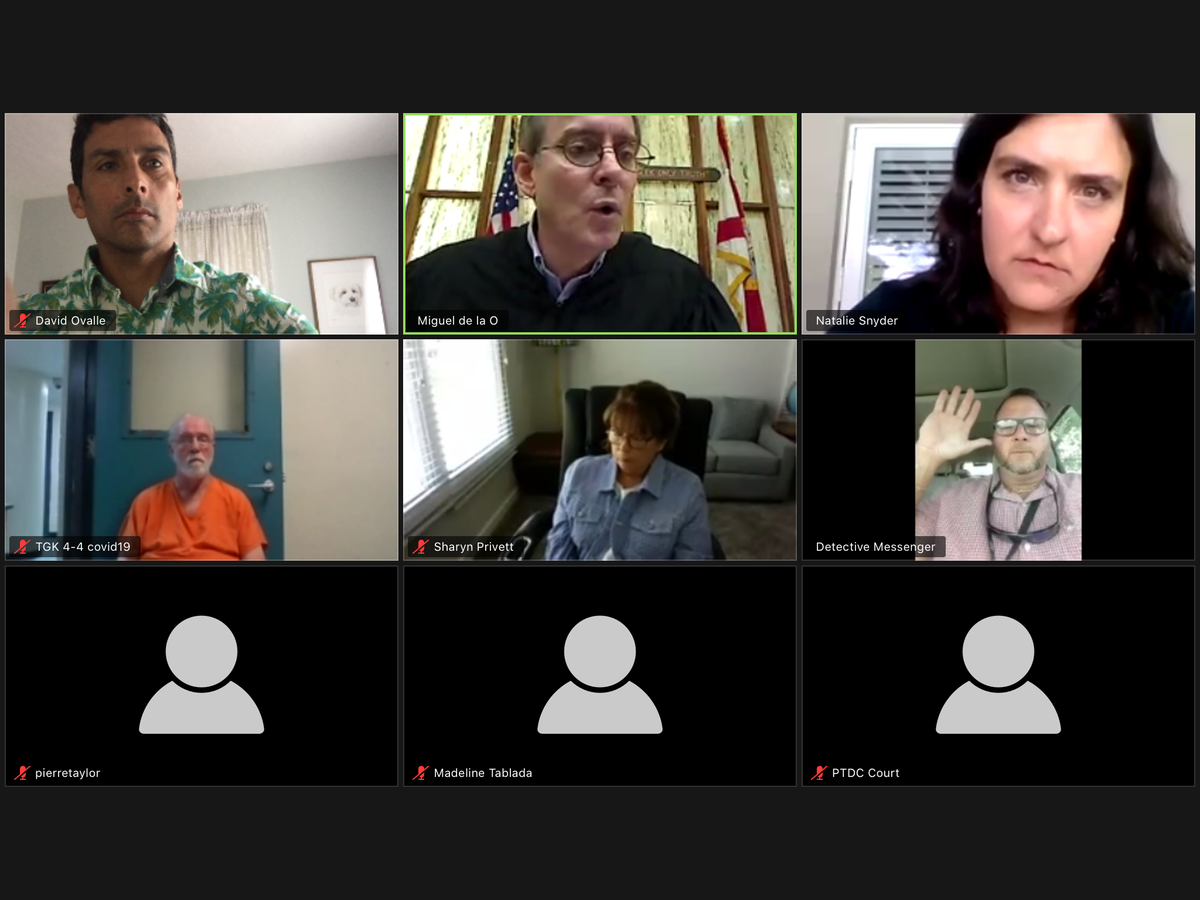
During a probation violation hearing last week, as is routine, lawyers invoked the “rule of sequestration.” In the physical world, that means potential witnesses need to leave the courtroom, so they can’t watch other witnesses testify and tailor their own testimony. It wasn’t so easy in Zoom court.
Circuit Judge Richard Hersch peered at a slew of boxes featuring over a dozen people watching or participating in the hearing.
“I have a bunch of names staring at me in the face and I have no idea who they are,” Hersch said. “I have the technical difficulty of putting them somewhere.”
After a few minutes of logistics issues, lawyers ultimately vouched that no witnesses were watching.
The case is not minor. The defendant, Christopher Rivera, who had been on probation for a slew of armed robberies, is accused of violating his release by getting arrested in a domestic strangulation case.
He faces up to life in prison. The hearing lasted a few hours but didn’t conclude, and will resume on Friday.
Many lawyers believe Zoom can be incorporated into the court permanently.
“Zoom allows an attorney to be able to move from jurisdiction to jurisdiction without the issue of traffic,” said Miami defense lawyer Rod Vereen. “There are a few kinks that must be hashed out, but I like Zoom hearings primarily because they save me time. I hope the courts move toward using Zoom for simple matters, like status conferences, soundings, arraignments, and uncontested motions.”
Not all defense lawyers are keen on Zoom.
South Florida criminal defense lawyer Brian Bieber says he won’t agree to any major hearings via Zoom because he doesn’t think his clients will get a fair shake. His belief was reinforced recently when he had to halt the Zoom deposition of a police officer because the court reporter kept missing parts of the questioning.
“It is inevitable that defendants unhappy with the uneven results will blame our new virtual world, and the novel process,” Bieber said. “The Zoom process would never give my clients a fair and balanced hearing.”
This story was originally published May 28, 2020 at 6:00 AM.