The battle for Wynwood: Miami’s hippest neighborhood has an identity crisis
A Wynwood ice cream shop owner poured his life savings into his dream of scooping homemade flavors only to see customers siphoned off by a food truck operating illegally nearby. A downtown Miami lawyer relocated his office to a Wynwood warehouse and commissioned a mural only to have his midday conference calls drowned out by booming music from surrounding cafe patios. A pioneering resident moved into one of the neighborhood’s new apartment buildings only to be kept awake by late-night noise from DJs and drunken brawlers. He moved out. Wynwood had lost its charm.
Not everyone is complaining. Millions of visitors and hundreds of inhabitants love Miami’s current hipster hub. They love the art splashed on old boxy buildings from the district’s industrial wasteland era. They love the restaurants, bars, nightclubs and pop-up parties. They love the creative, innovative “ecosystem” (Miami’s latest buzzword). They love the edgy urban vibe. They even love the noise, which they don’t hear as noise. It’s the beat of a different drummer, and they love Wynwood for being different.
“I came here for the vibrancy and I hope that doesn’t disappear,” said Claudia Gold, who moved from San Francisco to the new Wynwood 25 apartment complex. “Growing up in Boca Raton, I always wanted to live in a real city, without a car. Here, I have my morning cappuccino and watch the people walking by and feel energized. But it’s tricky striking the right balance in urban neighborhoods. They’re like living organisms. They have to grow and adapt.”
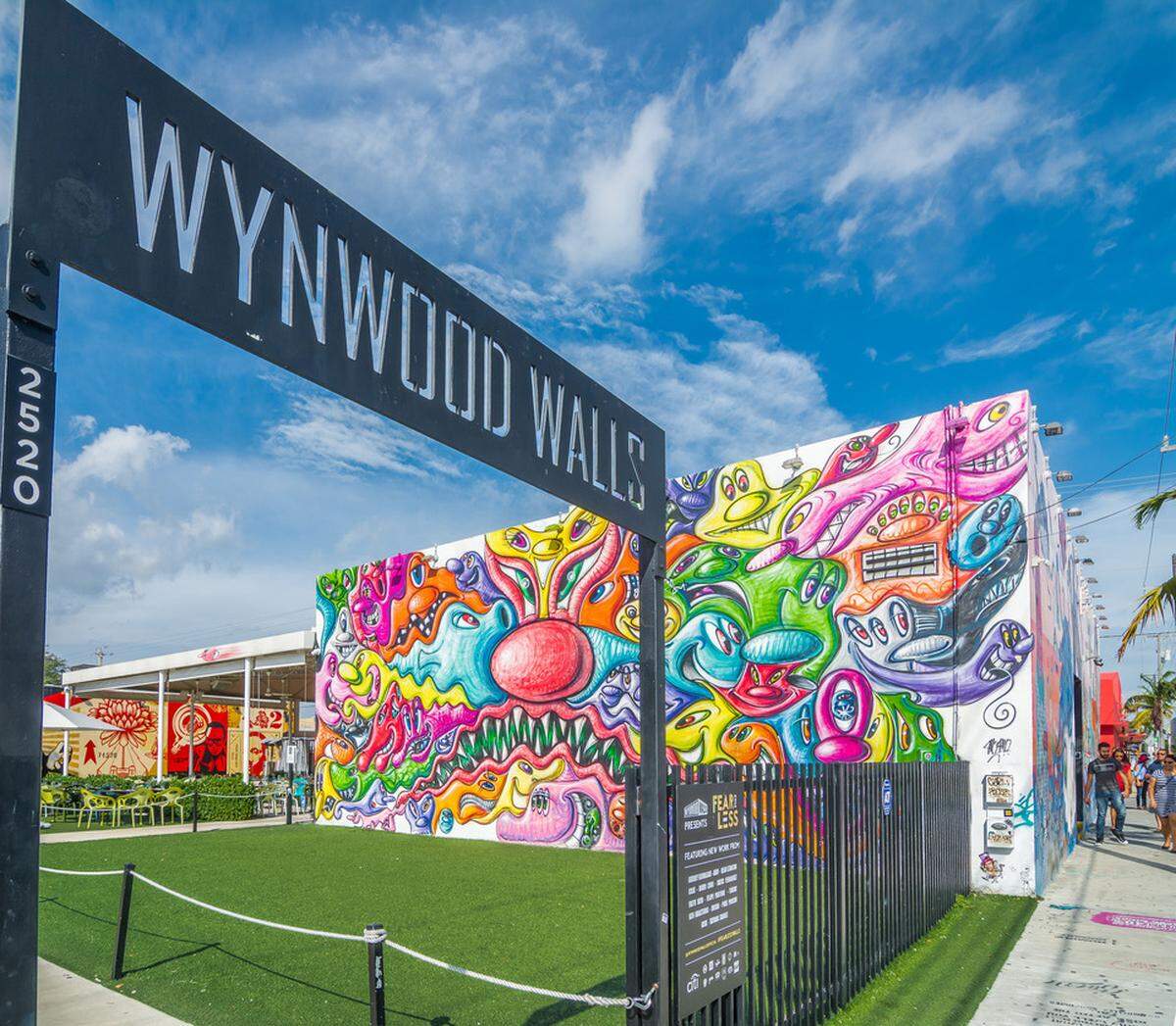
The battle for Wynwood is escalating. The 50-block neighborhood along the spine of Northwest Second Avenue is undergoing an identity crisis.
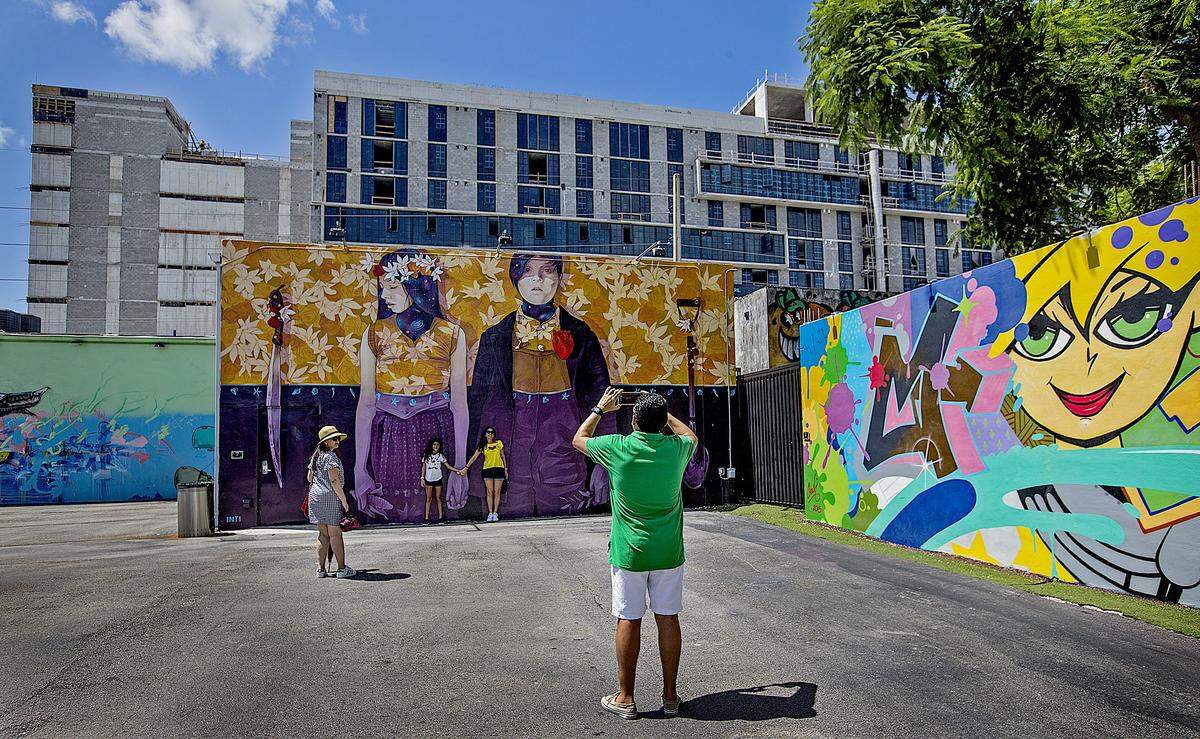
Does it want to be like Williamsburg in red-hot Brooklyn? The Mission District of San Francisco? Bourbon Street in New Orleans? Old Coconut Grove before the nut got sucked out of it? South Beach? Or does it want to be Miami’s permanent capital of cool?
Can the spirit of “Come one, come all, eat, drink, spray paint and be merry” be preserved as $1 billion in development of new residential buildings, offices and hotels goes up and artists and gallerists continue their exodus to less expensive neighborhoods?
As the G word (gentrification) rears its ugly head, can happening Wynwood evade homogenizing forces? Is it only a matter of time before Starbucks supplants Panther Coffee? Trendy by its very definition means fleeting.
The soul of Wynwood is at stake — if it hasn’t already been lost.
“We’re seeing collisions between living, working and playing,” said Steve Wernick, a lawyer based in Wynwood. “All these usages should complement each other but Wynwood is experiencing growing pains. We’re at a point where we should stop, reflect and figure out what our personality ought to be.”
The central conflict, percolating for three years and boiling over in the past two weeks, pits many residents, office tenants and brick-and-mortar small business owners against nightclubs, entertainment promoters, pop-up shops, partygoers and the outdoor Wynwood Marketplace, a collection of eateries operating out of cargo containers, food trucks, arts and crafts vendors, a tented stage and The Deck bar.
The Marketplace sits on a vast vacant lot owned by moving-and-storage tycoon Moishe Mana, largest private landowner in Wynwood and downtown Miami, and is the site of concerts and festivals frequently hosted by Swarm, Tony Albelo’s event production company.
The Wynwood Business Improvement District — a city board that represents business and property owners — has been fielding complaints about rampant violations of Miami’s noise law, abuse of temporary use and special event permits, low-balling of crowd estimates, and the city’s lack of enforcement. Enough is enough, the BID said at a Feb. 19 meeting attended by Mayor Francis Suarez, who assured everyone the city will do a better job.
Tension between BID and Mana erupted into threats and name-calling when code enforcement officers and police shut down Mana’s Marketplace on Feb. 15. It had been operating for three years with an expired temporary use permit (TUP). The city issued a new permit with 24 restrictions, and the Marketplace will remain closed until Mana and Swarm comply.
A temporary use permit “is a great mechanism to revitalize an area, and Wynwood was a black hole, but that was 15 years ago,” said Albert Garcia, BID chair and chief of Wynwood Ventures. His family’s Wynwood history dates back to the 1970s, when his parents owned the Mega Shoe factory. “Used to be you could not pay people to come here. High crime and the bad type of graffiti.”
Today, Wynwood is home to 400 businesses and 1,000 full-time residents and welcomes 4 million annual visitors, with foot traffic peaking during Art Basel, this year’s Super Bowl 54 and the upcoming Music Week. A wave of construction since 2018 added 400,000 square feet of office space.
“We want to make this a model for repurposing manufacturing warehouse districts. Art was the catalyst for that vision,” Garcia said. “Wynwood was never meant to be just party central or the Cancun of South Florida. It was intended to be a diverse, walkable, 24/7 community.
“Now we have one contrarian with major property interests undermining that vision. For a long time Mr. Mana has been treated differently at the expense of those who play by the rules.”
David Lombardi began buying warehouses in Wynwood in 2001, even before acclaimed Wynwood developer Tony Goldman. He had a hunch: The location was golden and artists wanted to work there. He built Wynwood Lofts in 2005 so artists could afford to live there, too. He sold his Wynwood Yard and O Cinema property on Northwest 29th Street to Lennar, which is building a 189-unit apartment building on the site. He’s not sure he likes Wynwood’s direction in 2020.
“It’s the classic tale we saw in South Beach and now it’s here,” Lombardi said. “We don’t have an attractive crowd anymore. It’s a rowdy and rough crowd buying cheap drinks, which is the path of least resistance for someone running a business.
“I blame the DJs and Swarm events on Mana’s land. He’s crying he can’t do the carnival on the corner. Simply move it inside, lower the decibels, add baffling. Everyone is entitled to their own clientele. Rich, poor, black, white — that’s how Wynwood started and that’s how it should continue. But you have to follow the law and be a good neighbor.”
Mana reacted to the Marketplace closure by telling BID’s executive director Manny Gonzalez he should be fired and the BID should be dismantled.
“U made your bed and u will have to deal with the consequences with everyone who was behind u,” Mana wrote in a text message to Gonzalez, who then filed for whistleblower protection.
Mana also allied with Albelo to create the Save Wynwood campaign, and Swarm began circulating a petition warning that Wynwood will be taken over by “billionaire developers” and become a place where “only the wealthy can exist.” The petition asserts that developers and city officials want to close the neighborhood by 11 p.m. every night.
“Their goal is to use the momentum of this trendy neighborhood to build large luxury residential buildings and make millions in profit,” the petition says. “As a result, they have taken aim at things that they think ‘cheapen’ the neighborhood, like public art, open marketplaces, events that are free and open to the public, cultural celebrations, and nightlife.
“They believe that money outweighs cultural authenticity and that only the wealthy should enjoy the thriving community that Wynwood has become. Their first step has been to take aim at the various nightlife establishments and event spaces that made Wynwood popular in the first place.”
The petition doesn’t mention that Mana is a billionaire developer whose original plans for the Marketplace — a massive 10-million-square-foot trade and tech mini city — are still on the drawing board. Mana helped remake New York’s Meatpacking District and created Jersey City’s sprawling contemporary art center.
Save Wynwood is holding a community meeting Tuesday afternoon at the Mana Convention Center. BID countered by scheduling a Tuesday morning meeting to “Set the Record Straight.”
“We want to make it very clear: the Wynwood BID has never ‘proposed’ closing nightlife venues, or any type of bonafide businesses in our neighborhood at 11 pm. To the contrary, we are opposed to an 11 p.m. closure,” the BID website says, adding that “Mr. Moishe Mana has launched a smear campaign rife with misinformation, exaggeration and personal threats in an apparent effort to intimidate city and police officials into ignoring the obvious violations on his property.”
Miami law prohibits outdoor music past 11 p.m. but allows music indoors until 3 a.m. Noise may not be “plainly audible at a distance of 100 feet” from the premises. Music is allowed in a closed building if it does not “disturb the quiet, comfort or repose of persons in any dwelling, hotel or other type of residence.”
Mana says that residential living and open-air partying cannot coexist in Wynwood. If too many residents move in, Wynwood will die, he wrote in a manifesto released last week, emphasizing that “the powerful” are trying to “stop the art, stop the music” and “drain the color” from “our cosmopolitan terrain and eclectic playground.”
Mana and Swarm plan to propose designating Wynwood as Miami’s Arts and Entertainment district governed by zoning tailored to allow nightlife and large events.
“An area becomes hip and trendy, people move in, hip and trendy annoys them, the night life leaves. It’s a cycle and Wynwood is next on the list,” said Albert Maloof Berdellans III, vice president of marketing for Swarm and executive director of Save Wynwood. “We’re going to end up in the Everglades if this keeps up. Instead, let’s centralize it and update the laws.
“People know what they’ve moving into; you don’t move into the Red Light District in Amsterdam and complain about what it is. We don’t want Wynwood to turn into a place where only the rich have access. Our events provide access to all classes and bring thousands of people into Wynwood.”
Jon Paul Perez, Related Group’s executive vice president, whose father Jorge’s company developed Wynwood 25, disagrees with Mana’s and Berdellans’ concept of Wynwood’s future.
“People who buy and sit there and hope for appreciation and don’t add anything to the neighborhood, I think that’s horrible,” Perez said at a Bisnow event last week. “I think that’s happening in Wynwood and parts of downtown. I also think there are certain tenants and events that take place that bring not the same crowd that is renting my apartments or working there.
“Everyone can play nicely in the sandbox,” he said, but “Wynwood is not really an entertainment zone.”
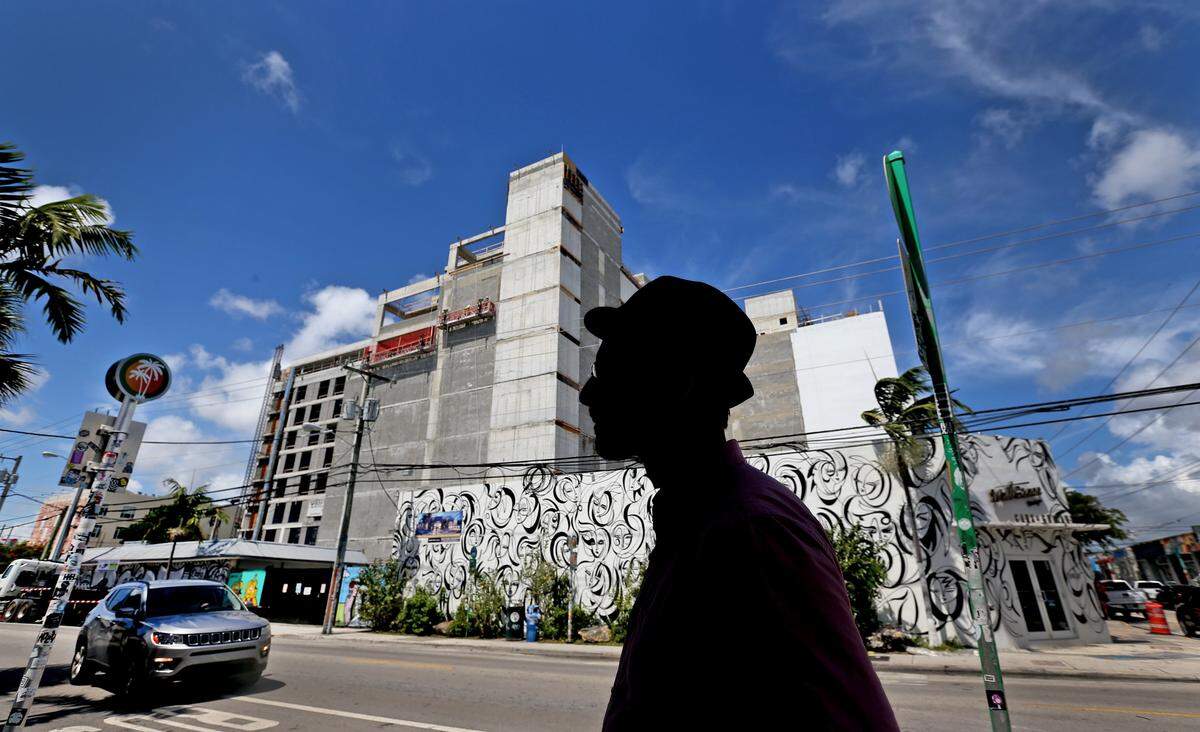
Michael Fogerty would argue that coexistence is not realistic. He moved into Wynwood 25 and lasted a year before he moved out last fall. For a working person, the noise from thumping music, screaming DJs, street fights and whooping patrons riding around on the Cycle Party — a mobile saloon — was unbearable.
“This area is 100 percent uninhabitable. Absolutely no one will pay to live in these new residential developments, no one,” Fogerty wrote in an email to the city. “Wynwood will continue its backslide and eventually decay into something even worse. The sonic night terror that has become Wynwood after 8 p.m. and until 3 a.m. occurs seven days per week.”
Tatiana Politi, business manager and resident at Wynwood 25, said music was so “extreme” on a recent weekend that she is buying white noise machines for several tenants. Politi shot a cellphone video from her window and complained about the usual suspects on Northwest 23rd and 24th streets — Centro, La Terraza, Shots, Proyecto Tulum and Maps Backlot — when she called the city’s code compliance hotline and the non-emergency police line at 1 a.m. and 1:40 a.m. and was told that due to the high volume of calls, her complaint would have to wait.
There’s no relief during the day, either, says David Haber, a lawyer who moved his firm to 251 NW 23rd St. in Wynwood to foster a progressive, Google-type office environment for his 25 employees. He upgraded a former sewing shop that became a gallery, and commissioned a mural by the artist known oas HOXXOH. purchased indoor and outdoor art. But he’s found it maddening to conduct phone conversations while “bombarded by noise” from outdoor restaurants and bars such as Le Chic and La Fanta Taqueria at Tulum.
“I was here before them, and I’m not trying to remove the edginess or cool element I came here for but you can’t have noise blaring 365 days,” he said. “What used to be a marginal area with a certain grunge factor is now also occupied by people who have invested a lot of money. There has to be give and take for those who are working or sleeping.”
Haber saw a similar clash play out in 1990s South Beach, when he represented Portofino Tower residents against noisy Opium nightclub.
“The reason it’s so loud is these places turn up the volume and use it as a magnet to attract customers,” he said. “In Miami Beach, we got the residents involved and created an ordinance that allows outdoor ambient music or you need a limited special event permit.”
There are fears of Wynwood being ruined, turning into another tacky Ocean Drive or clubless Coconut Grove. Gonzalez, formerly BID director in Coconut Grove, shares those fears.
“We are headed toward Coconut Grove II,” he said, referring to the fight over late-night music and alcohol sales that resulted in bars going out of business. “The city has been giving out special event permits like candy. It has to stop.”
Miami Police Commander Dan Kerr is often caught in the middle of Wynwood disputes. He exudes enthusiasm for the district’s liveliness and respect for Wynwood’s origins. He was there when it was a dangerous place and has overseen a dramatic reduction in crime.
“Six years ago I chased a drug dealer to Panther Coffee and tackled him. The Panther owner came outside. I thought he was out of his mind: ‘What are you doing opening a coffee shop here?’ Now I drink Panther coffee every day,” Kerr said.
“You know, everyone is right: The old school Puerto Rican abuelas say they built Wynwood. The garment guys say they built Wynwood. David Lombardi and Tony Goldman built Wynwood. The graffiti artists built Wynwood. Nobody is the sole decider of what Wynwood should be.”
Kerr acknowledges he is buffeted by pressure to give second chances to businesses that do not have proper permits or go easy on the loud ones. Miami Commissioner Joe Carollo echoed those concerns at a January meeting when he suggested chronic violations at certain businesses were overlooked because the mayor’s cousin works for Mana.
Kerr is determined to rein in the chaos.
“I don’t get influenced by politics and there’s a ton,” he said. “My officers and I will enforce the law equally. If Francis Suarez opened a food truck I would tell him to move. Legitimizing businesses helps; we don’t want rogue businesses. I believe we can fix the problems without destroying the neighborhood, but to say you were here first and buyer beware of the noise and crowds is not a valid argument. You have to get along. Everyone is entitled to peace and quiet.”
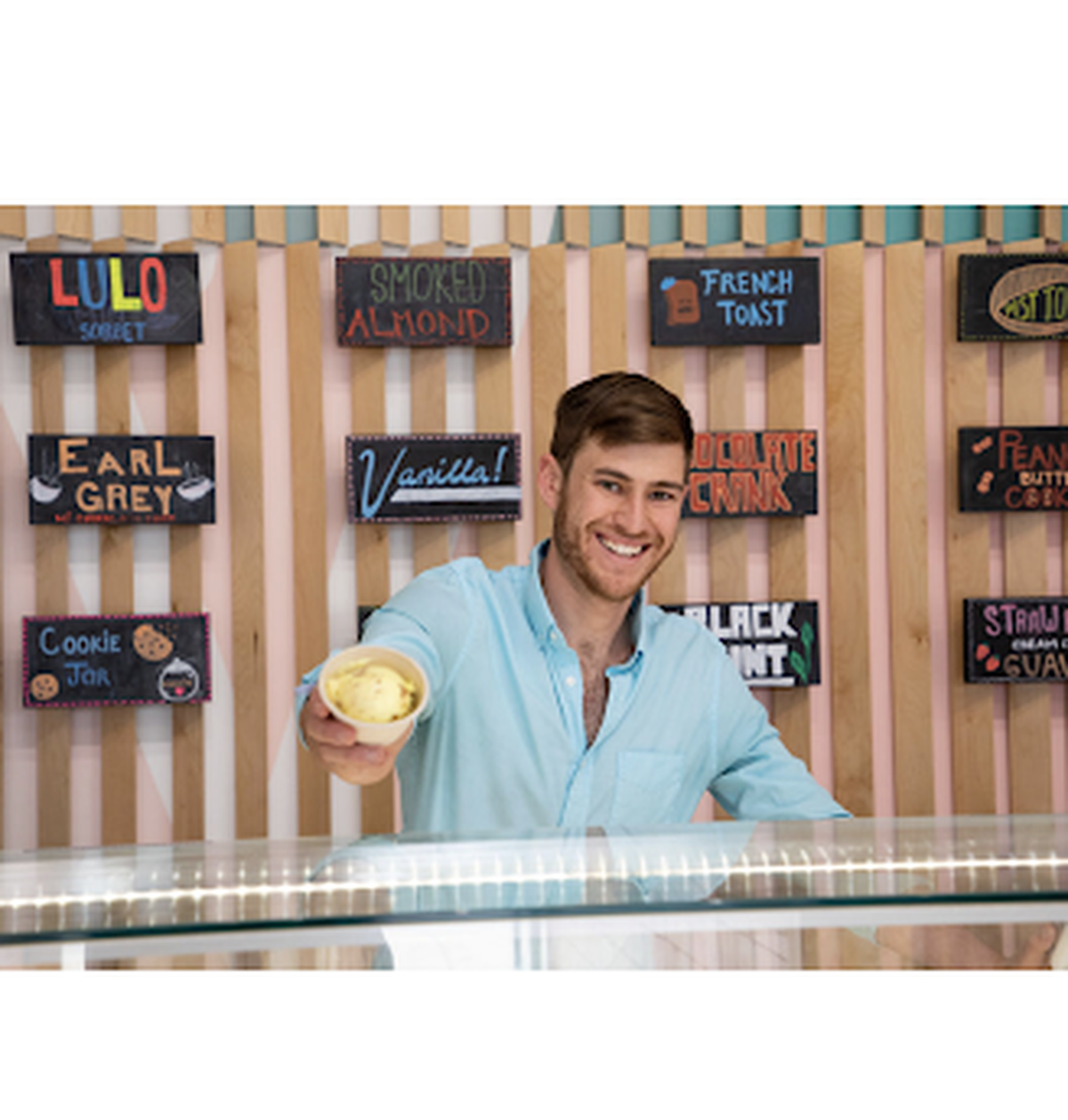
Dasher and Crank owner Daniel Levine won his ice cream war but it took months of calls to code enforcement for the city to order Angie’s Epicurean food truck to stop operating without a proper license a block from Levine’s shop on Northwest Second Avenue. He endured the city’s costly and lengthy permitting process to open his shop two years ago, and began selling cones infused with honey, babka and beer from a local beekeeper, baker and brewer.
“Every sale they made was a sale I could have made during this crucial high season. I’m paying rent, they’re not. I’m all right if I lose out to better ice cream, but to lose to someone who is cheating the system, that’s unfair competition,” Levine said.
He’s also weary of the disruptive throngs at Swarm’s events. “My customers don’t want to listen to ear-splitting regaetton. They’re holding four to eight parties per month and they advertise by saying ‘RSVP for this free event and you get a free shot of Fireball.’ Can Wynwood survive on that type of clientele?”
Lombardi says it is time “for us to get our house in order.”
“More people are moving in, and let’s not forget about the housing project that was here long before where school kids need to sleep,” he said. “Business owners have got to pivot. And the bad actors have got to be penalized.”
The BID has been following a plan to avoid the same gentrification mistakes that have consumed other communities, Garcia said.
“Hip neighborhoods end up flipping on themselves. In New York, Soho businesses are closing because it became too expensive,” he said. “We could easily fall into those traps of high rent, too many special events and allowing crowds of 5,000 when the application said 500.
“We incentivized developers to build affordable units. We created a trust fund for affordable housing and are starting our first workforce housing project. We are addressing sustainability and walkability with a streetscape plan. We pride ourselves on being a lab, a grand experiment. Let’s anticipate the issues that have bubbled up in Miami and other cities.”
When Sven Vogtland opened Coyo Taco six years ago, Wynwood was a hip, cozy place for locals. Since then, Vogtland has served his famous tacos to Barack Obama and opened live music spot 1-800-Lucky. He estimates he sank $500,000 into his businesses.
“Wynwood has grown into the most Instagrammed place in Miami with some of the most expensive commercial real estate in Florida,” Vogtland said. “There was a beauty to it before but it still has its own heartbeat. We’re at risk of losing that if everyone doesn’t play on an even field.”
He advocates less of a crackdown and more of a compromise between old and new.
“We’re feeling the changes hard, but we worked to build this creative community and we can figure out how to preserve it,” he said. “Love your neighbor. That is the essence of Wynwood.”
This story was originally published March 2, 2020 at 6:30 AM.