
Miami Gardens is hosting another Super Bowl, but what’s in it for the city?
Last Saturday, a mile down the road from Hard Rock Stadium, Miami Gardens Mayor Oliver Gilbert spoke to residents at a ribbon-cutting for SuperFest, a week-long event that will culminate this weekend with performances by A-list stars like Cardi B and Migos.
The festival marks a new chapter for the city, Gilbert said. For too long, “a game that’s played less than a mile from here did not include activities for this community.”
“It’s not [just] a carnival or a concert,” he said. “It’s the idea that we won’t be voyeurs of the Super Bowl experience. We will be participants in the Super Bowl experience.”
But unlike events in downtown Miami and Miami Beach this week — like Super Bowl Live in Bayfront Park and the Super Bowl Experience at the Miami Beach Convention Center — SuperFest isn’t being organized or partially paid for by the National Football League.
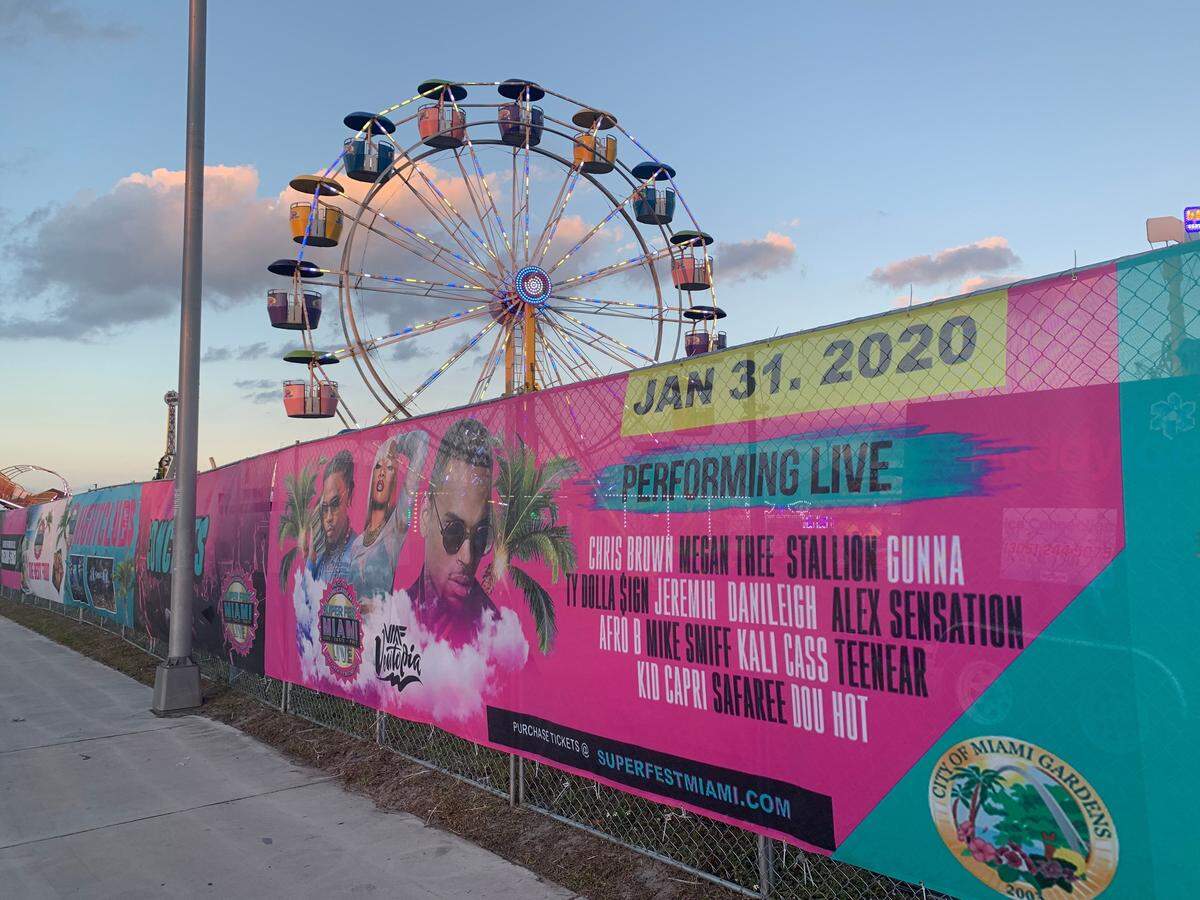
Instead, record producer Ted Lucas and former University of Miami football star Melvin Bratton, both Miami natives, have spearheaded the effort, and Miami Gardens is covering some of the costs. In November, city officials agreed to pay $100,000 to sponsor the event and put another $150,000 toward permit fees, police and code enforcement services.
“We’re supportive of their efforts,” Gilbert told the Miami Herald. “If for nothing else, we want our community to have something to do.”

Sunday will mark the third time that Miami Gardens, a majority African-American suburb of 113,000 people, has played host to the Super Bowl since the city incorporated in 2003.
A lot has changed since the last time the game was played at Hard Rock Stadium a decade ago. The city has welcomed popular restaurants like Lorna’s and The Licking along the 27th Avenue corridor opposite the stadium. The first high-end golf and entertainment facility in South Florida, TopGolf, opened its doors in Miami Gardens.
“There are more things to do here than the last time,” Gilbert said.
But Miami Gardens still seems to be something of an afterthought for the NFL and the Host Committee that organizes Super Bowl festivities.
The Host Committee’s list of “legacy projects” for 2020 includes a new athletic field at Miami Beach Senior High School, the alma mater of Miami Dolphins owner Stephen Ross; the renovation of turf football fields at Gwen Cherry Park and Goulds Park in Miami; and lighting along the downtown Baywalk pedestrian pathway.
The NFL is helping cover the costs. For the two turf fields, the league will donate about $850,000 while county taxpayers are expected to cover about $2 million.
No such project is planned in Miami Gardens. Tamara Wadley, a spokeswoman for the city, told the Herald there are no financial commitments between the city and the NFL.
“The city is not paying for any events/services,” Wadley said in an email. “The NFL is not offering any benefits to the city. No money is being exchanged between Miami Gardens and the NFL.”
On the one hand, that may be a mixed blessing. Super Bowl events bring traffic and inconvenience for residents, not to mention costs to taxpayers. Miami-Dade County, Miami and Miami Beach are contributing millions of dollars in payments to the Super Bowl Host Committee, public safety services and fee waivers.
Miami Gardens will pay for its own beefed-up police details on Super Bowl Sunday, with extra officers on bicycles, in cars and undercover.
But Gilbert said he was hoping his city would land one of the NFL’s legacy projects or host more NFL-sponsored events this week. He said Super Bowl organizers have developed formulas for how to pull off the event in the Miami region, which is hosting the game for a league-record 11th time, and Miami Gardens is not yet a central part of the equation.
“As we change, I think that interaction has to change,” he said. “We would hope that the next time the Super Bowl is in town, we’re going to have a whole bunch of Super Bowl stuff here.”
Asked about the NFL’s relationship with the city and the lack of legacy projects, Brian McCarthy, the league’s vice president of communications, said the NFL consults with the Host Committee on event locations and programming.
He noted that the NFL recently held two relatively modest events in Miami Gardens: On Monday, the NFL and UNICEF helped refurbish a vegetable garden at Robert Renick Education Center and gave the school a $1,000 grant, and on Tuesday, the NFL hosted a panel on healthy relationships for middle school students at St. Thomas University.
A representative of the Host Committee did not respond to a request for comment.
The Super Bowl’s arrival in Miami Gardens overlaps with a period of public strife between the city’s political leadership and Hard Rock over an attempt by Ross to bring Formula One racing to the stadium grounds.
At a Jan. 15 town hall at Miami Carol City Senior High, residents lobbed complaints about noise, pollution and congestion from the proposed annual Grand Prix, but they also linked their F1 complaints to gripes about life around the stadium.
“At the last [Dolphins] game, I had to leave my car at a neighbor’s house and walk home” because of traffic issues on her street, said Karen Hunter Jackson, a Miami Gardens resident. “You talk about being inconvenienced.”
Gilbert has come out against the Formula One plans, as has Barbara Jordan, the county commissioner representing the city. Jordan, normally a loyal ally of the Dolphins, portrayed Hard Rock as getting too big for Miami Gardens.
“I have a theory that Mr. Ross is building what I feel is a full attraction center. Period. We have the Dolphins. We have the University of Miami. We have a training facility,” she said. “There’s a time when we have to say no.”
A group of Miami Gardens residents is planning to protest the auto racing proposal outside the stadium before the Super Bowl on Sunday.
The relationship between the city and the stadium is a delicate one. Hard Rock is the city’s biggest property taxpayer by a long shot, paying about $1.4 million last year and representing more than 15% of Miami Gardens’ total assessed property value.
A massive renovation of the stadium starting in 2015, coupled with efforts to encourage development like the creation of an “entertainment overlay district” near City Hall that same year, have helped attract new businesses to the city.
The NFL may not be catching on, but the mayor seems determined to change that.
“We want you to come back,” Gilbert said Monday at a Host Committee press conference. “As a matter of fact, you don’t have to go to those other cities. There doesn’t have to be a rotation. .... We love inviting you to our home.”
Miami Herald staff writer Douglas Hanks contributed to this report.
This story was originally published January 29, 2020 at 6:15 AM.