Miami Beach’s Holocaust Memorial expands, offering new way to talk to survivors
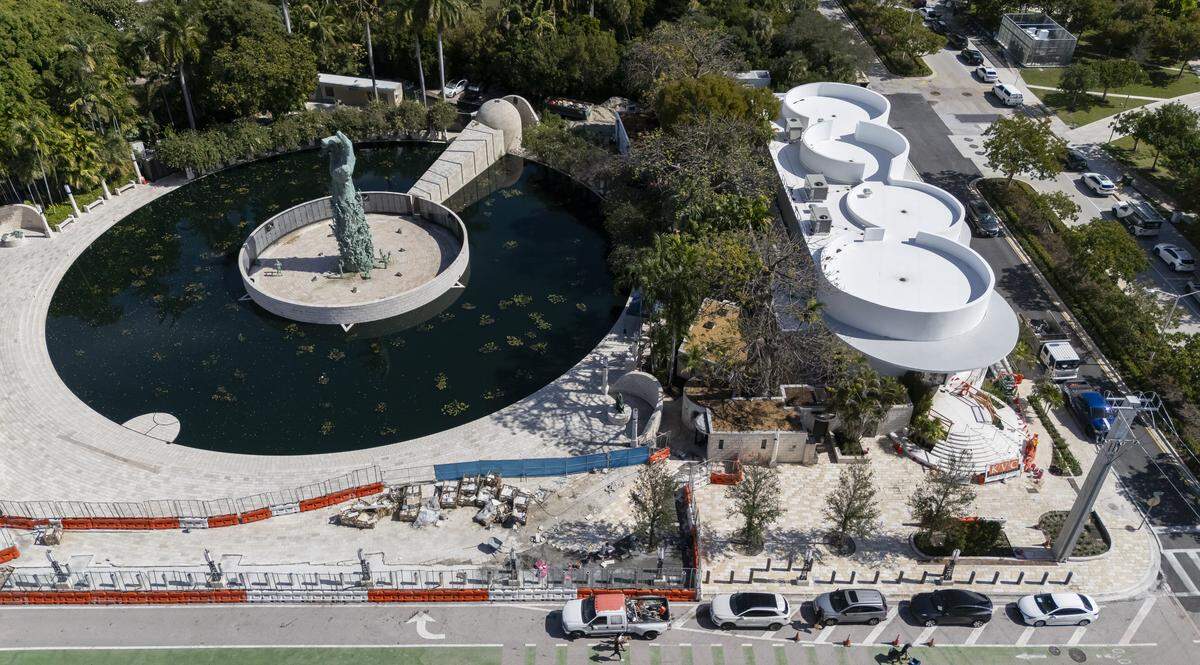
Most Miami Beach residents and visitors have likely seen the giant bronze sculpture of an outstretched arm reaching to the sky as hundreds of small human figures cling to it and each other with expressions of agony.
Since the Holocaust Memorial opened in 1990, that striking sculpture has been the center of the site, acting as a formal place of remembrance for the six million Jews and millions of others murdered by the Nazis.
Over the weekend, the Holocaust Memorial Miami Beach opened its newest addition, an Education Center that will include interactive exhibits and new technology to expand the way visitors can learn about the history of Holocaust and interact with survivors for years to come.
Sunday’s ribbon-cutting ceremony drew a crowd of the memorial’s founders, local elected officials and survivors whose stories are included in the new exhibit.
.jpg "Carlos Chattah 0869 (2).jpg")
The new center includes two theaters designed for virtual reality programming and a walkthrough exhibit with 11 informative panels tracing the history of the Holocaust — including historic family photographs — and two digital panels on the recent uptick in worldwide antisemitism.
READ MORE: Miami Beach Holocaust Memorial debuts new technology to keep survivor memories alive
At the heart of the Education Center, which is a separate building next to the outdoor memorial, is a program called “Dimensions in Testimony,” which offers visitors real-time simulated conversations with Holocaust survivors, even long after they’ve died. A face-to-face interaction with a Holocaust survivor is the single most impactful part of someone’s visit to the memorial, according to the memorial’s leadership.
The technology-driven exhibit allows people to have a one-on-one conversation with a virtual version of a survivor, based on hundreds of hours of interviews with the real survivor. The immersive installation is meant to look and feel like “you’re sitting with a survivor and you’re hearing their story,” said Matan Ben-Aviv, chair of the memorial.
As holocaust survivors get older and die, educators around the world are concerned about younger generations having little access to survivor testimonies. There are about 196,600 Jewish Holocaust survivors globally, according to the Conference on Jewish Material Claims Against Germany (Claims Conference).
“We don’t have many left,” Ben-Aviv said. “So this will help preserve that interaction and allow people to hear from survivors, ask some questions, and really get a personal experience in perpetuity.”
Survivor meets his virtual self
Days before the public opening, survivor Jack Waksal sat in the front row of one of the center’s new theaters, talking with a life-sized version of himself.
To complete the installation, Waksal, who is 101, was interviewed for five days, answering over 1,500 questions about his life —what his life was like before the war, how he narrowly escaped death six times, his time in four different concentration camps, and how he rebuilt his life after the war.
Visitors ask the video questions and the virtual survivor responds with answers that draw from the hours of interviews. People can start with a simple question like “What was your childhood like?” or “Were you in a concentration camp?” The education center also provides a list of suggested questions for each survivor to help get the conversation rolling.
After learning about Jack’s experience in the concentration camps, in which he mentioned a time he and others tried to escape, the Miami Herald then asked him a follow-up question.
“Jack, tell me about your escape from the camps into the forest?” a reporter asked the virtual Jack. A few seconds later, the video responded.
“I cut the wires from the top to the bottom and I took the people out,” the virtual Jack said. “There were 16 people and somebody got shot right away. After the railroad, they start shooting on us. We start running into the forest.”
Waksal, who was 15 when he was forced into the ghettos, is the only survivor left from his immediate family. His parents, siblings and extended family all perished in the Holocaust. He immigrated to the United States in 1950, settling in Dayton, Ohio, where he rebuilt his life and married his beloved Sabina — an Auschwitz survivor from his hometown in Jedlińsk, Poland.
Today Waksal lives independently in Bal Harbour and is passionate about sharing his story — no matter how difficult it may be to relive the horrors.
“We have to show the world that it happened, because a lot of countries in the world say it never happened, and it did happen,” Waskal told the Herald. “That’s what I wanted, that the world should see my story.”
The Education Center is free and now open to the public. Groups of 10 or more or classes can book a reservation.
This story was produced with financial support from Trish and Dan Bell and donors in South Florida’s Jewish and Muslim communities, including Khalid and Diana Mirza and the Mohsin and Fauzia Jaffer Foundation, in partnership with Journalism Funding Partners. The Miami Herald maintains full editorial control of this work.