How will Miami Beach runoff affect development, 2 a.m. last call? Candidates seek an edge
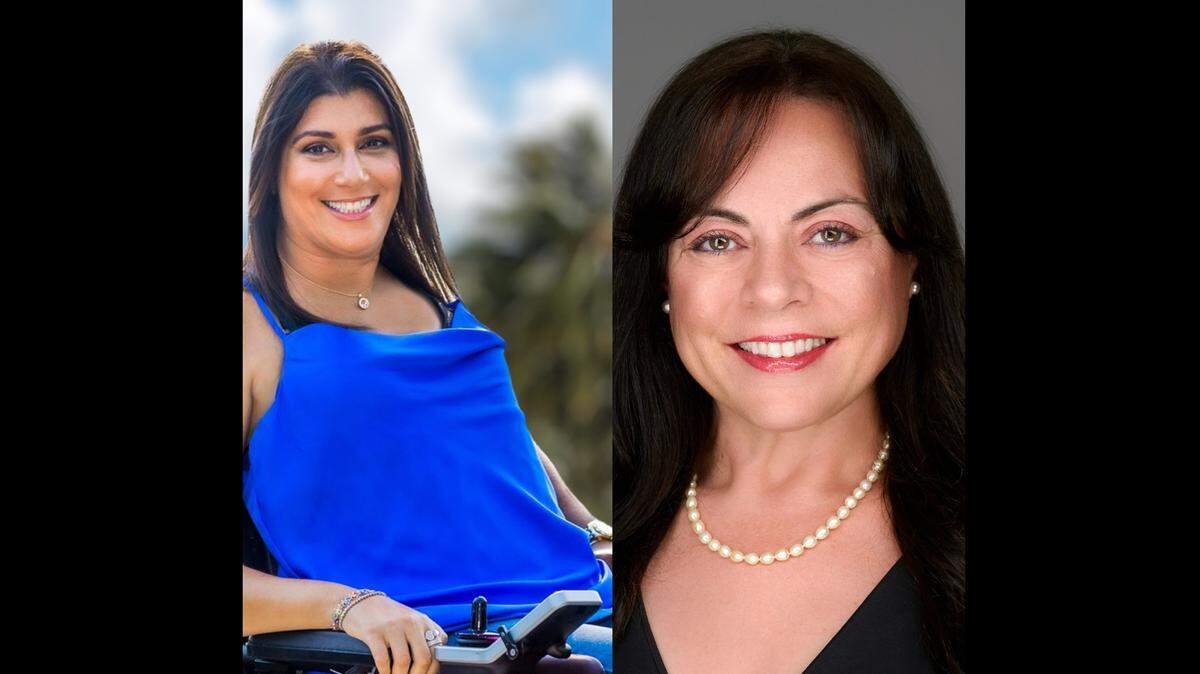
In a Dec. 6 runoff to replace the late Mark Samuelian on the Miami Beach City Commission, Laura Dominguez and Sabrina Cohen are looking to differentiate themselves on issues that could shape the city’s future.
Dominguez, who was Samuelian’s life partner and finished first in a Nov. 8 first-round election with 41% of votes, is emphasizing her opposition to controversial ballot questions on the redevelopment of the former Deauville Beach Resort site and city-owned parking lots near Lincoln Road.
Cohen supported the items, which voters rejected even after developers spent millions of dollars touting their benefits.
“I was clear: Enough is enough on rushing through development,” Dominguez said in an interview. “I’m certainly not opposed to development. But all of those ballot measures were rushed through, the residents didn’t really have community input, the community benefits weren’t clear.”
One of the failed ballot questions would have allowed Miami Dolphins owner and billionaire developer Stephen Ross to build a larger hotel tower and condo at the former Deauville site by providing the developer increased floor-area ratio for its design. Another series of questions asked voters to approve 99-year land leases to let developers build office space near Lincoln Road on multiple properties.
Cohen, a disability-rights advocate who received 31% of votes in the five-person primary, said the results suggest residents “were just overwhelmed with the thought of too much happening too quickly.”
Despite her support for the referendums, Cohen said she would seek a “happy medium” if she’s elected and consider backing away from certain development projects that residents aren’t ready to embrace.
“I think we just need a better balance,” she said. “I want to see more unity and harmony with these big decisions.”
The two candidates moved to a runoff because neither received more than 50% of votes. The winner will serve until November 2025, when Samuelian’s term would have ended. Samuelian died in June of an illness at 58 years old.
READ MORE: Five candidates compete for open seat on Miami Beach Commission in Nov. 8 election
What does it mean for last call?
While Dominguez points to the ballot questions, Cohen’s campaign is emphasizing differences with Dominguez on the issue of moving last call for alcohol sales on Ocean Drive from 5 a.m. to 2 a.m. — a hot-button topic in Miami Beach for years and one the City Commission is expected to take up soon after the Dec. 6 election.
Cohen says she supports a 2 a.m. last call on Ocean Drive, something Mayor Dan Gelber — who is endorsing Cohen — and other officials have sought as part of their efforts to change the area’s reputation as a late-night party destination.
Dominguez has said she supports a 2 a.m. alcohol cutoff in residential neighborhoods, but doesn’t support the same “blanket” change in other parts of the city.
She declined to say specifically how she would handle last call on Ocean Drive and other nightlife hot spots, saying she would first need to consult the city attorney on the legalities. But she noted there are many “good operators” in the city that have been in business for decades.
“I’m very sensitive to not hurting our businesses,” Dominguez said.
Last year, a Miami-Dade Circuit Court judge struck down the city’s attempt to impose a 2 a.m. last call at dozens of clubs in South Beach, saying the city’s vote to approve it wasn’t properly executed.
Later in 2021, a majority of voters supported a non-binding referendum on a 2 a.m. last call that envisioned the possibility of exceptions. Gelber said he would be open to letting large hotels with their own security and indoor queuing serve booze until 5 a.m., but debate on the issue centered on the fate of Ocean Drive.
The owners of Mango’s Tropical Cafe and the Clevelander hotel, two longstanding Ocean Drive party spots, bankrolled a campaign against the ballot question.
Still, action by the City Commission has been stalled since the judge’s ruling last year, which held that the city’s 2 a.m. proposal was improperly presented as an ordinance requiring a simple-majority vote when it should have been a land-development regulation requiring five-sevenths support.
That means the results of the runoff could potentially determine whether the commission has the five votes necessary to move forward with 2 a.m. last call in some form.
The commission approved multiple conflicting proposals on first reading in April, vowing to seek consensus on the matter at a later date. The options included a blanket 2 a.m. last call supported by Samuelian; a proposal to “grandfather” in businesses with existing 5 a.m. licenses proposed by Commissioner Kristen Rosen Gonzalez; and a system with exceptions for large hotels proposed by Gelber.
“I think residents have a right to have their vote vindicated,” Gelber told the Miami Herald this week, referring to the November 2021 referendum. “It’s unfortunate that Laura and Sabrina disagree on this issue.”
Dominguez’s campaign held an event at Mango’s last weekend, fueling speculation that the venue’s influential owners may be supporting her. Dominguez said her campaign paid for the event, and Joshua Wallack, the chief operating officer of Mango’s, said he and his father, David, aren’t endorsing in the race.
Entities connected to the venue have donated to both candidates.
“It really doesn’t matter who becomes the commissioner here. They have to follow the law,” Joshua Wallack said.
Dominguez said the Cohen campaign’s focus on last call is an attempt at “deflection” from the fact that Cohen supported high-profile ballot measures that failed.
Political divides
Dominguez and Cohen have plenty in common, too. Both have emphasized public safety and increased police presence as priorities and say they agree with Gelber’s goal of tamping down the city’s party atmosphere.
Dominguez is a registered Democrat, while Cohen is a former Democrat who now has no party affiliation, a switch she said she made in part because of the non-partisan nature of her disability-rights nonprofit, the Sabrina Cohen Foundation. Miami Beach City Commission seats are non-partisan.
But the two candidates have fallen on opposing sides of some of Miami Beach’s most heated political rivalries. While Cohen has the backing of Gelber and Commissioners Ricky Arriola and David Richardson, Dominguez is endorsed by Rosen Gonzalez — who spearheaded campaigns against the Deauville and Lincoln Road ballot questions — and Commissioner Alex Fernandez.
Cohen, a Realtor, runs a nonprofit that has partnered with the city and local leaders to improve accessibility in Miami Beach and is looking to build a recreation facility for people with mobility challenges. She suffered a severe spinal cord injury in a car accident at 14 years old.
Dominguez, a digital marketing professional who had served as Samuelian’s campaign manager and treasurer, has raised questions about whether Cohen’s role with the nonprofit poses a conflict of interest, given that it has received support from local developers. Cohen has said she will follow the city attorney’s direction if she is elected, “including recusals from any official actions or divestments of any interests, if warranted.”
“People like to say I’m in the pockets of the developers. That, to me, is nonsense,” Cohen said in an interview. “It’s my moral compass that leads me, nothing else.”
Low voter turnout is expected in an election that features no early voting and only one race on the ballot. Voters can submit their ballots by mail or vote in person at their regular precincts on election day.
This story was originally published November 25, 2022 at 11:27 AM.