‘We have ruled out nothing’: In Surfside condo collapse probe, findings still far away
A federal investigation into the Champlain Towers South building collapse likely won’t conclude until 2024, about three years after the Surfside disaster in which investigators say they have “ruled out nothing.”
But the process could take even longer, said Judith Mitrani-Reiser, an engineer who grew up in Miami and is overseeing the investigation by the National Institute of Standards and Technology (NIST).
“To get this right requires a comprehensive approach and a commitment to investigating every failure hypothesis thoroughly,” Mitrani-Reiser said.

A timeline of the probe released at a public meeting Thursday said a draft report could be published during the 2024 federal fiscal year, which runs from October 2023 to September 2024. A final report on the June 2021 condo collapse may come out around the end of that period.
The timeline is typical for the Department of Commerce agency with a mission that includes investigating a select few major building failures. Past NIST investigations — the first of which examined the fall of the Twin Towers after the 9/11 attacks — have taken between two-and-a-half and six years.
“Many will be frustrated by the length of time needed to conduct a thorough investigation,” Jennifer Huergo, an agency spokesperson, said during Thursday’s virtual meeting.
It was NIST’s second periodic update to the National Construction Safety Team Advisory Committee, which offers guidance on the agency’s investigations of catastrophic building failures. After the first update in November, a family member of Surfside victims told the Miami Herald he was frustrated with the lack of information that was released.
Huergo said investigators met with survivors and victims’ families in early April to update them on the process and answer questions. But the agency typically doesn’t share preliminary findings of its investigations before releasing a draft report.
Investigators said they are still exploring “numerous active hypotheses” and “have ruled out nothing at this time.”
Two weeks before the one-year anniversary of the shocking collapse that killed 98 people, the meeting offered the most detailed look yet at a sweeping probe in which dozens of experts are using advanced testing and computer modeling techniques to determine why Champlain Towers South fell on June 24.
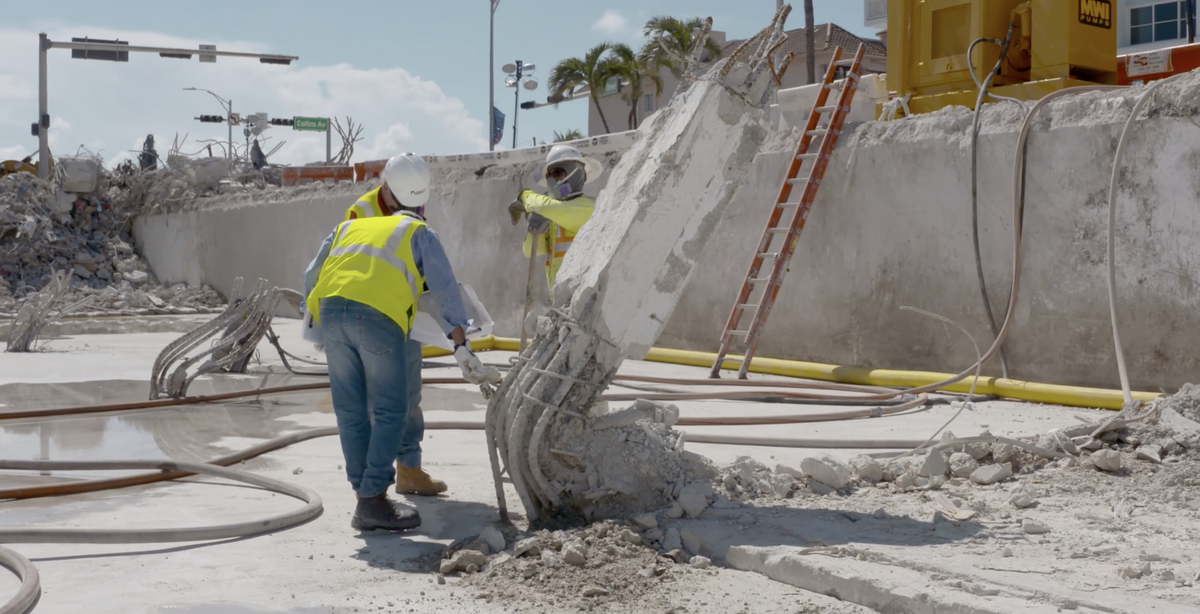
Non-destructive testing of materials from the collapse site is well underway at a warehouse in Miami-Dade County, investigators said, and they are preparing to start more invasive testing on concrete and steel this summer. The results will help NIST build and test full-scale replicas of key connections between structural elements at Champlain South to better understand its condition, including at the pool deck that collapsed minutes before half of the building crumbled.
Glenn Bell, one of the lead investigators, said that unlike with some other building failures, the cause of the Champlain collapse wasn’t immediately obvious.
“Even after almost a year, there is no clear initiating event,” he said. “There were likely several contributing factors to the collapse.”
That may sound “daunting,” Bell added, “but we have an exceptionally talented investigative team and a detailed plan to get to the bottom of it.”
The wide-ranging investigation has included examining the building’s original design, interviewing survivors who lived there, and reviewing photographs and time-lapse footage from the collapse site. Bell said the agency is working to enhance and analyze the only known video showing the 12-story condo tower pancaking to the ground, taken from a security camera at neighboring Eighty Seven Park.
Investigators also said they are analyzing a critical connection between the Champlain Towers South pool deck and the building’s southern perimeter wall. A Miami Herald investigation and computer model built in partnership with University of Washington engineering professor Dawn Lehman found that the connection may have played a critical role in the failure of the pool deck progressing into the tower itself.
“This connection plays a role in some of our failure hypotheses,” Bell said.
Lawsuit complicates process
Mitrani-Reiser said the process of testing materials was “complicated” earlier this year by civil litigation in which experts hired by the parties were granted access to the NIST warehouse to conduct testing of their own. The agency, along with Miami-Dade police, oversaw hundreds of visits to the warehouse in February and March.
But after a nearly $1 billion settlement was reached in the case last month, federal officials should have a clear path to start intensive concrete and steel testing that will continue through the end of the year, Mitrani-Reiser said.
Investigators acknowledged Thursday that there is uncertainty in their work, even as they try to provide answers to grieving family members and South Florida residents desperate to know if their homes are safe.
NIST engineer James Harris said it’s not clear, for example, exactly how much weight was added to the pool deck slab over time. A Herald review of permit records found that pavers and sand were layered on top of the original pool deck tiles, adding weight to an already overburdened deck, but messy record-keeping by the town of Surfside and the building’s 40-year history have made some details difficult to find.
Harris said his team has been seeking out contractors who worked on the deck for interviews. He said he’s also been reaching out to people who knew the building’s original engineer, Sergio Breiterman, who died in 1990, to learn more about how Champlain South was designed and constructed.
The agency’s final report will seek to explain why the building collapsed and recommend changes to building codes and standards that could have national implications — “so that a disaster like this never happens again,” Mitrani-Reiser said.
This article has been corrected to clarify the findings of the Miami Herald’s computer modeling, which determined that the connection between the pool deck and southern perimeter wall likely played a significant role in the collapse progressing from the pool deck to the residential tower.
This story was originally published June 9, 2022 at 6:47 PM.