
Grand Hyatt is coming to South Beach. ‘Sky Bridge’ will connect to convention center.
There is only one Grand Hyatt hotel in Florida. The second one is planned for South Beach — and it comes with a “sky bridge.”
The 800-room luxury hotel planned for city-owned land near the newly renovated Miami Beach Convention Center will be managed by the Chicago-based company, Miami Beach Mayor Dan Gelber announced during his State of the City speech Monday.
The new convention center hotel will join the Grand Hyatt Tampa Bay as the company’s only properties in Florida, and the 13th in the United States, according to information from Grand Hyatt’s website. The brand also has a hotel in the Bahamas.
Monday’s news is the latest development in the nearly four-year process of bringing a hotel to the city’s convention center, which promoters say will make it more competitive in bringing high-spending conventioneers to South Beach.
“The reason it was so vital was to give our beautiful new convention center the best opportunity to attract higher-tier conventions — whose guests tend to stay overnight, not drive cars, and who spend generously in our city,” Gelber said during his speech. “So it was with great joy that I was advised yesterday that the hotelier that will be operating our new convention center hotel will be a company known for its best-in-class quality, its diversity and its inclusion, and its support for arts and culture.”
The convention center’s renovation has spurred renewal in the surrounding area of Collins Park. But lodgings there are generally small, and having a headquarter hotel that connects to the convention center has long been a goal of city lawmakers and developers who say it is essential to compete with other cities for meetings business. The Greater Miami Convention and Visitors Bureau estimates that the hotel-less convention center lost at least $130 million in bookings since 2015.
“The Miami Beach Convention Center’s renovation and now connected headquarter hotel greatly increases the appeal of Miami as a convention destination and has allowed us to consider Miami as a host city, where we otherwise may not have been able to make it work with the existing hotel package,” Carly Bushong, director of meetings and events at the Urban Land Institute, said in a statement.
In 2018, after two previous efforts failed, Miami Beach voters approved a plan to build a convention center hotel. The city needed 60% approval to lease public land in the convention center district.
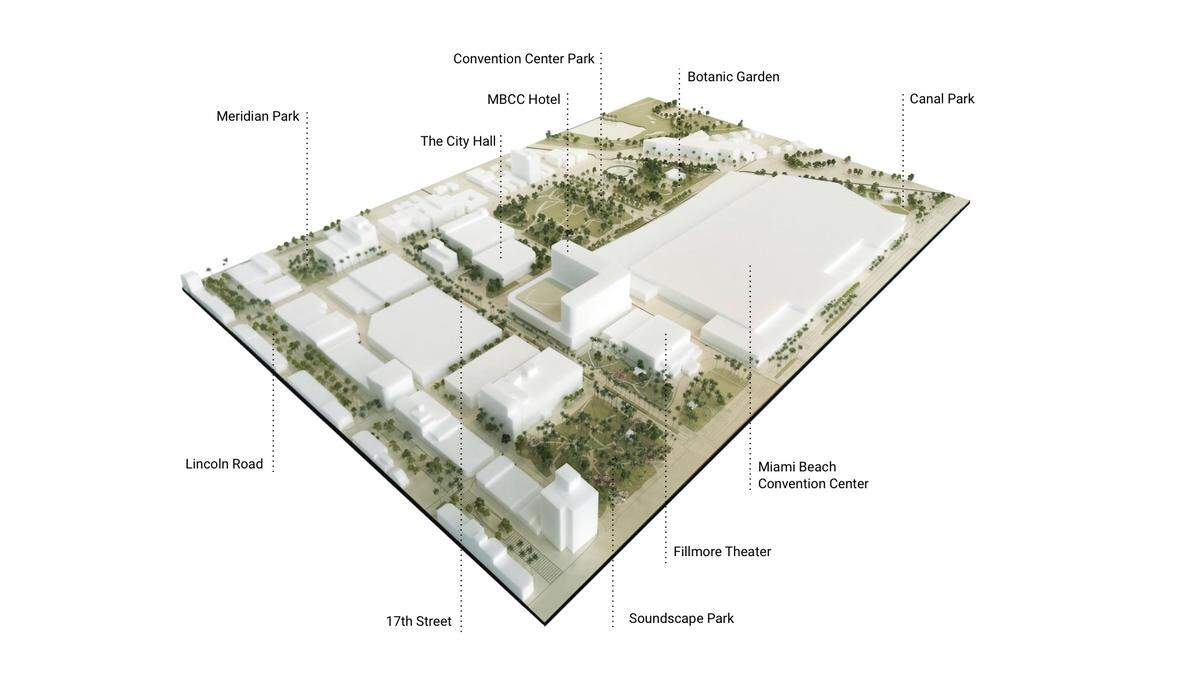
The 2.6-acre project received approval in July 2019 from the city’s Design Review Board, but construction cannot begin until developers demolish the structures standing in the way of the new headquarter hotel: portions of the rear of the Fillmore Miami Beach, a one-story office building and a surface parking lot at the corner of Convention Center Drive and 17th Street.
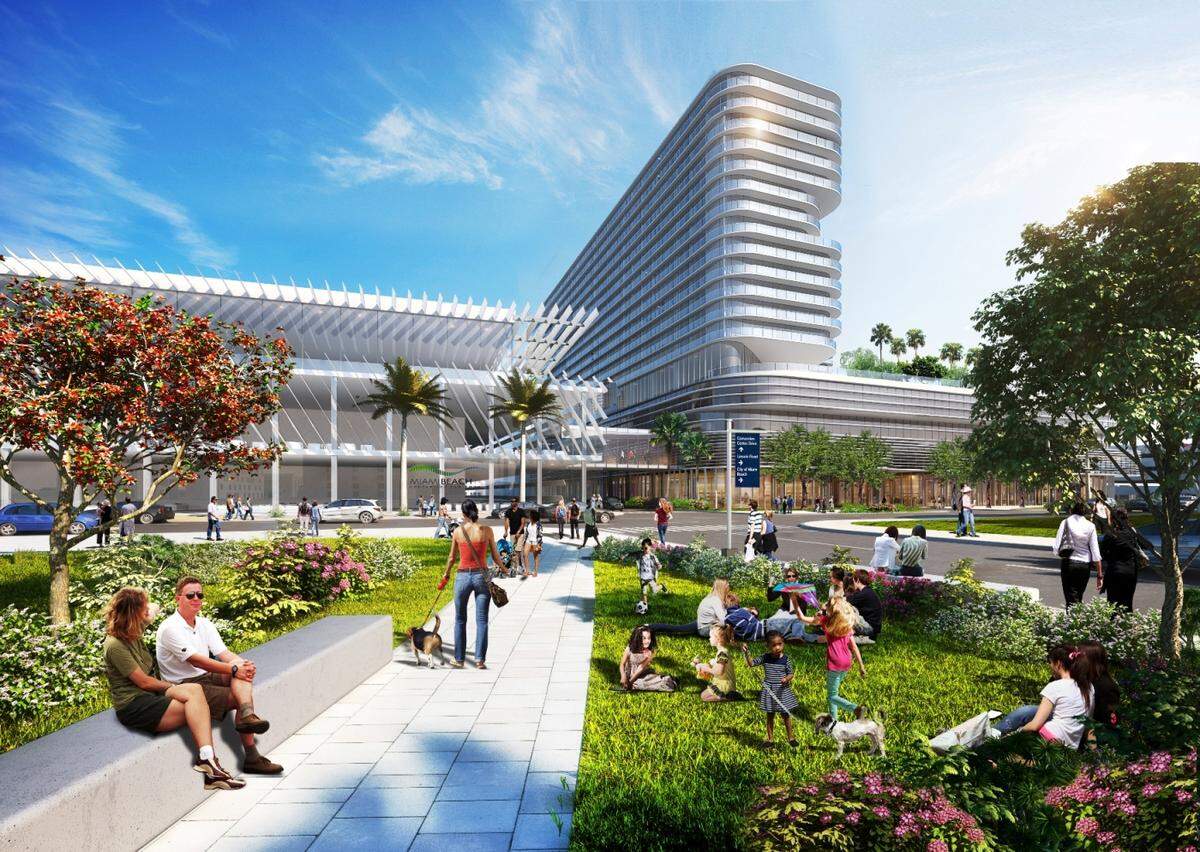
After the 555 17th St. project receives a building permit, city leaders expect construction to take about three years. It will be 185 feet tall, include ground-level retail and restaurant space, and come with 320 parking spaces on site. It will feature an elevated walkway, or “Sky Bridge,” connecting the 17-story hotel to the convention center.
Private funding will cover an estimated $400 million price tag, up from the previously announced $362 million figure, the development team said Monday.
Clocking in at 800 rooms, the 17-story hotel will be the second largest in Miami Beach, behind only the Fontainebleau. The hotel will have 12 floors of hotel rooms, including 50 suites and two presidential suites, two floors of meeting space, a pool deck and retail space at the street level.
The development team includes Terra Group President David Martin, Turnberry Chairman and CEO Jackie Soffer and Miami Design District developer Craig Robins, who is married to Soffer. Miami-based Arquitectonica, led by Bernardo Fort-Brescia, is the architecture firm.
Soffer, Martin and Robins are Miami Beach residents, which should give residents confidence in their commitment to the city, Gelber said.
Hyatt Hotels Corp. beat out Hilton and Marriott for the project, which were both in talks with the developers last year.
“It was a rigorous process,” Martin said. “We wanted a company with a strong commitment to the city that wanted representation in Miami Beach, had experience and financial wherewithal to be a sustainable operation here.”
Martin told the Miami Herald that construction will begin in 2021 and that the hotel will be finished by 2023.
“Site activity will begin in the coming months,” Martin said.
For the Grand Hyatt brand, the entrance into the Miami Beach market is decades in the making. The company first competed 26 years ago for the hotel that is now the Loew’s, and has been trying to get into the market ever since, said David Tarr, Hyatt Hotels Corp.’s senior vice president of real estate and development for the Americas.
“We pick our spots with intent, with care,” Tarr said. “Public-private partnerships like this are something we embrace. We work very well with convention centers.”
William Talbert III, president of the Greater Miami tourism bureau, said the Grand Hyatt announcement has already spurred interest from convention meeting planners.
“They have had two questions for us: what and when?” he said. “Now we have the what and the when.”
Holocaust Memorial
Among the city officials, employees and residents in attendance at the New World Center on Monday, Gelber singled out three: Holocaust survivors Lazlo Selly, David Mermelstein and Fred Mulbauer.
Thirty years after the city’s Holocaust Memorial Miami Beach was dedicated, Gelber said he feels duty-bound to expand the memorial “in size and mission” after he was approached by Norman Braman and Ezra Katz, local businessmen and founding members of the memorial.
“Recently the Braman and Katz families and others reached out to discuss a plan to expand the memorial in size and mission so it can have a more active and relevant presence in a world where hate, clearly, still exists,” Gelber said. “A modest expansion would give it the bandwidth to take a greater role in education and outreach to the entire community, combating hatred of all kinds — giving it a vitality at a time when all communities must speak out against hate.”
Parks and other projects
The convention center hotel is not the only 2018 ballot item Gelber mentioned during his annual speech. He updated residents on the $439 in general obligation bonds they authorized to fund public safety, infrastructure and parks projects.
The bond program will pay for 57 projects. Within 18 months of its passage, Gelber said, the city has begun 32 projects and completed three.
“When residents approved the general obligation bonds with 70% support, you did so with the promise that the city would deliver these quality of life enhancements in a timely and transparent manner,” he said. “We take that promise seriously.”
The bond program is helping fund the city’s green-space “renaissance,” Gelber said, with the city on its way to adding more than 30 acres of new park space around the city and upgrading 20 existing parks.
A planned park at the site of an old par-3 golf course in the Bayshore neighborhood near Miami Beach Senior High School will account for about 20 acres of that green space. Gelber said the city will break ground on the 19.5-acre park by the end of the year.
Bayshore Park is designed with a central lake and boardwalk, six tennis courts and a dog park. It’s designed with environmental remediation measures to help naturally reduce storm-water runoff, he said. It will include 259 additional trees and a playground.
Gelber touted the city’s efforts to open parks near the convention center, at Pride Park and the Collins Canal Park, and in North Beach at Altos del Mar.
“Parks provide recreational opportunities, preserve property values and, most importantly, give family and friends (and their pets) beautiful spaces in which to share common experiences,” Gelber said. “And in our city, where many residents don’t have yards, they are especially vital.”
A legal settlement at the Feb. 12 commission meeting ensures that developers will build a new three-acre park at the entrance to South Beach on Alton Road. Up to $9.6 million in bond money is going into the construction of a colorful pedestrian bridge to span the MacArthur Causeway near Fifth Street and Alton Road.
While the city’s beaches are not technically considered parks, Gelber said the city prioritizes their maintenance and improvement as if they were green spaces. He said the city’s plan to build an uninterrupted beach walk from 88th Street to South Pointe Park will be complete by early 2022. Construction of the last sections to be replaced, from 24th Street to 45th Street, is underway and expected to be completed by spring of 2021. The final section of beach walk in North Beach will be completed by 2022, he said.
Policing the city — and its parties
Ahead of a vote Wednesday to move up “last call” at some South Beach bars for spring break, Gelber expressed concerns about turning Ocean Drive into Bourbon Street.
He spoke about efforts the city has undertaken to curb excessive partying in the entertainment district, like requiring that bars hire off-duty officers and “eliminating” promoted parties.
“During the Super Bowl the entire world saw how uniquely stunning Ocean Drive can be. But Ocean Drive — and our entire entertainment district — sometimes doesn’t meet expectations,” he said. “Too often it feels like Bourbon Street or a place where anything goes.”
Miami Beach Police Officer Ricardo Castillo, who was stabbed on Ocean Drive in January, sat in the crowd on Monday as Gelber thanked Castillo and the department’s other 415 officers.
While noting that recent FBI data shows overall crime decreasing in Miami Beach, Gelber said that the influx of millions of visitors every year can pose dangers to residents and tourists.
“Part of the challenge is to make sure our efforts to protect our tourists don’t cause us to neglect our residential communities who have an understandable expectation that our neighborhoods should be crime-free,” he said.
Among the new programs the police department has rolled out under new Chief Rick Clements, Gelber highlighted the formation of a Community Affairs Unit and new high-visibility patrolling practices in busy areas.
Gelber mentioned the city’s efforts to improve bicycle safety as well, a few months after the death of a local chef on the Venetian Causeway. The commission voted on Feb. 12 to approve, in concept, support for a multi-jurisdictional effort to upgrade the bike lanes.
Rising seas, rising streets
There is no “pause” in the city’s fight against rising seas, Gelber said, using a term that his critics have weaponized. To those critics, like Commissioner Ricky Arriola, the city has “studied to death” the issue of climate change. Instead of taking decisive action, the city has hired experts to study the issue and bring back recommendations.
Several experts have told the city that in order to keep Miami Beach dry — and insurance premiums low — roads will need to be raised. The most recent findings from Jacobs Engineering, presented to the commission in January, indicated that the longer the city waits to elevate its streets, the more it will cost.
“We cannot push this issue to the bottom of our inbox. And there is no pause,” he said. “We are simply informing our program with new information.”
Residents have consistently bristled at the idea of raising roads, pointing to years-long construction timelines and instances of water overflowing from higher roads onto their property.
But Gelber said the scientists are right. Now it’s time for the city to develop an updated “action plan” with community input, he said.
“We don’t have the luxury of converting this into a political debate,” he said. “For me the only thing we should care about is what is the best science and engineering available to guide our decision-making.”
This story was originally published February 24, 2020 at 10:05 AM.
.JPG)