
Miami Beach settles with Alton Road developer. Construction of park, bridge to follow.
Visitors driving to South Beach from the MacArthur Causeway won’t be greeted by vacant, dusty lots along Alton Road for much longer.
Construction will begin soon on a 3-acre public park and a colorful pedestrian bridge at the mouth of South Beach, part of a large mixed-use development between 500 and 700 Alton Road that will also bring a 519-foot residential tower and retail pavilion to the site where the South Shore hospital once stood.
Permits still need to be approved, but the project is finally moving forward after the city of Miami Beach agreed to settle a legal dispute with the project developers, who used a loophole in the city’s land-use codes to add 36,000 square feet to their building.
The development team, led by Russell Galbut of Crescent Heights and David Martin of Terra Group, challenged the city’s rules on how densely developers can build on any given plot of land. For nearly 50 years, the city has interpreted its calculation of floor-area ratio to include voids in buildings for features like elevators, stairwells and trash chutes. That eats into how high or densely developers can build.
The developers won a favorable ruling from the City Commission-appointed Board of Adjustment, which led the city to file a legal challenge to the ruling. After hammering out key concessions from the project team, including legal fees and financial protection from future lawsuits, the commission voted Feb. 12 to settle the dispute and allow construction to begin.
Through a carve-out in the floor-area ratio rules, the Alton Road project will include 45 total floors, instead of 43 floors, a city spokeswoman said. Developers can build up to 36,000 more square feet under the exception to the city rules.
“I think this is a landmark vote for Miami Beach,” David Martin, president of Terra Group, told the Miami Herald. “The gateway to Miami Beach has been unimproved for quite some time.”
Bridge will span the MacArthur Causeway
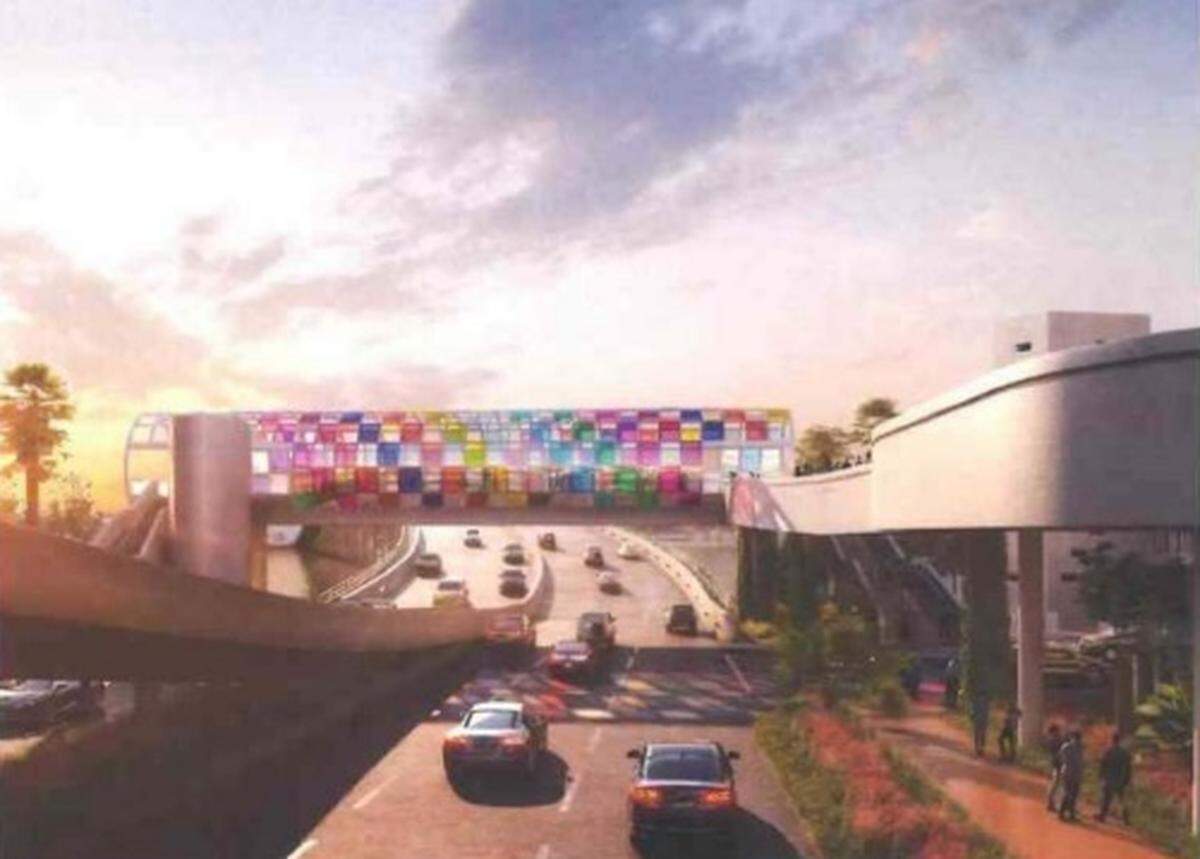
The city will spend up to $9.6 million in general obligation bond money for a pedestrian bridge to span the MacArthur Causeway and West Avenue along Fifth Street. The Canopy Bridge, designed by French conceptual artist Daniel Buren, will connect the new development to existing baywalk paths south of Fifth Street.
The kaleidoscopic bridge will cast a colorful shadow on passing cars and pedestrians.
It is unclear when construction on the bridge will begin, but it must be completed within 540 days, about a year and a half, after breaking ground.
The budget for the bridge is $12.5 million. The developers would pay for anything above the $9.6 million city commitment. They will also be in charge of building a platform for the bridge.
As part of the settlement agreement, the city will receive ownership of the park three years earlier than originally promised — and construction of the park could be completed by 2024, rather than 2027.
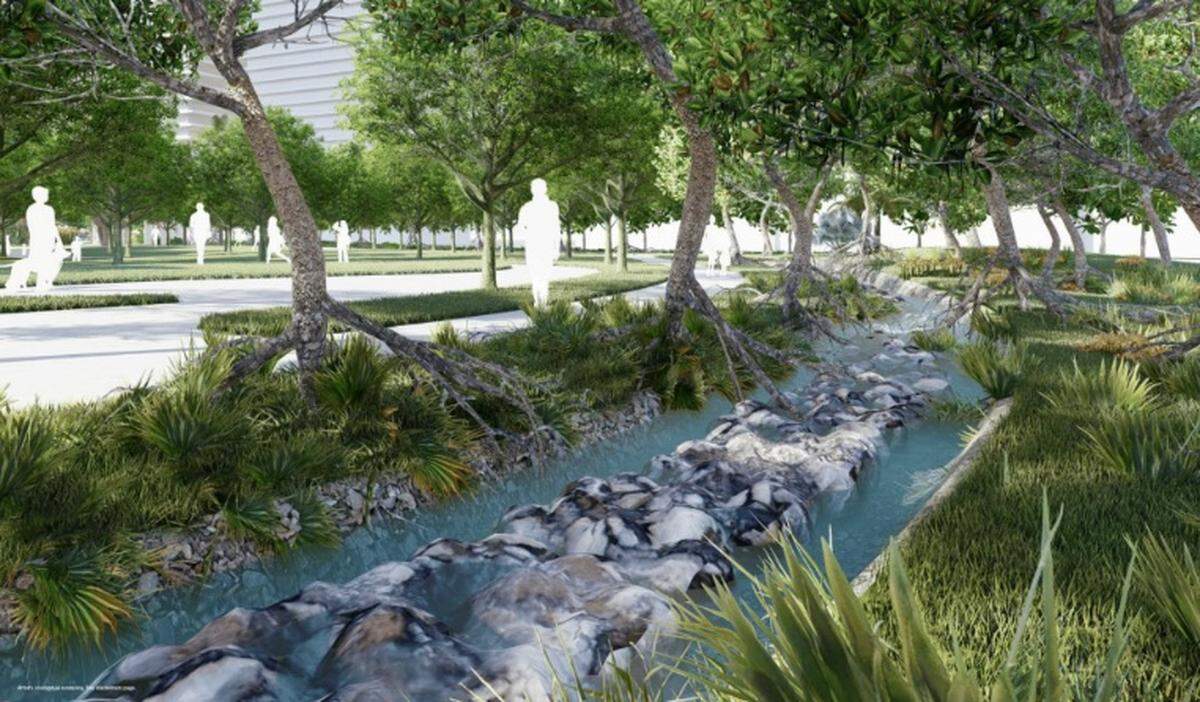
The park will include a “dry river,” or a system of storm water collection basins, and other green infrastructure, like a 25,000 gallon cistern for use in irrigation. The park will also include 221 trees and 2,500 shrubs.
Construction of the park is anticipated to begin in June or July. It is scheduled to be completed by whichever date is earlier — three years from the issuance of a building permit or four years from passage of the development agreement, which the commission approved on Feb. 12.
Developers will shoulder the entire financial load of the park, paying a minimum of $8 million for the design, permitting and construction. That was the agreed-upon public benefit to the city in exchange for vacating use of Sixth Street between Alton Road and West Avenue to the developers.
For the residential tower and retail pavilion, the development agreement has an initial term of eight years with a 17-year extension if the park is completed in a “timely” fashion, assistant city manager Eric Carpenter said in an email.
Commissioner Ricky Arriola told the Herald the settlement “removed the cloud of uncertainty and allows everyone to just move forward.”
At the Feb. 12 commission meeting, Arriola and his colleagues on the dais congratulated the city staff and the development team for working to a conclusion and moving the project forward.
For his part, Galbut seemed relieved to put the sometimes tense deliberations with the city behind him.
“It’s time now to create and finish what will be the most incredible legacy building and construction partnership that any municipality has done with a private developer up and down the seaboard,” he said. “Simple as that.”
This story was originally published February 20, 2020 at 6:00 AM.