Calvo’s first 100 days: Savings, stimulus checks, new style of governance for Hialeah
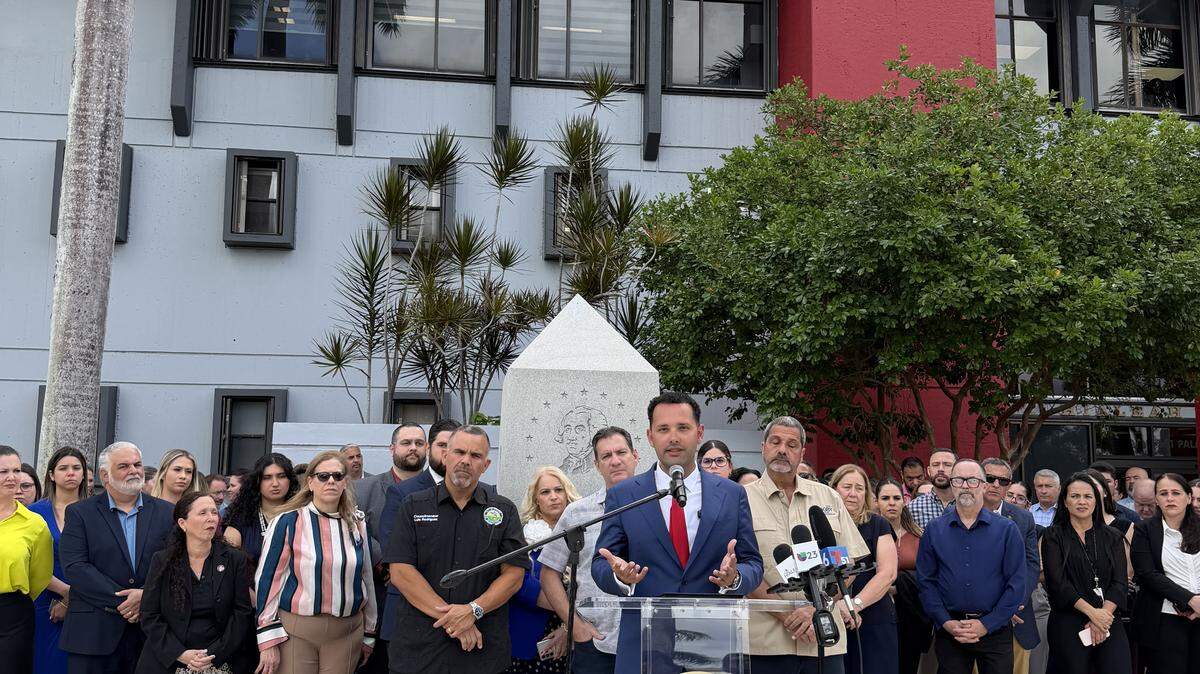
As Bryan Calvo hits the 100-day mark as mayor of Hialeah, he’s touting early wins—millions in projected savings from government shakeups and stimulus checks for the city’s seniors—and framing them as “creative” solutions to run the city.
In an interview with the Miami Herald, he said the over $1.5 million in savings are part of a broader effort to cut costs and redirect funds in a city of nearly 1,500 employees and an annual budget approaching $500 million.
Sworn in as the city’s youngest mayor in January, Calvo promised a reset in municipal operations, emphasizing efficiency and stricter oversight of spending. His early agenda has included audits, contract reviews and departmental restructuring aimed at reducing inefficiencies and improving accountability.
As part of that effort, the administration reduced the number of independent departments by merging Risk Management, Grants and Human Services, and Public Libraries into larger units, while also restructuring leadership roles in finance and human resources and creating a new Special Events Department.
“The idea is to ensure that everything is more or less equitable,” Calvo said.
One of the most visible measures he has taken as mayor is a one-time property-tax stimulus check for senior homeowners earning less than $38,000 a year. The roughly $1.2 million program is funded through surplus general fund revenue, driven in part by savings from early pension payments that reduced long-term costs. About 2,225 households, or 6.9% of Hialeah households benefited— with an average rebate of $539.
The measure effectively takes the place of a wider but unsuccessful plan from the previous administration. That earlier proposal would have provided smaller property tax rebates to a significantly larger group of Hialeah’s roughly 32,100 homeowners.
Tackling the water issue
The administration has also identified more than $3 million in unpaid water and sewer bills from 2024 owed by residents, condominiums and businesses, which the city is now working to collect.
At the same time, Hialeah is negotiating its own financial obligations to Miami-Dade County, including a potential settlement in an $18 million water-related debt dispute. Calvo declined to disclose the city’s offer but said it is below $8 million, leaving open whether Mayor Daniella Levine Cava will accept the proposal.
Also, the city advanced an agreement with two companies to launch a smart-meter pilot program aimed at addressing residents’ main concern over average water and sewer bills. The 180-day pilot will be deployed in designated residential and commercial areas across the city and is expected to run at no cost during the testing phase.
No financial deficit
Calvo said Hialeah has reserves and “has no financial deficit,” even as long-term cost pressures remain a concern for residents, employees and city officials.
“In my opinion, the city benefited for many years from the tax increases that were implemented.... Clearly, there was additional revenue,” he said.
Those “tax increases” refer to the way Calvo framed his policy agenda, which dates back to his time as a councilman under then-Mayor Esteban “Steve” Bovo. At the time, he advocated during every budget hearing for lowering the property tax rate, arguing that keeping it flat would effectively function as a tax increase for residents in a growing city. But, as Calvo was a political underdog for several years, many his proposals did not gain enough support to move forward.
Hialeah has maintained the same property-tax millage rate for more than 15 years, despite nearly approving a reduction last year during a heated election cycle under former mayor Jacqueline García-Roves’s administration.
Now, as mayor, Calvo has stopped short of committing to reducing the rate, instead saying any decision will depend on upcoming budget discussions.
“The idea is to try to provide relief—or to restore it—to the greatest possible number of people with the most urgent needs,” he said. “As we move forward with these budget discussions—specifically around the month of September—that decision will be made.”
Calvo says his priority is identifying internal savings before making any changes to fiscal policy, arguing that efficiencies must come first.
“The task at hand is to generate as many savings as possible,” he said, “so that when that moment arrives, we can ask ourselves: ‘How can we expand this aid program to reach the widest possible audience?’ That is the goal.”
As Calvo heads into his first full budget cycle, the real question is whether the early savings will last and lead to lasting changes in how the city runs, or whether they’re mostly short-term cuts and accounting shifts made under a new administration.
Governance changes, oversight expansion
Beyond budget measures, Calvo has also moved into administrative and regulatory oversight, creating a new Condominium and Homeowners Association Advisory Task Force and a Cuba Business Advisory Task Force.
The condo initiative responds to longstanding complaints from residents—many of them seniors—about deteriorating buildings, rising maintenance fees and mismanagement by condominium boards. With more than 26,000 condominium units in Hialeah, the city is one of the most condo-dense in Miami-Dade County.
While condo enforcement authority remains at the state level, the task force is designed to connect residents with regulators and provide guidance in navigating disputes, a response to what city officials describe as a gap between residents and enforcement agencies.
Separately, as soon as Calvo took office in January, he launched a Cuba Business Advisory Task Force to review more than 290 local firms that do business with Cuba.
“Our new Cuba task force will review businesses in our city that are doing business with the Cuban dictatorship,” Calvo said at a Jan. 20 press conference.
Three months after the creation of the task force, Hialeah has not provided an update or public findings from the investigation. Calvo told the Herald he remains in ongoing conversations with the the U.S. Treasury Department’s Office of Foreign Assets Control regarding the review of businesses identified by the city.
Separately, in April, U.S. Rep. María Elvira Salazar of Miami said in a statement that, following a joint letter with colleagues and continued pressure on federal agencies, the U.S. Department of Commerce is moving to rescind export authorizations that allowed luxury goods to reach the Cuban government.
Calvo said those federal actions reflect the impact of efforts originating in the city. “The work we have led from Hialeah to investigate, identify, and expose these corrupt schemes is already producing results,” he said. “Our community has been the starting point of this fight, elevating what was ignored for years into a federal priority.”
Both task forces reflected a broader pattern in Calvo’s early tenure: expanding the city’s role in coordination and oversight, even in areas where direct enforcement power is limited.
Advocacy on behalf of residents
In what he describes as a transparency-driven agenda, Calvo has been publishing daily videos documenting his activities in office, part of a broader communications strategy that has at times drawn scrutiny from residents.
Recently, he posted a video on his official Instagram account filmed outside Amelia Earhart Park after a series of reported crimes in the area, noting that the park is managed by Miami-Dade County rather than Hialeah. The remarks effectively shifted attention to County Commissioner René García, whose district includes the park. Garcia had initially considered running for Hialeah mayor before withdrawing his candidacy and later endorsing García-Roves.
“We’ve had issues there—specifically a significant amount of trash piling up outside the designated waste enclosures,” Calvo said. “There have even been stories about this in the news.”
Asked whether he was positioning himself for a future county commission run when Garcia leaves office in 2028, Calvo rejected the idea.
“No, absolutely not,” he said. “My job as mayor is to advocate on behalf of the residents.”
He added: “I don’t face an election for another four years,” he said. “We’ve completed 100 days of work, and now I’m looking ahead to the next 100 days—and then the ones that follow. The focus right now is simply to do a good job. It’s a tremendous privilege to hold this position.”
This story was originally published May 1, 2026 at 11:55 AM.