
Do you remember the giant tornado that aimed for downtown Miami? Take a look
It was right out of the Wizard of Oz.
A massive and menacing tornado danced through the Miami skyline and spun over Biscayne Bay to Miami Beach.
It scared workers as they stared out windows they probably shouldn’t have been near.
But for all its end-of-the-world appearance, the towering twister didn’t do much damage or injure anyone on May 12, 1997.
The front of the next morning’s newspaper said TWISTER! — and was eventually made into a poster.
Here is a look at the scare from the archives of the Miami Herald:
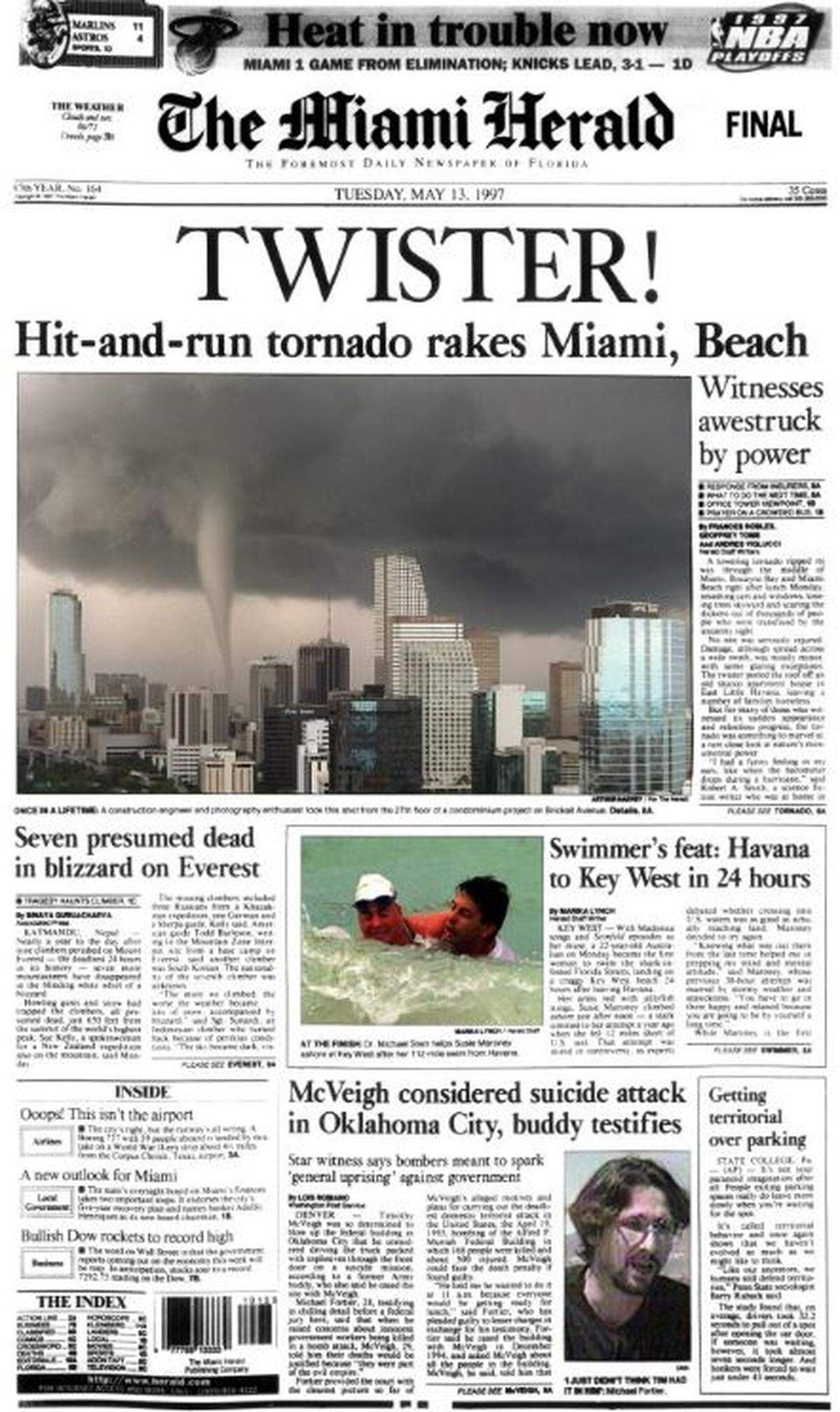
TWISTER!
Published May 13, 1997
A towering tornado ripped its way through the middle of Miami, Biscayne Bay and Miami Beach right after lunch Monday, smashing cars and windows, tossing trees skyward and scaring the dickens out of thousands of people who were transfixed by the uncanny sight.
No one was seriously injured. Damage, although spread across a wide swath, was mostly minor, with some glaring exceptions: The twister peeled the roof off an old stucco apartment house in East Little Havana, leaving a number of families homeless.
But for many of those who witnessed its sudden appearance and relentless progress, the tornado was something to marvel at, a rare close look at nature’s monumental power.
“I had a funny feeling in my ears, like when the barometer drops during a hurricane, “ said Robert A. Smith, a science fiction writer who was at home in East Little Havana. “I looked up, and there it was, the sinister-looking black cloud. I stood like a deer in the headlights. I was just staring at it. I couldn’t move.
“It was awesome, incredible, like a big giant walking along. It was something of God’s that just happened to come down here.”
Said Metro-Dade bus driver Hugo Louissaint, who spent three harrowing minutes in his rocking, crowded bus on the MacArthur Causeway bridge while the tornado passed overhead: “I could see it over the bridge that goes to the port, but it was coming very close and very fast. I couldn’t get away.”
He spent the time reading his Bible.
Though it seemed unhurried, the funnel’s northeastern traverse was in fact rapid, taking about 30 minutes. Preliminary estimates put wind speeds at 73 to 112 mph, the National Weather Service said.
After forming in the Miami neighborhood of Shenandoah at around 1:55 p.m., the tornado pummeled East Little Havana, crossed the Miami River and Interstate 95, where stunned motorists stopped cold to let it pass. It then swirled through downtown, churned sea water into foam in Biscayne Bay, exploded transformers and uprooted trees on Biscayne Island, continued across the water to Arthur Godfrey Road in Miami Beach, where it blew out storefront windows and flipped over a car near Indian Creek. Then it dissipated into, well, thin air.
“It was surreal. You could see the rotation and the debris flying around, “ said Todd W. Bernstein, in Miami Beach from Philadelphia to visit his sister. “Then it just got sucked up again and disappeared into the clouds.”
Before it did, it left a long trail of glass shards, fallen power lines and the strange tableaux typical of a tornado’s haphazard destruction.
The tornado tossed a tree through the back windshield of Bernstein’s blue Chevrolet Cavalier but spared most other cars parked on the street. Nearby, a yellow newspaper vending box was wedged between a white Chrysler and a parking meter.
It imploded all the windows out of The Citadel, a three-story office building downtown, just south of Miami Arena, yet did not disturb a three-story-high Miami Heat banner hanging from the arena’s west facade.
The tornado toppled ancient oaks and ficus trees right and left in Lummus Park, the city’s oldest, a park since 1909, and it turned a construction trailer over on its side at the neighboring Park Towers apartments.
It did a fandango on the MacArthur Causeway bridge, freezing traffic in place at the acme, and passing directly over a Metro-Dade bus, but left it unharmed.
Hardest hit was a 24-unit apartment building in East Little Havana that lost its roof, sending its elderly, barefoot tenants scurrying into the street. The building was condemned, leaving 30 people displaced.
One woman was injured when she was struck in the head by flying debris, firefighters said. Other tenants were shaken but otherwise all right.
Miami Mayor Joe Carollo talked to the tenants, letting them know they’d have a meal and a place to stay for the night.
“We’re doing everything we can for you, “ he said as half a dozen people crowded around him.
One of them was Marta Lopez-Hernandez, who wanted the mayor to understand that her neighbor’s roof landed squarely on top of her 1979 Cadillac, the one she uses to shuttle back and forth to her many doctor appointments.
“The car next to mine? Not one little stick fell on it, “ the 68-year-old woman lamented. “It all fell on mine. I don’t have any money or insurance to buy a new one! I live on disability checks. I just got out of the hospital for cancer surgery, and I need my car to get to the doctor.”
Concrete blocks also fell through her neighbor’s roof.
Yournet Fumero, 19, was sitting on her couch around the corner from the destroyed building when she caught sight of the twister from her window. No sooner did she get up to take a peek when concrete blocks came flying -- through the ceiling and onto the spot where she had just sat. She was unhurt.
Across town, most injuries were minor -- people shoved by the force of the wind against walls, poles and other objects.
One woman waiting for a Metrobus on Biscayne Island, the closest to the mainland of the Venetian Islands, was slammed to the pavement and rolled around, scraping her arm. Still shaking from the experience, she cleaned up at a nearby condo tower, then got on the next bus, said Linda Zelaya of the building’s staff.
Patio furniture from the condo’s apartment verandas littered the sidewalk below.
Toll-takers on the Venetian Causeway were in their booths as the tornado swept through just yards away, tearing into trees at a small public park at water’s edge. Joe McCrea, 36, had seen the movie Twister.
“Man, that was garbage. This was the real thing. It was massive. It covered the whole causeway and blocked that 20-story building there so you couldn’t see it. I’ve never seen anything like it in my life, “ McCrea said.
“My mother called me to tell me to watch out because there was a tornado watch, and I told her, ‘It just hit here.’ And she screamed, ‘What?’ “
The tornado’s passage initially left some 21,000 people without power, although electricity was being gradually restored. By 9:40 p.m., 9,000 were still without power.
It also had some far-flung effects. Just before 4 p.m., turbulence associated with the weather system that produced the twister caused seven injuries on an American Airlines flight to Miami from Boston. Two passengers and five flight attendants were taken to local hospitals.
“There appear to be no broken bones, “ spokeswoman Martha Pantin said.
All over town, city leaders and the curious ran out moments after the tornado to assess damage or just gawk. They said it was too soon for dollar estimates.
On Biscayne Island, Miami Police Chief Don Warshaw and Mayor Carollo ran into Florida Lt. Gov. Buddy MacKay, fresh from the morning’s meeting of the state board overseeing the city’s financial recovery.
“This is the most excitement I’ve had all day, “ said MacKay, who was having lunch at a staffer’s nearby house when the tornado struck, dousing the electricity.
For many who had expected the worst, the overwhelming reaction was relief, followed perhaps by a nervous guffaw.
Kent Williams, 37, leasing director at the Miami Center downtown, was having lunch with Metro-Dade Commissioner Pedro Reboredo when he saw the tornado pass and head north.
“Then I realized it was heading right for my house, “ said Williams.
His wood back fence was gone, but his dog and house were fine.
FRONT-ROW SEAT
Published May 13, 1997
It was 10 minutes before the twister hit. From the window of his 46th-floor downtown office, attorney Scott Sheftall noticed a strange, solitary cloud that worried him.
“I’d seen tornadoes growing up in Jacksonville,” Sheftall, 45, said from his office atop the NationsBank building. “This cloud was black as coal, low to the ground, lower than my office and moving fast. It was the kind tornadoes drop from.”
Sheftall summoned partners and staff at Sheftall, Alvarez and Torres and pointed to it. No one took it seriously, and they left.
“Then I saw the ceiling of the cloud lift and come up quickly, higher than my office. All sorts of gaseous turmoil. You could see something burst in that cloud. . . . The hint of a funnel appeared near the top, and that’s when I screamed to them to come.”
For the next 20 minutes, they moved window to window and watched it happen beneath them.
“I pointed, but at first they couldn’t see it,” Sheftall said. “It had just rained, no dust was drawn into the vortex. It was translucent, no funnel visible on the ground. But then they saw roofing peeling and being ripped off houses. Trees being ripped from the ground. Electric wires exploding. We saw it all clearly, like watching football plays at the Orange Bowl. We saw specific pieces of tar-paper roofing pulled hundreds of feet into the air. They said, ‘Wow.’ “
They watched it dance through Little Havana. “It snaked and skipped from one building to another,” Sheftall said. “I never saw it lift up completely off the ground for more than an unpredictable second. It intensified and then relaxed. When it was intense, it picked up debris, and you saw the funnel. When it relaxed, it dropped it. There were times when it was just awe-inspiring.”
They watched it expand and contract, he said.
“At moments, it was as wide as 200 to 250 yards to 1,000 yards at the top. The point of destruction on the business end of the tornado was 150 yards down to a drill bit of 50 yards. It was like bringing a drill or a buzz saw down on top of something. It never skipped more than one or two buildings in Little Havana.”
Sheftall said that as the tornado picked up enough debris to have a visible funnel, people on the ground reacted.
“You could see some people running across the roads. You could see people in cars swerving out of the way.”
He could see that the damage in Little Havana was not severe. But as it approached the Miami River, I-95 and downtown, he became worried.
“I was afraid it would lift boats right off the water,” he said. “Traffic was heavy on I-95 in both directions, and they didn’t know it was coming. I was afraid it would pluck cars off I-95 and explode buildings. It seemed strong enough.”
But when it hit the river, it lifted water vapor, and Sheftall couldn’t see. As it passed over I-95, his view was blocked by the Museum Tower. It did not lift cars or boats, but it did sweep into downtown Miami.
“I guess it picked up dust from the parking lots, and you could see the funnel right in the middle of the city,” he said.
He watched it pass about 200 yards from the Metro-Dade Government Center, rip two trees up near the Miami Arena.
“When it hit the water, it turned white and assumed the classic form of the tornado,” he said. “It really looked fierce at that point.”
Sheftall said he became worried again as he saw the twister sweep toward the houses on Venetian Causeway and raise a wake about four feet high. Again the water spray obscured what happened there just before the twister lost its power. He was told later that no one had been seriously hurt there.
“Thank God,” he said.