Another massive observation wheel on the bay? Neighbors are annoyed by new proposal

A small meeting of downtown condo dwellers played out like a scene from a classic Miami big-dream story — a would-be developer high on ambition but short on details, skeptical neighbors whose questions about traffic and the environment went unanswered, and a fancy set of images showing another large observation wheel looming over Biscayne Bay.
That’s right — another super-sized Ferris wheel, though that designation was only used by some of the 20 residents who gathered at 1100 Biscayne Blvd. on Thursday night. The concept’s creator, structural engineer Haskel Mayer, was quick to note his proposal, called the “Miami Wave” is far more than what one man called a “carnival ride.”
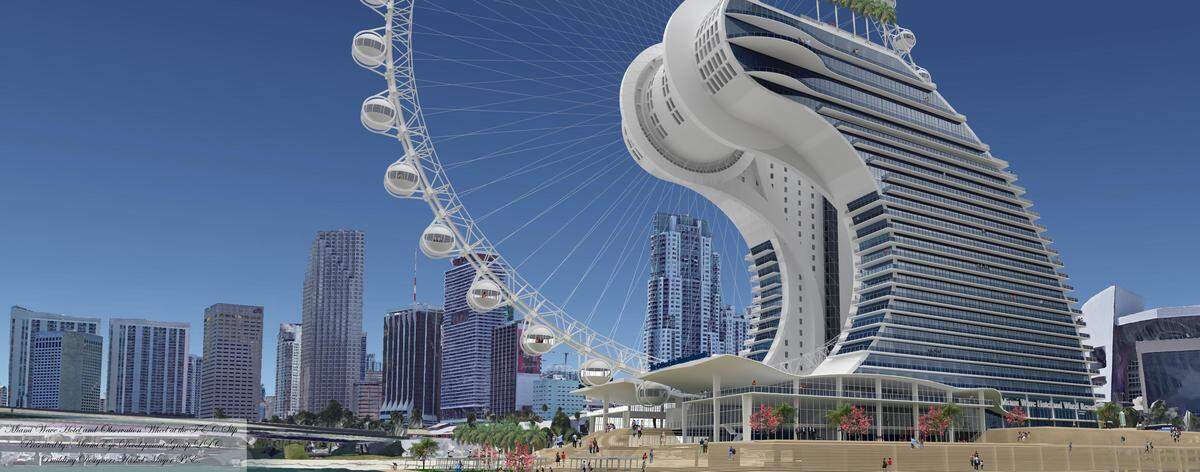
His proposal features a newly patented design for a 550-foot observation wheel that would spin between two hotel towers in a complex built over the water in the boat slip between the American Airlines Arena and Maurice A. Ferré Park. The nine-acre slip would not be filled in, but pilings would be driven into the bottom of the bay to support the whole structure.
Mayer is presenting his plans to the residents first. He has not submitted his plan to the city.
While several residents called the project a Ferris wheel, Mayer objected to the term for his London-Eye-style design, which would have 36 gondolas that would fit 15 people each and stand as tall as Las Vegas’ High Roller, the world’s tallest observation wheel.
“We’re not building a Ferris wheel,” Mayer said to residents.
Indeed, the project includes more than the wheel. The slender 45-foot-wide hotel towers would include 80,000 square feet of space for two museums, a Cuban exile museum and African-American history museum and 500-600 rooms.
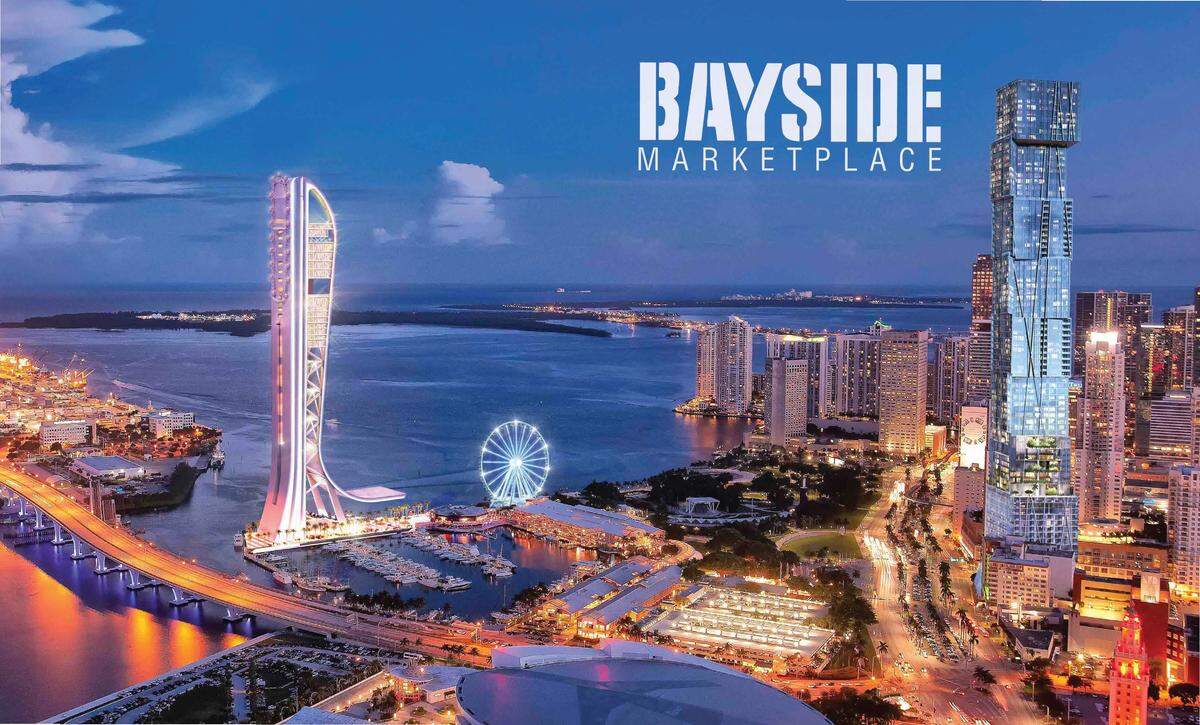
Consider the potential landscape if Mayer and two other builders got their way: All of this would be erected less than a mile north of another similar but smaller 176-foot tall wheel, which has been approved by the City Commission and is anticipated to be built in early 2020 next to Bayside Marketplace. That wheel is planned to be built next to Miami SkyRise, a planned 1,000-foot, hairpin-shaped observation tower with a ballroom, three observation decks, fine dining and theme-park style rides.
If all this came to pass, the edge of Miami’s publicly owned downtown waterfront would feature a mini skyline of privately operated observation structures, effectively providing South Floridians and tourists three tiers of options to observe Biscayne Bay and PortMiami from high up. The bayfront would become Observation Row.
Environment and traffic
As far as Mayer’s $400 million project is concerned, such a reality is likely a long way away, if Thursday night’s conversation was any indication. A few slides into a presentation held in a private room of Cvltvra Restaurant, residents launched into a series of specific questions about Mayer’s plan that elicited few details but a large dose of optimism laced with contradictions and what appeared to be misplaced political confidence.
The Florida Inland Navigation District granted Miami $6.5 million for improvements to the slip, dollars that might need to be refunded if the use of the slip changes from being a waterfront and maritime activity center, which includes the mooring of large vessels. Mayer couldn’t offer specifics on this, nor on any environmental questions raised by the audience, from ensuring the development would not pollute the bay to protecting a coral community on the bottom of the slip.
Another top concern: traffic on an already-congested Biscayne Boulevard. Residents weren’t satisfied with the suggestion that the Miami Wave would not make traffic worse. In the same hour, Mayer said the current population of visitors and downtown residents could support the development and yet, “there will be more people coming to the area.” He added the caveat that a new kind of high-capacity water taxi is being developed to serve the Wave and lessen the strain on the boulevard.
The artist renderings drew praise for what looked like a creative engineering design. Several people complimented Mayer for a grand vision forged with legitimate technical expertise seen on other large-scale projects around the country, including retractable roofs on sports stadiums. Mayer’s firm, Mayer Structural Design, worked the roof on Marlins Park, the Avatar-themed section of Disney World’s Animal Kingdom and the retractable field at University of Phoenix Stadium, home of the NFL’s Arizona Cardinals.
Yet at the end of the night, people were nowhere close to being convinced.
“They’ll add traffic and obstruction of views, which will lead to destruction of my property value,” said Tommy Barone, a real estate agent and downtown resident.
“There’s a panoply of obstacles,” said resident Miguel Criscuolo.
“Mr. Mayer, your project is amazing. No one is going to deny that,” said Amal Kabbani, president of the Downtown Neighbors Alliance. “The locale of where you have a vision to put it is not, unfortunately.”
In the face of deep skepticism and outright opposition, Mayer asserted he could be ready to apply for necessary permits in six months. Given the unique design and location of the proposal, permitting from multiple agencies would likely be a complicated process. In the past, a referendum has been required to execute a long-term lease for private use of public waterfront land.
When asked about this and other zoning considerations, Mayer said discussions were ongoing. The engineer also projected confidence that he’ll get the support he needs from Miami city commissioners.
“We’ve spoken to the commissioners, and we got a favorable response,” he said.
An overstatement, perhaps, according to interviews with multiple commissioners.
“I’ve made no commitment to anyone on this project,” said Commissioner Ken Russell, who added that he would need buy-in from residents first.
Commissioner Manolo Reyes echoed Russell in stating he’s not committed either way. He still has a lot of unanswered questions about the Miami Wave’s impacts. The most important question, he said, is how residents feel about the project. James McQueen, chief of staff for Commissioner Keon Hardemon, told the Herald he was not aware of a meeting between the commissioner and the project’s principals.
Earlier this year, Commissioner Joe Carollo said he supported filling in the slip to create more park space, a change a study showed would cost $232 million. On Friday, his chief of staff José Suárez said the commissioner would only support a filled-in slip used for more park space.
Museums and wheels
One of the cultural facilities would be a Cuban exile museum, a concept that has been stalled on Miami’s waterfront for years. In February, county commissioners reversed an endorsement of plans to build the museum on the county-owned waterfront behind the American Airlines Arena, three acres known as “Parcel B.” Green-space advocates applauded the move, while museum advocates pondered how to move forward on a project they insist needs a firm commitment on location before raising money for a privately funded museum.
On Thursday night, Nicholas Gutierrez Jr., secretary of the museum board, pleaded with community members to not shoot down Mayer’s idea at such an early stage. It was clear his group’s hopes are riding on the project.
“Right now, the best opportunity to get our museum built and funded is the Miami Wave,” he said.
Mayer offered no insight on the concept for the second museum, though the idea likely stems from a 2014 county resolution to consider an African American museum on the waterfront, possibly in conjunction with the Cuban exile museum.
Mayer said this museum would not be tied to the planned civil rights museum in Virginia Key Beach Park, Miami’s historic black beach. The Virginia Key facility recently received an injection of dollars from fees paid to the city by Ultra Music Festival.
The debate around what to build on Miami’s public lands, particularly in the park space on the downtown waterfront, would have a new flashpoint if the Miami Wave makes progress at the city. It would still be a recycled idea — Mayer may have a novel approach, but he is not the first person to propose a big wheel in that exact location.
Five years ago, a North Miami Beach marble salesman proposed building the “Eye on the Bay,” a 650-foot-tall steel wheel over the boat slip, with an elevated walkway connecting the park to Parcel B. The project included retail and restaurants. It never got off the ground.
This story was originally published December 20, 2019 at 5:22 PM.