
Neighbors’ complaints stall county’s plan for Coconut Grove Playhouse — again
Even as work crews ready the storied Coconut Grove Playhouse’s gutted front building for restoration, a group of neighbors who have been fighting a plan to reopen the historic 1927 theater for years have gotten it blocked once again.
A Miami-Dade County plan to reconstruct the long-shuttered theater, 13 years in the making, failed Wednesday night to win sufficient support from a city of Miami board after objecting neighbors persuaded a minority of members to vote against needed new zoning approvals.
After a contentious four-hour-plus hearing, the city planning and zoning board voted 5-4 in support of a list of zoning waivers and exceptions that county officials say are essential for the project to move forward, but that was one vote short of the six-vote supermajority required for approval. Two board members were absent.
The county’s Department of Cultural Affairs said in a statement to the Miami Herald on Thursday that Miami-Dade would “explore the appeal process.”
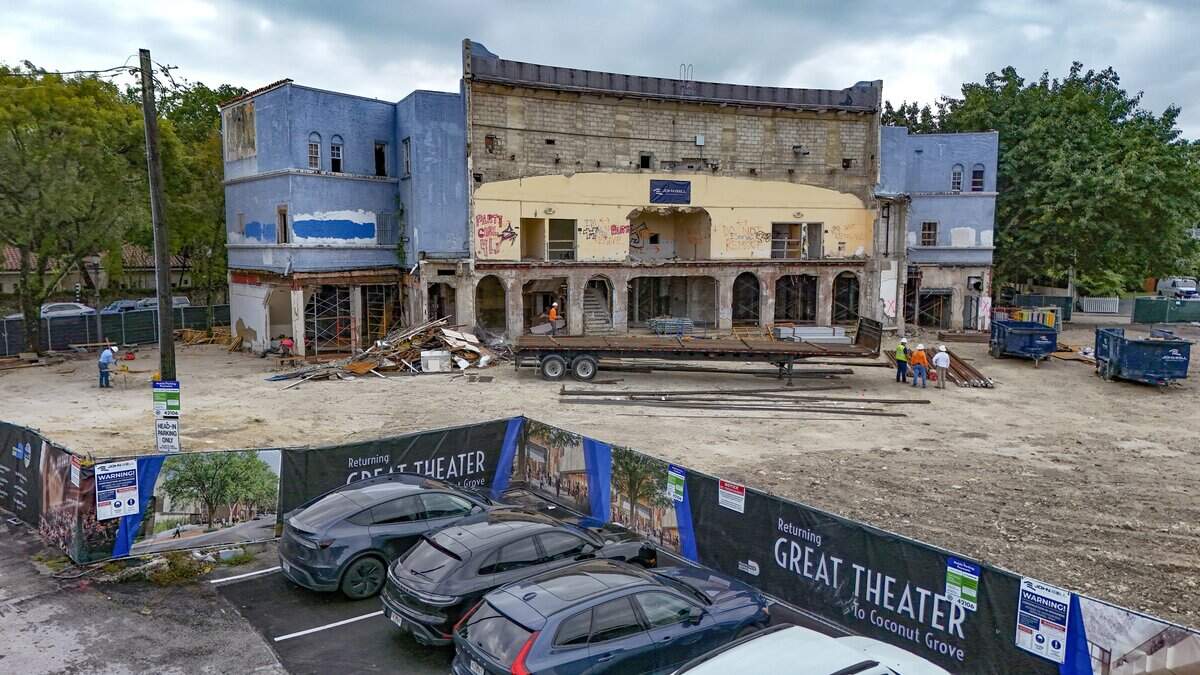
The statement added that the vote wouldn’t stop already-permitted reinforcement work now underway on the theater’s deteriorated three-story Mediterranean front building, all that remains of the original Playhouse after the county won city approval following years of legal skirmishes to demolish its large, obsolescent auditorium — one of the project’s most controversial elements.
Wednesday’s vote was only the latest twist in a Byzantine saga stretching back to the abrupt closure of the legendary but debt-laden Playhouse in 2006.
The county has been trying to resurrect the theater under an agreement in 2013 with the state of Florida, which owns the property, but has been stymied repeatedly by political and legal challenges from preservationists, Grove neighbors and then-Mayor Francis Suarez over a shifting menu of issues. Those have ranged from the auditorium demolition to neighborhood impacts of ancillary commercial space included in the plan.
While the county has ultimately prevailed in every instance, the challenges have set back a project that was supposed to be done by now for years, while construction costs rise well beyond the $20 million the county originally set aside for the job.
From the start, the county blueprint has encompassed several elements. It calls for construction of a new stand-alone theater to replace the original auditorium, demolished earlier this year, behind the restored front building. A new Miami Parking Authority garage would rise on what is now an asphalt lot next to it. The historic building and the garage would both include office and retail space to financially support the reopened theater’s operations, along with parking revenue.
In effectively denying the zoning measures sought by the county, the planning board on Wednesday reversed course on a previous 2018 approval by the same body, though with some different members, of essentially the same county plan.
Those previous zoning approvals expired in 2020 while the legal challenges ground slowly through the appellate court system. The county plan, meanwhile, has been blessed at different times by other city boards, including the historic preservation board, the urban design review board and the City Commission, sometimes after initial denials were overturned by courts.
Just last month, a court dismissed the latest long-shot lawsuit by Playhouse neighbors.
But the county’s need to get the zoning exceptions reapproved opened the door to a renewed challenge before the planning board by some of the same neighbors, organized as the Preserve the West Grove group, who raised new objections that had seemed resolved long ago, as well as some fresh complaints.
More than 30 Grove residents, most from the section of the West Grove that abuts the rear of the Playhouse property, lined up to object to the commercial elements in the county plan as an “intrusion” into their residential neighborhood. Playhouse plan supporters also turned up but were not as numerous or vocal.
Several objecting neighbors hyperbolically labeled the proposed new Playhouse complex as a “shopping mall” — a description that county officials have repeatedly complained is inaccurate.
Their attorney, David Winker, tallying up the total commercial space in the plan of 34,432 square feet, called it “Cocowalk 2.” Cocowalk has 235,000 square feet of commercial space, according to a representative, or about seven times as much as the county Playhouse plan.
“We want no retail,” Winker told the board. “Make them go back to the drawing board.”
Without the retail, county officials insist, there won’t be a new Playhouse. They contend that retail revenue and office rents, as well as the parking garage, are essential to the economic viability of the reconstruction plan and theater operations, noting that the Playhouse previously failed financially as both a movie house and later as a nonprofit live theater company.
County cultural subsidies are already spread thin, they say, and taxpayers don’t have the appetite to cover big deficits at a reopened Playhouse. Cultural groups, meanwhile, are bracing for potentially large cuts in county funding amid a significant budget crunch.
Financial and practical concerns also dictated another decision by the county that neighbors objected to — to limit the new theater’s seating capacity to around 300 seats, given that the old Playhouse could in later years never fill its far-larger auditorium.
After repeated court losses on the demolition issue, the preservation and neighborhood group dropped demands that the original auditorium be restored or duplicated, and instead focused on technical details such as the amount and placement of green space or impervious pavement in the Playhouse zoning plan, made a demand for an updated traffic plan, and tried to persuade planning board members that the county had disregarded the neighborhood’s requests and complaints.
Those requested zoning exceptions, county cultural affairs interim director Ashlee Thomas and assistant county attorney Eddie Kirtley told the board, are necessary because of the Playhouse property’s atypical wedge shape, the need to accommodate the garage and new theater, and the need to preserve the historic front building, which sits directly on the sidewalk at the corner of Main Highway and Charles Avenue with no setbacks.
Anthony Vinciguerra, a longtime Charles Avenue resident who has led efforts to fight the county plan, said the group would like to see a reopened Playhouse but said the group’s demands are “reasonable” and limited to traffic-mitigation measures and a binding agreement providing that and other undefined “public benefits” to the neighborhood.
Some of the demands by neighbors have been more extensive and at times confusing and contradictory.
The county plan would significantly increase the amount of greenery and green space on the site, though it falls short of the minimum required by the city zoning code.
Even as many neighbors complained about that shortfall, others had also asked the county to remove planned palm trees from a new central promenade on the site, which its designers acceded to.
At the same time, some also raised objections on Wednesday to portions of the new planned green space. Some also opposed other changes in the plan the county had adopted in response to neighbors’ complaints in previous meetings.
The most significant touches on the racial history of the Grove and its historically Black West Grove neighborhood, which the theater backs up to. Through the 1960s, Black residents could not attend movies or plays at the segregated theater, and the property long had a fence topped with barbed wire facing the neighborhood.
During a series of public meetings as the county shaped and refined its plan, Black residents said the new blueprint still turned its back on them and asked that the fence be removed and the property be opened up to the neighborhood.
In response, the county’s designers added a small park, greenery and an extended public promenades through the property from Main Highway to William Avenue and Charles Avenue, the historic street that marks the site of Miami’s oldest Black settlement.
Charles Avenue is undergoing a dramatic gentrification that has brought big new “white cube” houses to the street and an influx of new non-Black residents.
In a shift that the Coconut Grove Spotlight said “drips with irony,” many of those new residents, angrily complaining that those neighborhood-friendly changes could bring noise and unwanted people into their streets, are now demanding their removal from the plan, to be replaced with what several referred to as “a wall” and others, a “tree-lined barrier.”
On Wednesday, non-Black residents were the overwhelming majority of objectors to the county plan, with many of them saying they were trying to preserve the historically Black West Grove. They were joined by some leaders of predominantly Black organizations in the neighborhood.
Taken aback by those demands, Thomas, the county cultural affairs official, noted drily to the board: “The neighborhood is changing, and these are new requests.”
Thomas said the county would consider changing those elements but defended the overall plan, noting it was the product of years of public meetings, deliberations and debate, including a town hall-style Zoom conducted two weeks ago by Miami-Dade Commissioner Raquel Regalado, whose district includes the Grove.
“This has been a very rigorous process,” Thomas said.
The four board members who voted against the county plan echoed complaints that the county had not done enough to accommodate neighbors but did not indicate what officials could do in response.
As the clock tripped past 11 p.m., four hours after the hearing started and minutes after the final vote, board chairman Adam Gersten asked the four if there were any changes they could propose that would satisfy their objections. None responded.
If the county does appeal, the City Commission would hold a full public hearing on the county plan.
This story has been updated to include a statement from Miami-Dade’s Department of Cultural Affairs.
This story was originally published May 7, 2026 at 6:47 PM.