
After 13 years of fighting, is the Grove Playhouse rehab finally ready to go?
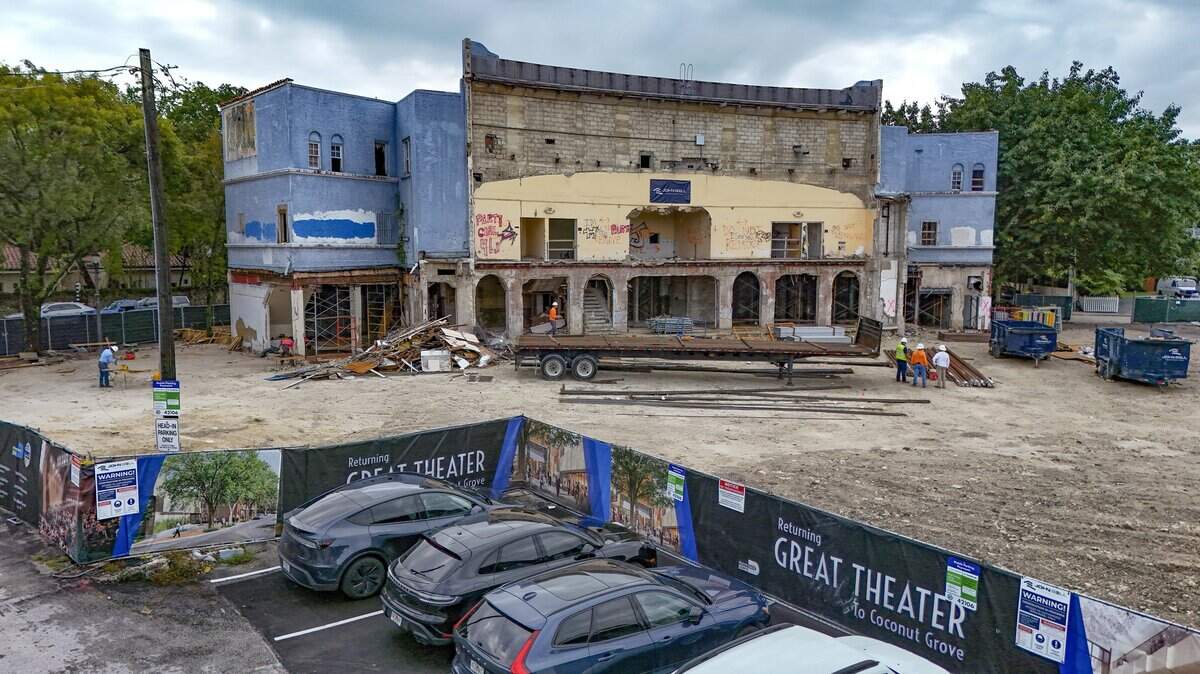
Miami city commissioners on Thursday unanimously gave what could be the final green light to a $40 million plan to rebuild and reopen the historic, long-shuttered Coconut Grove Playhouse after 13 years of legal and political battles.
The commission voted 5-0 to grant an appeal by Miami-Dade County, which is running the playhouse project and was challenging a May decision by the city’s planning and zoning board that would have blocked the plan from moving forward.
Miami-Dade County Commissioner Raquel Regalado, whose district includes Coconut Grove and who has served as the playhouse project’s public face, was jubilant after the vote. She compared the result to seeing the plume of white smoke rise from the Vatican when a new pope is elected.
“We are done and ready to go,” Regalado said in an interview after the quasi-judicial hearing at Miami City Hall.
She said final designs for a modern new 300-seat standalone theater and restoration of the playhouse’s 1927 Mediterranean front building have been finished and await only building permits from the city to proceed to construction. The front building, protected as a historic landmark, is already undergoing structural stabilization after the completion of interior demolition and the controversial razing of the large auditorium behind it earlier this year.
Separately, the city’s Miami Parking Authority can also move ahead with a linked $45 million plan for a new garage and office and commercial space on the playhouse’s adjacent surface parking lot, though its specifics are still being finalized, Regalado said.
Will there be another appeal for the Coconut Grove Playhouse plan?
David Winker, an attorney for a group of Grove residents who have persistently challenged the county plan, said they are considering appealing Thursday’s decision to the administrative division of the Miami-Dade Circuit Court.
Past court decisions in numerous legal challenges that have consistently gone in the county’s favor, however, suggest that may be a long-shot effort. Earlier this year, a court dismissed the latest legal challenge by the group, Preserve the West Grove.
The filing of an appeal won’t slow the project unless the group wins an injunction, Regalado said, a prospect she called unlikely given its string of court losses.
The commission hearing came two months after the city planning board effectively denied the county a set of zoning variances needed for construction of the new theater and parking garage as well as public plazas, a promenade and elaborate landscaping on the property, which sits at the corner of Main Highway and historic Charles Avenue, once the heart of Miami’s first Black settlement.
While the planning board voted 5-4 for the variances, that fell short of the required six-vote supermajority required for approval.
The county had previously won the board’s OK for the same plan, but long delays caused by legal and political challenges by Grove residents and then-Mayor Francis Suarez meant those original approvals had expired, while the board’s composition in the meantime changed.
What are the objections to the county’s plan?
Residents of Charles Avenue and the historically Black but rapidly gentrifying neighborhood around it objected to the county plan, saying they feared intrusion and increased traffic from the project, which they described as a large commercial and shopping development.
After the planning board vote, Miami City Commissioner Damian Pardo held a town hall meeting at which Regalado and other county officials sought to allay those fears, promising to shield the neighborhood and develop traffic-mitigation measures.
That was enough to satisfy West Grove church and community groups, leaving only the Preserve the West Grove group to contest the plan on Thursday. The group was seeking to intervene in the county appeal as a legal party and secure a legally binding “benefits” agreement that would include a traffic plan, guarantee of jobs to community members, and access for local churches and organizations.
“We do not oppose the playhouse,” West Grove resident Mamie Armbrister told commissioners during public testimony before the hearing. “We just don’t want our neighborhood invaded.”
But another West Grove stakeholder, businessman Jihad Rashid, said it was time to allow the county to move.
“Dammit, let’s do something,” he said.
Miami Mayor Eileen Higgins denied the West Grove group formal legal status but allowed Winker to make his case that the zoning variances the county sought and the size of commercial space its plan envisions, about 35,000 square feet, violate the property’s civic and institutional zoning classification.
“That’s the bottom line here,” Winker said. “They’re trying to circumvent the code, and they can go back to the drawing board.”
But commissioners agreed with the county and the city’s planning department that the variances are appropriate. In granting the county’s appeal, they also established requirements for a traffic plan and measures to lessen the impact of commercial activity on the neighborhood behind the playhouse.
“This obviously has been an incredibly emotional and contentious issue,” Pardo said, noting that the county had already stripped back the garage and office space facing the neighborhood in response to residents’ concerns. “I think the county has done a good job of designing and preserving what could be preserved.”
And, he added: “When you hear that this is a big commercial thing, it’s just not.”
Higgins, who doesn’t have a vote on the commission though she served as meeting chair Thursday, said the county plan and the zoning exceptions it requires represent a significant improvement for the site, which Regalado described as an “asphalt jungle.”
“The exceptions are so much better than what we have today,” Higgins said. “We are literally going to have eight times the amount of green space and double the number of trees.”
Efforts to save the playhouse, widely considered to be one of the city’s leading architectural and cultural landmarks, stretch back to the abrupt closing of the debt-laden nonprofit theater in 2006. The county has been trying to resurrect the theater under a 2013 agreement reached by then-Miami-Dade Mayor Carlos Gimenez with the state of Florida, which owns the property.
The county concluded that revenue from parking and office and retail space, which the playhouse’s three-story front building used to include, is essential to the economic viability of the reopened theater, to be managed by the GableStage company and Florida International University.
Its consultants also concluded that its expansive auditorium was antiquated and had too many seats for the theater to fill, opting instead for a smaller, more viable modern theater in its place with around 300 seats — a decision that led to years of litigation and objections from preservationists, theater buffs and neighbors.