
Will rail ever expand across Miami-Dade? New report says not without higher taxes
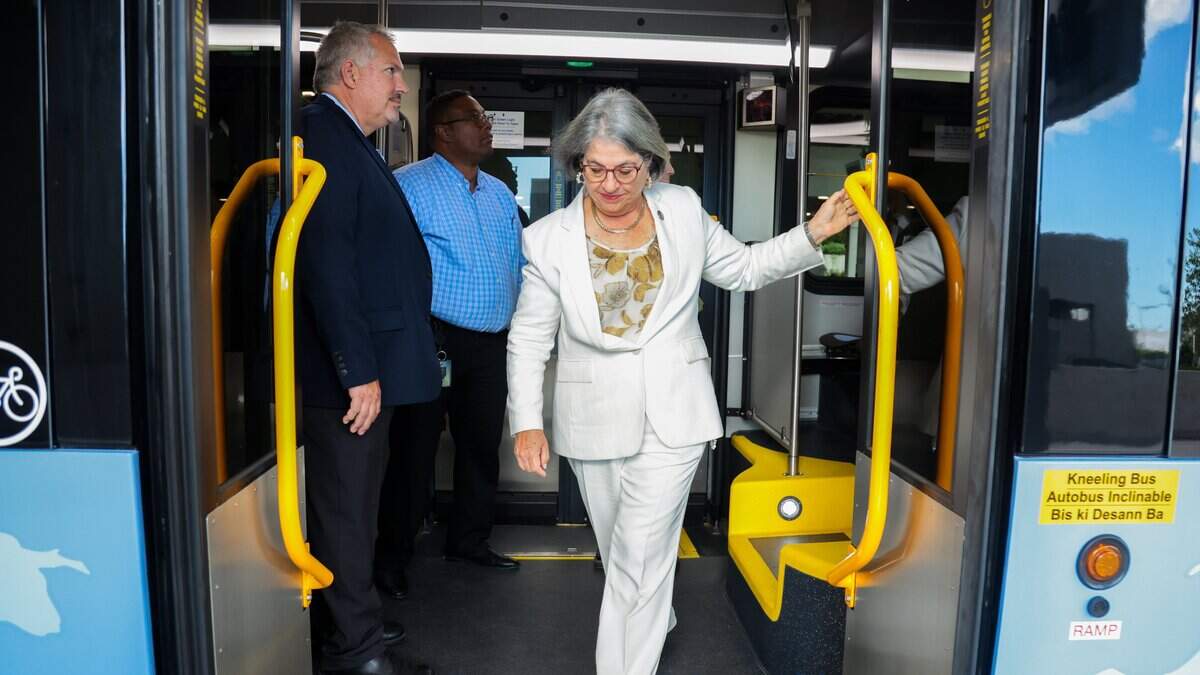
With its transit system already short on cash, Miami-Dade’s ambitious blueprint for expanding rail service countywide no longer looks viable without higher taxes, according to a memo from Mayor Daniella Levine Cava.
Citing cuts in Florida’s transit grants, soaring construction costs and the county’s own financial challenges, the memo states the 2016 transportation blueprint known as the “SMART Plan” needs billions of extra dollars that likely would need to come from new taxes. Otherwise, most of the planned transit routes would have to wait a generation before Miami-Dade could consider building them.
Of the six commuting routes targeted by the SMART Plan, only one has landed a new transit line in the 10 years since the blueprint launched under then-Mayor Carlos Gimenez. That was the $300 million rapid-transit bus system that opened last fall on the existing South Dade busway, with gate arms at intersections to speed up arrival times.
The remaining SMART Plan routes — a potential rail line to Miami Gardens, trains or express buses to Kendall and Florida International University, a commuter rail between Miami and Aventura, and Metromover to South Beach — remain in the planning stages.
“This analysis indicates that the remaining corridors of the SMART program cannot be implemented under the current financial trajectory,” Levine Cava wrote in the memo that was circulated internally in May and recently obtained by the Miami Herald. “Therefore, the county must explore some of the revenue expansion strategies discussed in this report or consider [a] phased extension, which effectively defers most corridors beyond the 2045 horizon…”
Levine Cava’s memo offers a lengthy breakdown of what’s already conventional wisdom in some circles of county government and transit advocacy: While the idea of the SMART Plan makes sense, paying for it increasingly seemed like more wishful thinking than reality.
“It’s been 10 years since the SMART Plan was unveiled. It doesn’t seem so smart now,” said Matthew Gultanoff, a longtime transit advocate who founded the Better Streets Miami Beach group. He sees Miami-Dade in desperate need for better transit, which requires more spending. “Everybody complains about traffic. But nobody wants to rip the Band-Aid off and do something about it.”
The planning stage for the yet-to-materialize routes has still cost taxpayers millions, with both Florida and Miami-Dade paying consultants to analyze bringing new transit modes to those neighborhoods.
Last year, commissioners approved $20 million in consultant costs for the Northeast Corridor alone, the SMART Plan route that would bring public trains to Brightline’s privately run route from Miami to Aventura and beyond as part of a regional effort along South Florida’s urban core. Having publicly run trains on the same route was championed as an affordable way for commuters to move between South Florida counties on a path farther east than the Tri-Rail route.
When he was a county commissioner, Steve Bovo was pushing Miami-Dade to pursue a street-level rail line on existing cargo tracks along the Dolphin Expressway when that would-be project got folded into the larger SMART Plan effort. At the time, he criticized the idea of launching studies for six commuting routes to mollify all regions of the county instead of focusing on a single rail project the county could actually afford to build.
“The problem was going big to avoid the food fight over the corridors,” Bovo, a former Hialeah mayor who lost the 2020 race for mayor to Levine Cava, told the Herald on Wednesday. “It’s very, very disappointing.”

The Levine Cava memo cites a $7.6 billion revenue gap over 20 years in dollars needed to both build and operate six major new transit lines that are currently budgeted at nearly $5 billion to build and $160 million a year to operate, based on current budget forecasts. Those cost estimates are soaring, with the memo saying the SMART Plan projects, including a $1.3 billion Metromover extension to Miami’s Design District that is considered the second phase of the Beach corridor plan, would cost $8.4 billion to build.
At a budget town hall Wednesday night in Miami Gardens, the county’s transportation director, Stacy Miller, said the latest state-funded study of the North Corridor’s elevated Metrorail extension to Miami Gardens puts construction costs on that project alone at more than $4 billion.
“The price is so very expensive,” Levine Cava said after Miller’s report to the audience at the North Dade Regional Library. “Ideally we’ll come up with an alternative that is more affordable and more attainable than Metrorail...The price is so very expensive.”
The $7.6 billion deficit is based on an accounting calculation that estimates what the projects would cost today to build and operate, despite the memo saying construction wouldn’t happen until the years between 2032 and 2038.
Funding outlooks have worsened in recent years, given the county’s budget struggles, Florida cutting back funding for local rail projects, and this fall’s statewide referendum on a big cut in the property taxes that fund most county government operations, including transit.
Heading into 2027, the memo says, the county’s transit system faces a $120 million deficit that will need to be closed with service cuts or new revenue – and that’s without paying for an additional SMART Plan route.
The memo will be officially made public once it is sent to county commissioners this month, with a potential discussion slated for the board’s July 21 meeting. Levine Cava’s office released it this week after a request from the Herald.
To close the SMART Plan’s worsening funding gap, the memo outlines several tax-increase possibilities, without endorsing one option or arguing that Miami-Dade should raise more money to build the SMART Plan. Instead, the memo lays out different scenarios that would close the SMART Plan’s funding gap by raising the needed revenue through new tax sources.
Those scenarios are:
- Borrow construction dollars from Wall Street and pay back the loans with property taxes. This would have voters authorize Miami-Dade to sell bonds, the investment vehicle that allows local governments to borrow money at a lower rate than private banks would offer. Wall Street investors purchase the bonds, which then are paid back with an existing property tax dedicated to Miami-Dade debt. That tax rises and falls based on that year’s debt repayment schedule.
- Double the county’s current half-percent transportation sales tax. Passed by voters in 2004, the current “half-penny” transportation tax generates sales tax dollars for both transit and road projects. While it funded Metrorail’s three-mile extension to Miami International Airport, modernizing the bus and Metrorail fleet, and other projects, it has yet to produce the major new rail route county leaders promoted during the referendum campaign. Doubling that tax to a “full penny” would require another countywide referendum, with backers having to convince voters not to let failed promises from the 2004 campaign sour them on a new plan.
- Temporarily increase the county’s property-tax rate, and earmark the dollars for transit. Tax-rate increases are rare in Miami-Dade — the countywide tax rate last went up in 2011, only to be brought back down the next year. But the County Commission has the power to raise taxes, and the Levine Cava memo floats a higher rate for between 8 and 16 years to raise money for both transit construction and operations.
Levine Cava has not publicly embraced any of those revenue-raising scenarios, and the memo presents them as options without endorsing any course of action.
At a Monday town hall on the 2027 budget proposal she’s releasing on July 15, the second-term mayor leaving office in 2028 said she plans to ask for flat transit fares and cover some funding gaps with service cuts and by tapping into the county’s modest reserve for future SMART Plan projects, which had $120 million in it last year.
“It’s not sustainable,” she said of the short-term funding patch. “We obviously need a more sustainable source of funding.”