
A toxic toad could kill your pet. What to do during Miami’s rainy season
The rainy season in South Florida attracts more amphibious jumpers to home yards — and every pet owner should fear one kind.
More frogs and toads are jumping around backyards, and their numbers increase when the rain does, said Ron Magill, goodwill ambassador and conservation liaison for the Zoo Miami Foundation.
“It’s definitely part of the spring-summer cycle,” Magill said. “Keep in mind, these are amphibians — they need water to reproduce.”
But one particular amphibian can kill your pet.
The cane toad, also known as the bufo toad or the marine toad, is known for the large, poisonous glands behind its eyes that secrete toxins when it’s touched.
“This can be fatal to pets,” Magill said. “Probably countless dogs every year get very sick, and many of them die in Florida because of their encounters with these toads.”
The cane toad, an invasive species in Florida, is similar in appearance to the native and non-poisonous southern toad, though there are ways to tell them apart:
- The southern toad grows up to three inches, but the cane toad can grow from three to six inches
- The cane toad has a flat head, with no crests like its native lookalike, and it has the glands that secrete the bufotoxin behind its eyes.
- The cane toad is reddish-brown or grayish-brown in color with a light-yellow or beige belly.
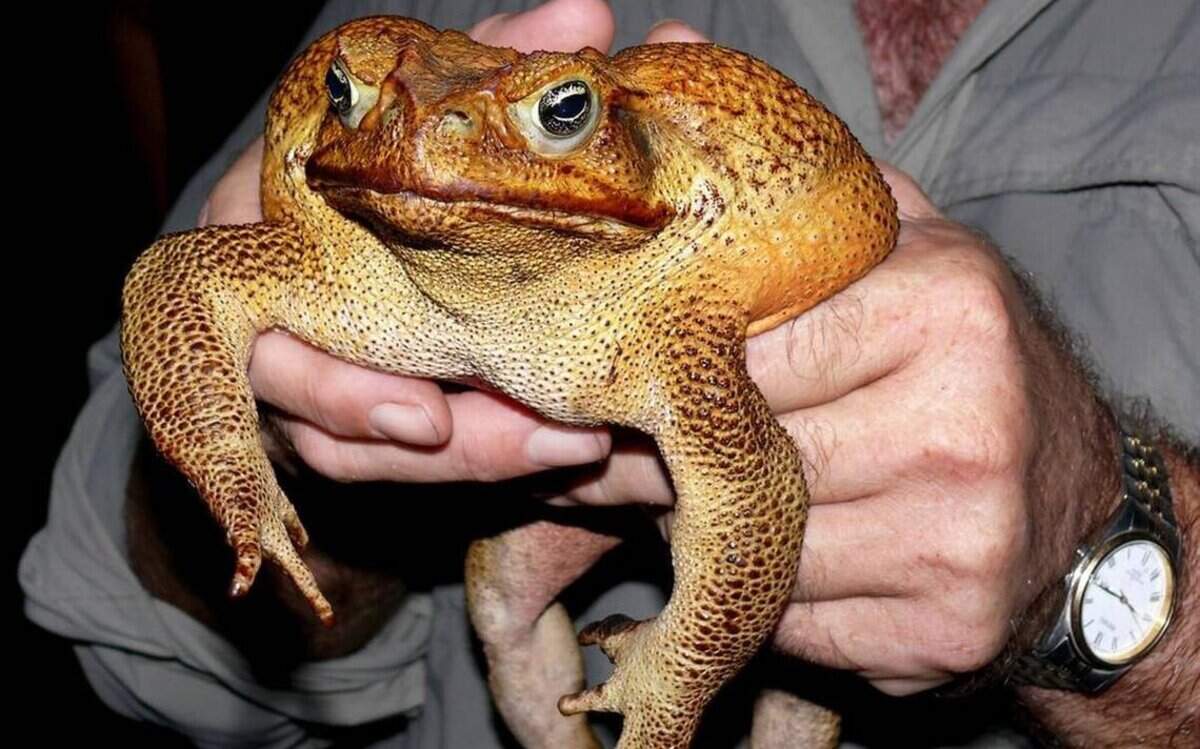
The invasive cane toad, originally introduced to Florida from Central and South America, is “really the only species that is going to be of any type of real danger to pets,” according to Magill.
“Almost all amphibians, the tree frogs, the smaller frogs, they also secrete substances in the skin that’ll make your dog sick,” Magill said. “But they’re not really going to be fatal to dogs.”
According to Magill, invasive species in Florida are outcompeting “all of the native species.”
The ecosystem is not “so delicate it’s going to collapse,” but it will become imbalanced, and then it can “totally change the environment,” Magill said.
“If you release a snake or a toad or a frog in a place like Chicago or New York, usually during the first winter, that animal is not going to survive,” Magill said. “It escapes here in South Florida, and it’s like going to Club Med for these animals. They not only survive, but they learn to thrive.”
READ MORE: The most annoying season has started in Miami — and the mosquitoes are biting
Today’s cane toad population was originally introduced in Florida for agricultural reasons— to eat beetles preying on sugar cane in the 1930s and ‘40s. The current population is a result of the toads escaping or being released by importers during the 1950s and ‘60s, according to the Florida Fish and Wildlife Conservation Commission.
“We’re lucky to live in South Florida for a lot of reasons, and sometimes it’s a challenge because a lot of other animals like to live here for the same reasons,” Magill said.
What if your dog bites a cane toad?
Cane toads are dangerous to both dogs and cats, but dogs are more likely to ingest the toxins because they are outside more often and are more likely to chase and catch a jumping amphibian, according to Dr. Yamilka Lago-Alvarez, the DVM and medical director at VCA Knowles Central Animal Hospital and interim medical director at VCA Knowles Snapper Creek Animal Hospital on Sunset Drive near Kendall.
Lago suggests that to prevent a dog from putting its mouth on a cane toad, owners should walk their pets on a leash and supervise outside at all times.
Dogs that are fed outside are at higher risk as well.
“Do not leave that pet food outside, because these animals come,” Magill said. “Cane toads love pet food. They go to it.”
If a cane toad enters a bowl of pet food or water, their toxins will contaminate it, and pets can ingest the poison that way.
If a pet is poisoned by a cane toad, there are some warning signs. But according to Lago, owners have a limited time frame to get their pet to an emergency vet before illness turns fatal.
The first signs that your pet has ingested bufotoxin from the cane toad are bright red gums and excessive drooling. In more severe cases, neurological signs develop, such as seizures.
If only mild signs are present, Lago recommends rinsing the dog’s mouth with water, either using a hose or a damp cloth. If a hose is used, she stresses the importance of running the water out of the dog’s mouth and not down the throat because the toxins can be ingested that way.
If a dog comes into contact with the toxin, time is crucial.
“If the patient is just hypersalivating, and we can rinse the mouth out, then yes, go for it,” Lago said. “But if they’re actively seizing, then no. The most important thing is to bring them to the vet clinic immediately. Within several minutes, we can see the clinical signs develop quickly from just a mild case to a severe case.”
At the animal hospital, veterinarians will administer anti-seizure medications and monitor the animal until the toxins leave the body. With care, a full recovery is possible.
Because there is no test to determine that there’s cane toad intoxication present in a dog, veterinarians rely on owners to constantly monitor and supervise their pets when outdoors, especially in areas where cane toads could be present.
“If the client presents the patient immediately after the exposure, the pet can have an excellent prognosis,” Lago said. “The pet will recover well from this.”
How to keep cane toads away
The best way to protect your pets is to keep cane toads away from your property.
To do that, Magill recommends eliminating excess water in buckets and flower pots and using motion-sensored LED lights instead of leaving porch or outdoor lights on all night — constant lights attract food sources for amphibians.
“Toads, frogs, learn about that very quickly, which is why you always see toads and frogs around porch lights and entrance ways,” Magill said. “They adapt to those lights because they know that’s where the insects are attracted and that’s how they get the insects.”
Magill also says that with rain already moistening the areas around your home, don’t make it worse by watering your grass or plants.
“Listen, it’s the rainy season, turn off your sprinkler system…” Magill said. “All you’re doing is creating a much more moist environment that’s much more conducive to these animals.”
When protecting your home from cane toads, it’s also important to be mindful of the other creatures in the area, especially the native ones that are important to the ecosystem.
“Don’t put out salt. Don’t put out chlorine. Don’t put out bleach,” Magill said. “This is a destructive chemical that not only hurts those invasive species, but hurts native species, too.”
What to do if you already have a cane toad in your backyard
If a homeowner sees a cane toad in the backyard, take note: It’s illegal to move them elsewhere. Moving them creates an issue for someone else, and the toad can easily return to the spot it was caught.
The best practice is to catch them and humanely kill them.
When catching a cane toad, the University of Florida Institute of Food and Agricultural Sciences recommends using a plastic bag from the grocery store to grab the toad by hand, then flipping the bag inside-out around the toad to ensure it’s trapped.
After the toad has been captured, the University of Florida says the toad must be positively identified as a cane toad — native toads should not be euthanized. The university recommends that any toad less than 1.5 inches long should not be harmed because they are likely native.
Once the toad is positively identified as the invasive species by spotting the poison glands behind its eyes, benzocaine or lidocaine ointment or spray can be used as anesthesia to ensure the toad doesn’t feel pain. Any anesthetic product used on the toad must contain 20% benzocaine or lidocaine. The product should be applied liberally to the toad’s belly and rubbed in. It will be absorbed within 10 to 15 minutes.
After applying the ointment or spray, the toad can be placed in a freezer for 24 hours to euthanize it. If no benzocaine or lidocaine is available, the toad can be chilled in a refrigerator for several hours before being frozen for 24 hours.
After 24 hours in the freezer, the toad can be placed in the trash. Anyone who handles a toad should wash their hands throughout the process. If you don’t want to handle the toad themselves, hire a pest removal specialist.
This story was originally published June 23, 2026 at 5:00 AM.