
No flashing yellow lights? Cameras can still issue $100 tickets in school zones
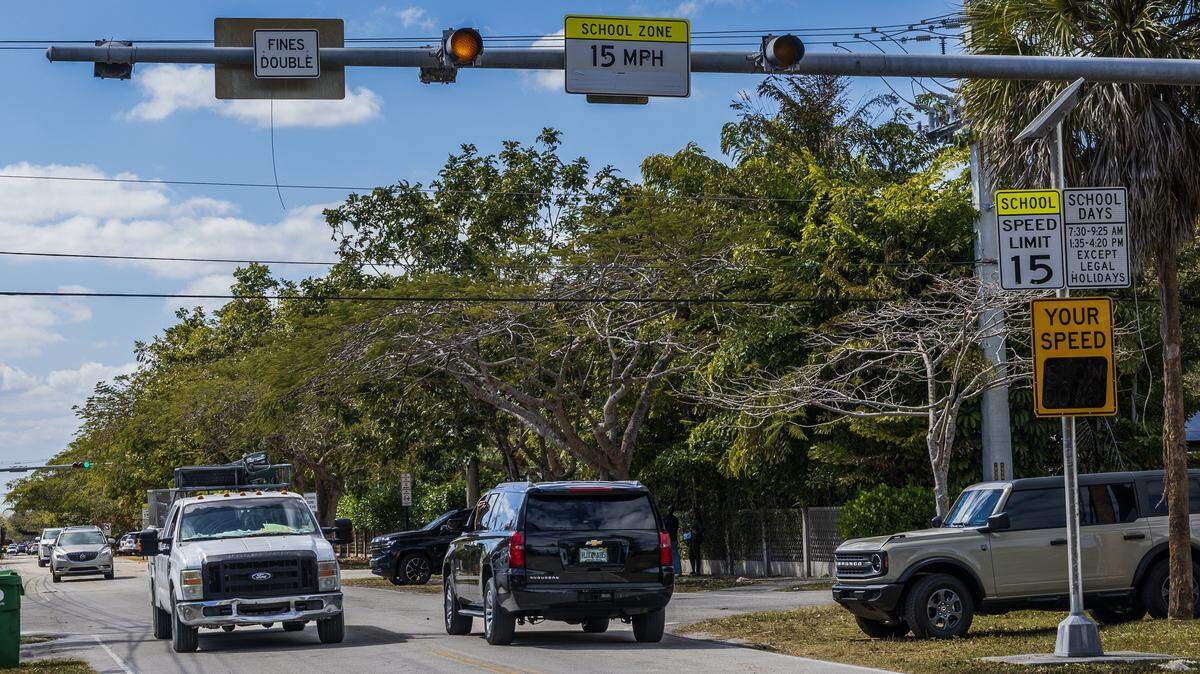
Don’t count on flashing yellow lights to warn you about speed cameras near a school in Florida. Those cameras can issue $100 violations whether or not the yellow lights are flashing — a rule that many drivers say is news to them.
“That’s the biggest misconception,” said Pinecrest Police Chief Jason Cohen, who helped launch one of the first speed-camera zones in Miami-Dade after Florida legalized the devices in 2024. “The lights don’t define the school zone. The signs do.”
Florida rules do require that a street sign alert drivers that they’re entering a school zone, where the speed limit drops to 15 mph whenever students are supposed to be arriving and departing. Those drop-off and pick-up windows are also when yellow lights usually flash overhead to warn drivers about the slower speed rules. But many schools don’t even have the optional yellow flashers.
Besides, the new speed cameras produce most of their violations outside the pick-up and drop-off windows, when the speed limit reverts back to normal and any yellow lights should go dark. Florida law allows the privately operated cameras to operate throughout the school day, nabbing speeders at times when many drivers wrongly think the absence of yellow lights means they don’t have to worry about automated speeding citations.
READ MORE: What drivers should know to avoid $100 tickets from Fla. school-zone speed cameras
“In my case, there were no yellow lights,” said Scott Weinkle, an architect in Sunny Isles Beach who said he’s received two speeding violations from the school-zone cameras in Miami-Dade. “I was just going on my merry way — no faster or slower than anyone else.”
While there’s currently no requirement for yellow lights to be blinking in order for drivers to get a ticket from the speed cameras that have been cropping up across the state, that could change.
A bill by state Sen. Nick DiCeglie, R-St. Petersburg, would limit speed cameras to operating only during pick-up and drop-off times, and only if any nearby yellow-light beacons are actually flashing — in other words, establishing rules that many drivers seem to think are currently in place.
Drivers wrongly counting on flashing yellow lights to warn them about school speed cameras
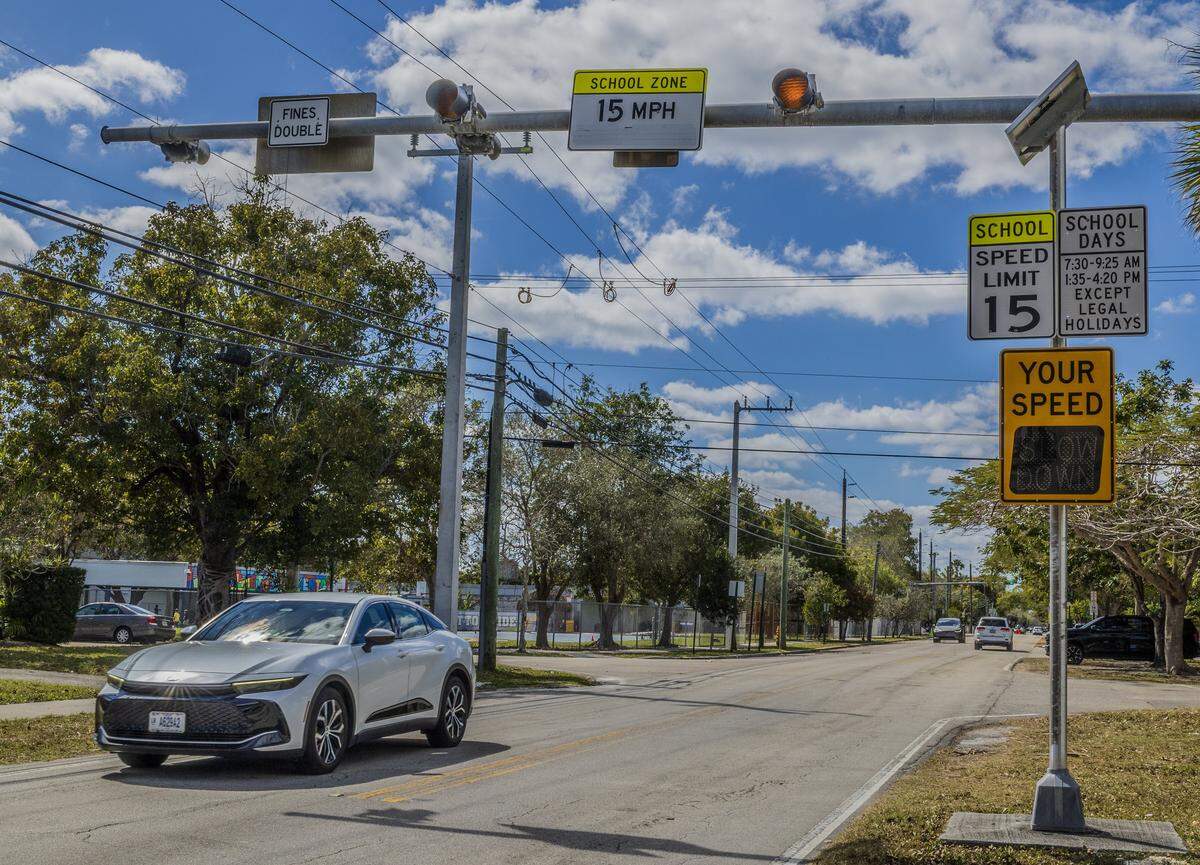
When the Miami Herald recently asked readers to share their experiences with school zone speed cameras nearly two years after Florida legalized them, a common complaint was receiving a $100 violation without any warning from yellow flashing lights.
“If they want to really deter speeders, there should be better and more clear signalling,” one reader wrote. “As of right now, they seem to be chasing the money.”
Wrote another: “I believe the flashing lights should be ON where and when the cameras are active.” A third wrote back to the Herald: “Both my wife and I have received tickets. In neither case was there a flashing yellow light nor were children present.”
Other readers praised the cameras, which last summer were generating more than $2 million a month in violations in Miami-Dade, according to a recent county report.
“I live next to a school without a camera and see cars speeding by every day,” one reader wrote.
“A child’s life is worth more than the few seconds you may save if the zones weren’t there,” wrote another. A third wrote: “I support any and all enforcement mechanisms that slow down Miami drivers.”
Sgt. Eduardo Pares, who oversees the camera program for the Miami-Dade Sheriff’s Office, said the agency’s violation database shows some people are roaring past schools during the day. “The highest so far has been 98 mph,” he said.
The cameras only generate a violation if a driver is exceeding the speed limit by more than 10 mph, so backers of the program say it’s targeting people moving much faster than is allowed during the school day.
Florida law imposes the 15 mph speed limit 30 minutes before a school’s arrival or dismissal time — and 30 minutes after, too. That means the 15 mph limit can be in place at times when it’s unlikely children will be outside since class has already started or is still in session.
Karen Alvarez, a college professor from Kendall, told the Herald she was surprised to get a $100 violation in the mail for driving 27 mph past South Miami’s Ludlam Elementary at 2:48 p.m. on a Thursday in October. The speed limit was 15 mph at the time, even though the school’s dismissal bell wouldn’t ring for another 15 minutes.
“I didn’t even notice I was driving by a school,” she said.
In Florida, speed cameras outside schools are big business
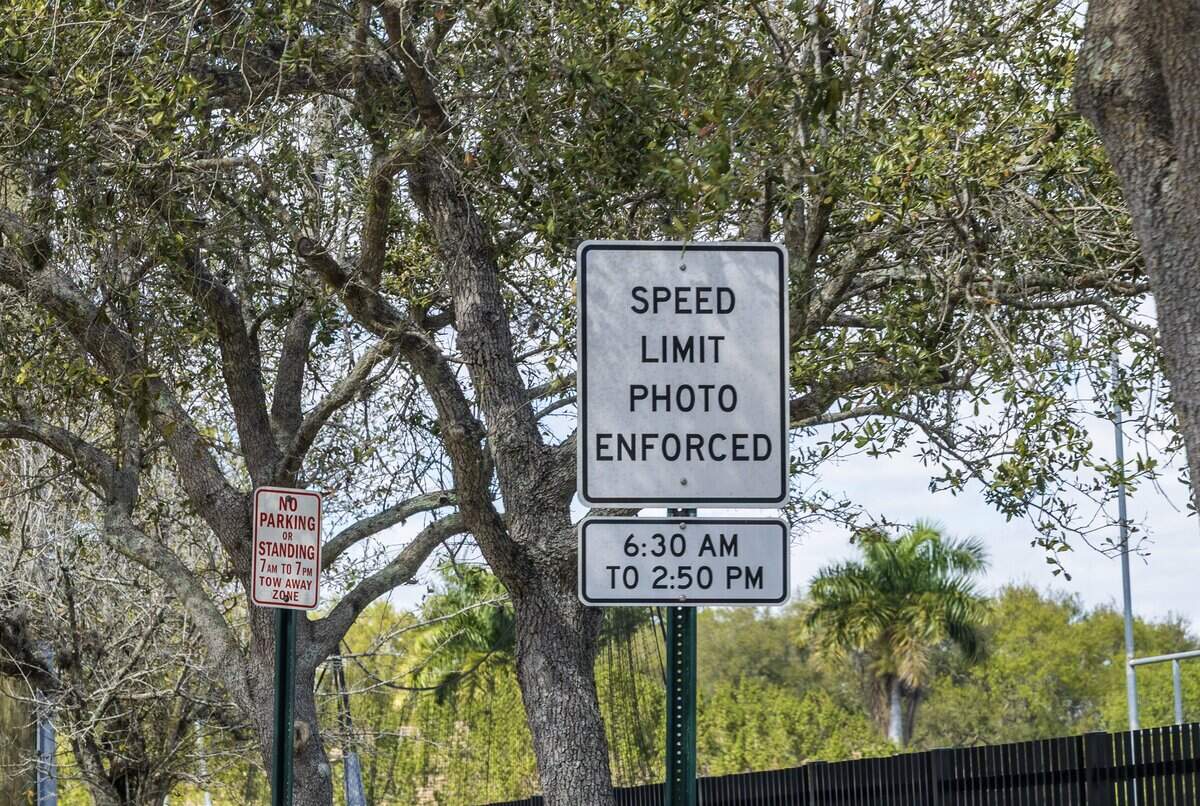
Speed cameras are big business across the country, and that includes in Miami-Dade.
A Chicago-based company, RedSpeed, operates the cameras for the county and in other jurisdictions across Florida. In Miami-Dade, the company retains about $20 of every $100 violation, according to a December memo.
RedSpeed describes the speed cameras as designed to generate less money over time as more drivers realize they’ve been speeding past schools without knowing it.
In Pinecrest, for instance, the company says its cameras saw violations drop roughly in half this winter, compared to a year ago. “Our goal is not to issue violations, it’s to prevent violations,” the company said in a statement.

David Arnold said he has the same goal — but by reining in the current program.
The Coral Gables lawyer received a $100 violation on a Tuesday morning in November when driving 28 mph by the Palmetto Elementary School in Pinecrest. The 82-year-old said he was shocked to be accused of speeding.
“I’m a very safe driver,” he said during an interview with the Herald, where he shared the mailed violation, photos of the school zone and data on similar violations he obtained from Pinecrest police through records requests. “I last got a ticket in 1971.”
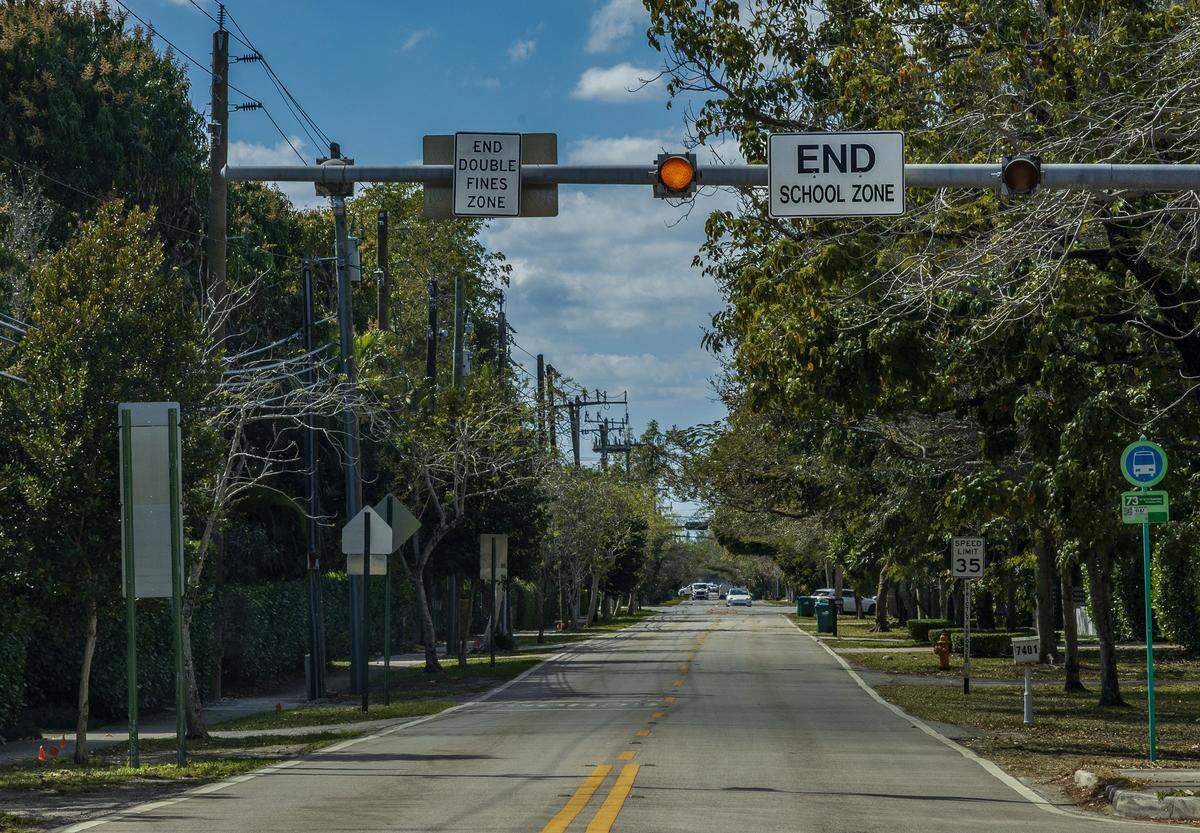
The violation was marked 9:24 a.m, one minute before the 15 mph speed limit reverted to the normal 35 mph limit on Southwest 124th Street.
But Arnold contends the violation was improper because Palmetto Elementary opens at 8:35 a.m., according to the school’s website. Florida law imposes the 15 mph speed limit for 30 minutes after a school opens, meaning the reduced speed would only be in effect until 9:05 a.m. — 19 minutes before Arnold got his $100 violation for driving what was 7 mph below the regular speed limit.
“I’m not against the detector cameras. I think we should have more of them,” Arnold said. “But I would like to have them operated according to the law.”
The signs outside Palmetto Elementary do show the 15 mph speed limit is in effect through 9:25 a.m., as Arnold’s citation indicated. Cohen, the Pinecrest police chief, said the later time is used to match the later opening time of Palmetto Middle, the school that shares a block with Palmetto Elementary. “The carpool pickup queue wraps the perimeter of both schools at different times,” Cohen said.
For Arnold, who lives in a luxe condominium tower at the Deering Bay Yacht and Country Club, a $100 fine is hardly a financial hit. But as he walked a reporter through the paperwork he’s compiled against the cameras — including an illustrated flowchart titled “Anatomy of an Invalid School Zone Speeding Ticket” — Arnold said changes are needed to protect people who can’t easily shake off a $100 fine.
“I just want to get it fixed,” he said.
The Pinecrest Police Department, which signed off on the RedSpeed-generated ticket, did drop Arnold’s violation after he appealed. Cohen said the decision was a courtesy because the violation was issued just seconds before the 35 mph would have been back in place. Arnold said he wasn’t thrilled to see the $100 fine go away so easily because he wanted to take his case before a judge.
While the $100 fine may seem like more of a nuisance than a financial hit for many drivers, the camera-issued violations can bring more serious consequences. If ignored, the violation becomes an actual traffic citation. If that’s left unpaid, a suspended driver’s license will follow. Mark Gold, founder of the Ticket Clinic, said his firm gets calls from drivers who didn’t switch their car registration’s address after moving and so never received a speed-camera violation.
In those cases, Gold said a lawyer is vital to minimize the legal and financial consequences facing a driver from what should have just been a $100 fine.
While Gold said he sees the speed-camera program as a “money grab,” his firm generally recommends against fighting the violations when they do arrive in the mail because a lawyer’s fee will be pretty close to the ticket fee itself.
“We have an ethical obligation to tell people: Just pay it,” he said. “It’s like a giant parking ticket.”
This story was originally published February 27, 2026 at 8:31 AM.