
Five key issues to watch in the race for Miami’s next mayor
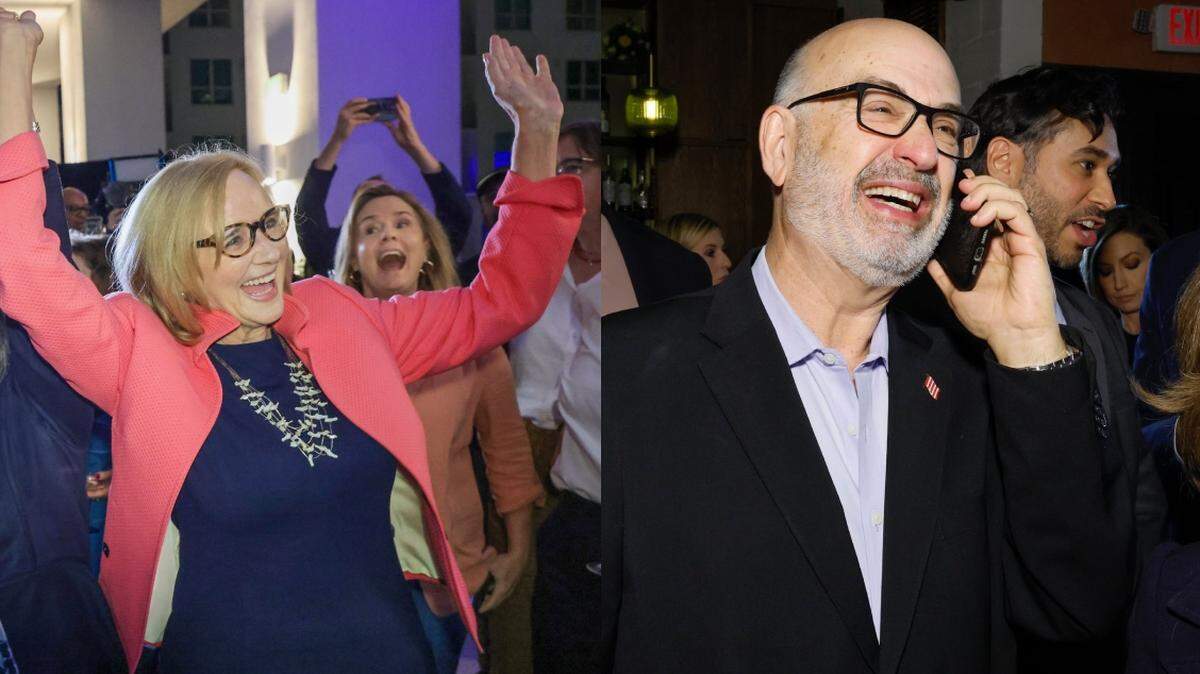
Miami’s most competitive mayoral election in more than two decades will reach its conclusion next week when candidates Emilio González and Eileen Higgins compete in a Dec. 9 runoff.
Tuesday night’s results will cap off what has been — even by Miami standards — a chaotic election season with unusually partisan vibes.
Although the position of mayor is officially non-partisan, the race — which voters last month whittled down from a 13-candidate royal rumble to two finalists — has garnered national attention and become steeped in party politics. González, a former city manager, landed the endorsements of Trump, Gov. Ron DeSantis and Texas Sen. Ted Cruz, among other major GOP politicians. Higgins, a former county commissioner, has the backing of the Democratic National Committee, Miami-Dade County Mayor Daniella Levine Cava and Miami Congresswoman Frederica Wilson.
Despite their ideological differences, González and Higgins have both pledged to quell the chaos and dysfunction in City Hall as they head into the runoff.
Here are five key issues at play in the pivotal race for Miami mayor.
Immigration
The issue where the candidates arguably diverge the most is their stance on immigration.
González, a Cuban immigrant and former director of U.S. Citizenship and Immigration Services, has said he will be an advocate for the immigrant community. But he also said he supports “rounding up people who commit crimes.”
“I cannot in good conscience fight the federal government and defend a rapist or a murderer, like happens in other cities,” González said in a debate last week hosted by CBS Miami.
In June, the City Commission voted to enter into what’s called a 287(g) agreement with ICE, which deputizes certain Miami police officers with immigration enforcement powers. The vote was highly controversial, with scores of residents showing up to City Hall and pleading with commissioners to vote against the measure. It passed 3-2.
González has said he’s not opposed to Miami police cooperating with federal immigration officers, assuming it remains limited to just a few officers rather than the whole department.
Higgins has said the city should have joined a lawsuit with South Miami that sought clarity from the courts about whether cities are required to sign 287(g) agreements, rather than opting into the ICE partnership. She previously called the city’s vote to enter the agreement “really sad and tragic.”
“First of all, they said they were gonna go after criminals, but guess what? They’re going after everybody,” Higgins said last week’s CBS Miami debate.
Housing affordability
Both candidates have spotlighted housing affordability as a key issue in the city.
Higgins has said that “the only way to solve our affordability crisis is to actually build affordable housing,” and that she would look at city-owned land as an option to build on. She’s also proposed creating an affordable housing trust fund, basically a city-run savings account set aside to finance affordable housing projects.
González, on the other hand, says adding more housing units isn’t necessarily the solution.
“We can talk about building affordable housing, workforce housing, fine. It’s never going to meet demand,” he said at a previous mayoral debate.
Instead, González has pointed to a DeSantis-backed proposal to eliminate homestead property taxes as an avenue for easing the financial burden on residents, saying Miamians are being “overtaxed and under-served.”
Outside employment
The position of Miami mayor is officially part-time, and the city’s elected officials are allowed to have outside employment — a policy that allowed Mayor Francis Suarez to drastically grow his net worth from more than a dozen income sources while in public office.
Higgins, a mechanical engineer by trade, has vowed to operate as a “full-time mayor” with no outside work if elected.
González is a partner at a California-based asset management firm called Ducenta Squared Asset Management, which he said does no business in Florida. The company’s CEO heads another company that donated a half-million dollars to González’s political committee, but González said during last week’s CBS Miami debate that the company expects “absolutely nothing” from him, and that the CEO is “an old friend of mine.”
González plans to continue working for the asset management firm if elected, although he said he wouldn’t take on any additional work beyond his current role.
City leadership
Both candidates have said they would replace City Manager Art Noriega — an unsurprising move for a new mayor.
González has first-hand experience as city manager, serving in the role from 2018 to 2020 under Suarez, the current mayor. After González’s departure in early 2020, Noriega was appointed to the post and has held the position since.
READ MORE: Emilio González, the most powerful administrator in Miami’s government, resigns
“I’m looking for a city manager that’s well-respected, that has gravitas, that is experienced, that when people point at him, they say, ‘You know what, it’s a new day.’ We’ve got to set the tone and tenor,” González said in last week’s debate.
He added that “our residents have to take us serious again.”
Higgins said she has “a number of people” that she’s thinking about for the position.
“We need somebody that is outrageously innovative, tech-facing, that can implement the new ideas that we need to move Miami into 2026,” Higgins said. She added that it’s also important to have a “second person that is really about change management and who has experience transforming organizations.”
Expanding the City Commission & even-year elections
It could be argued that the current election wouldn’t be taking place at all if it weren’t for González. Over the summer, he sued after the City Commission voted 3-2 to cancel the 2025 election and postpone it to 2026 in an effort to move the city from odd- to even-year elections.
The courts sided with González, finding the city’s ordinance postponing the election to be “unconstitutional” because it amended the charter without voter approval.
But the issue of switching to even-year elections remains a hot topic viewed by many residents as an important reform measure that proponents say would increase voter turnout and lower election costs.
González has said he supports sending the issue to voters, although he cautioned that aligning with the national election cycle could take the spotlight off of local candidates featured on the same ballot.
Higgins, who supports moving to even-year elections with voter approval, has said she’s not concerned about being on the same ballot as federal and state candidates. She’s also pledged to shorten her term so she’s out of office a year early, in 2028 instead of 2029, to sync up with the national election cycle.
González agreed, saying: “I would give up a year. That’s not a problem.”
Another reform measure that gained traction this year is a proposal increase the number of city commissioners. Currently, there are five commissioners representing a city of about a half-million residents.
Higgins said that, per capita, Miami has one of the smallest commissions compared to similarly-sized cities in Florida and across the country, and that she supports expanding to nine commission districts. Expanding the commission size, she told CBS Miami, “will make sure that each neighborhood gets true representation.”
González said he supports the concept, but that it’s not the right time for that change.
“We don’t need more commissioners, we need better commissioners.” He said it’s something to revisit in a few years, “but I don’t think we should have that as a going-in position.”
This story was originally published December 4, 2025 at 5:30 AM.
.jpg)