Miami-Dade slashed eviction aid program. Faith leaders push to restore funding
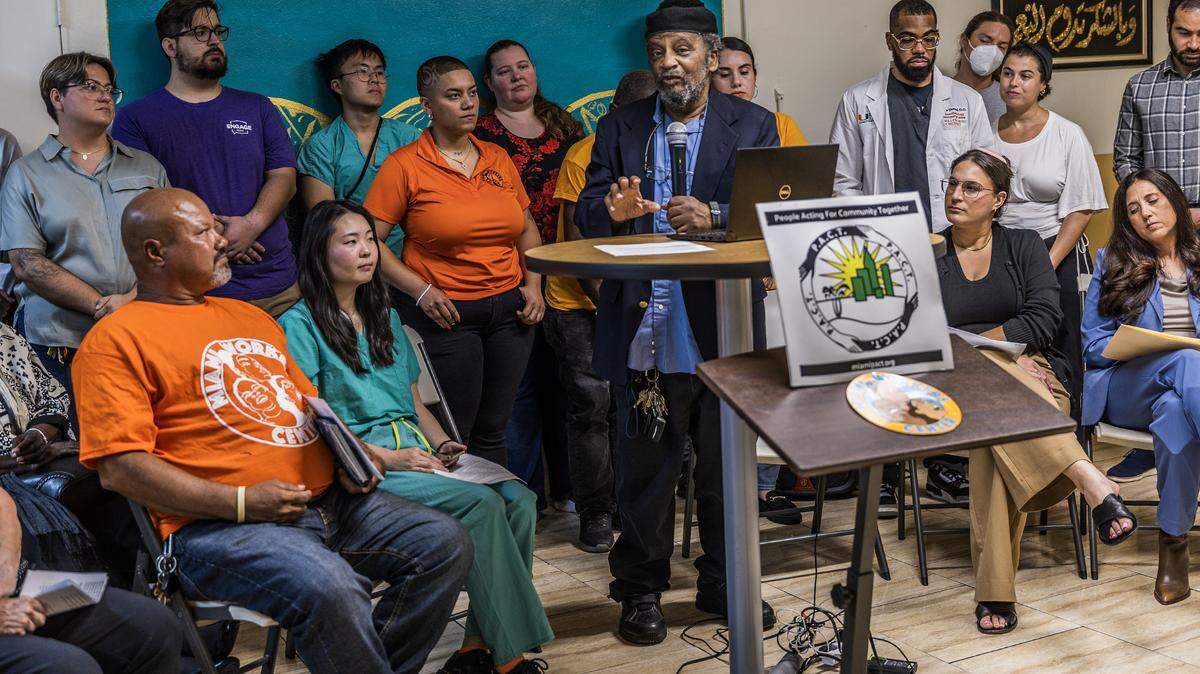
In the basement of Miami’s oldest mosque, faith leaders — Muslim, Jewish and Christian — along with attorneys and healthcare workers listened as resident Yovanny Martinez discussed the harsh reality of facing an eviction.
After 13 years of living in a mobile home park with his grandfather, Martinez received a notice from his landlord: move out in six months or get evicted.
Martinez — a roofer who is also the caretaker for his grandfather — is one of 90 families at Palm Lake Mobile Home Park in Gladeview facing the same dilemma. Many of the residents are low-wage workers, immigrant families with young children or elderly and disabled people on a fixed income.
“We have invested all of our savings and all of our resources into maintaining our trailers and maintaining the mobile home park, and with that investment we cannot accept failure,” Martinez said in Spanish.
But Martinez has some hope and help thanks to the folks at Miami Workers Center, a nonprofit that works to expand tenants rights and protections across the county. Martinez — who is now a member of the group — received legal help from a program called the Eviction Diversion Project, which has been providing families at Palm Lake with free legal representation to help fight the mass eviction. The case is still ongoing, but Martinez says that without the program, he would be forced out of his home. The legal help is the reason why the 90 families are still living there today.
“All of us residents at the mobile home park, we feel that this program is absolutely essential … we haven’t paid a cent for the support that we’ve received in this program,” he said. “It truly is providing life saving services.”
Martinez was one of several speakers at a prayer vigil, held at Masjid Al-Ansar, a mosque in Liberty City, who highlighted the mental and physical struggle of finding and keeping affordable housing in Miami-Dade. Many stressed the importance of programs like the one introduced by Miami Workers Center — but the eviction program may be in trouble due to recently proposed county budget cuts.
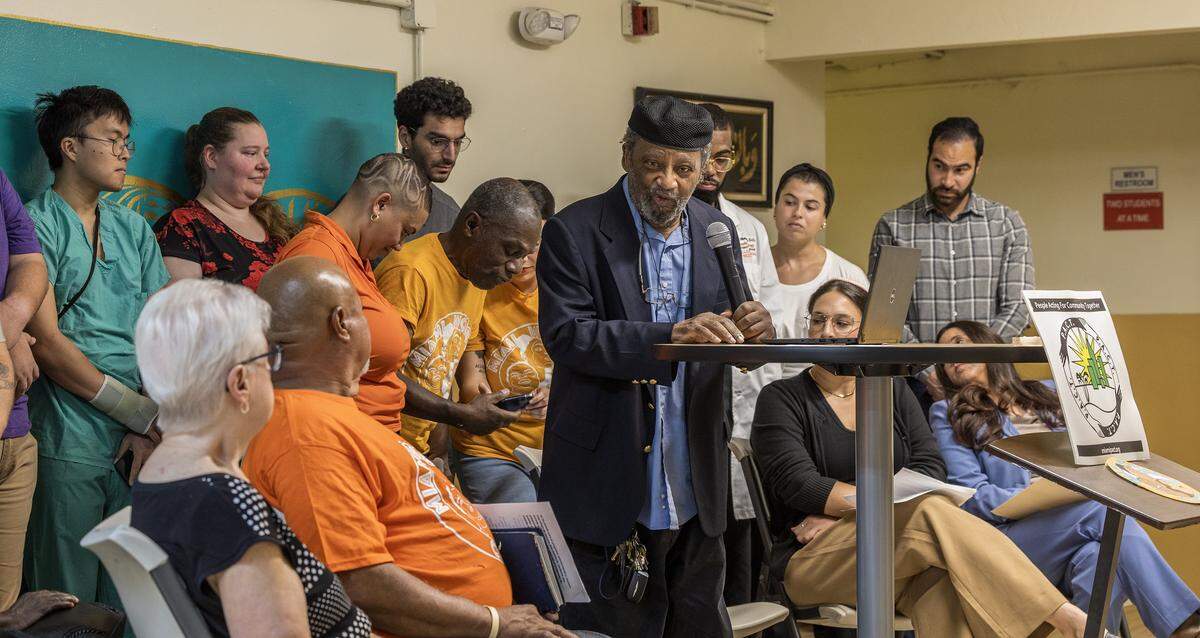
At the vigil, organized by a nonprofit called PACT — People Acting for Community Together — one of Miami-Dade’s most politically engaged interfaith groups — faith leaders, attorneys, healthcare workers and community members called out Miami-Dade County elected officials who failed honor their previous commitment to thousands of renters facing evictions.
That commitment came in April at PACT’s annual assembly where members press elected officials on issues like affordable housing and reducing evictions throughout the county. At that event, Miami-Dade County Mayor Daniella Levine Cava agreed to commit $3 million to the eviction diversion program in front of nearly 800 residents at Sweet Home Missionary Baptist Church in Cutler Bay. The current proposed budget allocates only $ 1 million to the program.
READ MORE: ’Rent is too damn high.’ Interfaith group demands action from Miami-Dade leaders
Vanny Veras, lead tenant organizer with Miami Workers Center, said the nonprofit is grateful that county leaders didn’t cut the program altogether, but that the reduction in funding is not a good sign for a pilot program fighting for permanence.
“This program is really the bare minimum,” said Veras, who works with residents facing dire housing conditions.
“We have elderly people living in rat and roach infested apartments, mold-infested apartments. They’re getting sick, high blood pressure, in and out of the hospital, broken ACs in the middle of the summer. Like people are going through so much. And to think of this program being cut when it’s one of the few things that we have, it’s just unacceptable.”
In a statement to the Miami Herald, County Commissioner Oliver Gilbert said the county has been “working tirelessly to make progress” in the area of housing affordability.
“We fund a range of programs to address this crisis, but one of the most important is the Eviction Diversion Program, which provides vital support for residents at risk of losing their homes,” he said.
Gilbert said that this year “is not an easy budget year,” and that he and his colleagues have been working to “close the funding gap” for programs that “protect families, reduce evictions, and give Miami-Dade residents the stability they need to thrive.”
Mayor Levine Cava and Commissioner Vice Chair Kionne McGhee did not immediately respond to requests for comments.
Facing evictions “with dignity”
The pilot program was funded by the county commission in 2023, and was designed to assist at-risk tenants and their families through free legal assistance and eviction diversion programs. Organizers also went door-to-door canvassing to households and people who were struggling to navigate an eviction process.
“When there’s an attorney involved, it’s better for everybody,” said Carrie Feit, an attorney with Community Justice Project. “A lot of times we’re almost serving as a mediator between the landlord and the tenant.”
Feit, who is working on the mobile home case, said even in situations where the eviction is lawful — like in cases of non-payment due to unaffordable or rising rents — the lawyers can help structure payment plans or ask for extended vacate dates. The free legal assistance helps people, regardless of income status, “navigate a very scary time with dignity and respect,” Feit said.
In many cases, Feit said the county has referred people facing evictions to the program for help. The lack of funding would leave more people without legal help, potentially leading to increased homelessness.
The program also allows the nonprofits involved to share data on how evictions impact housing stability, and identify ways to improve plans and processes for the future.
Within one year of the pilot’s launch, evictions fell from 19,479 to 18,142 — a nearly 7 percent decrease, according to Miami Workers Center. Organizers say this proves that legal help and outreach helps keep people housed and off the streets.
“We know that while poverty plays a role in whether or not you face an eviction, we also know that evictions are pretty evenly filed across the county at different income levels and different rental rates. In other words, eviction affects all of us,” said Feit at the vigil.
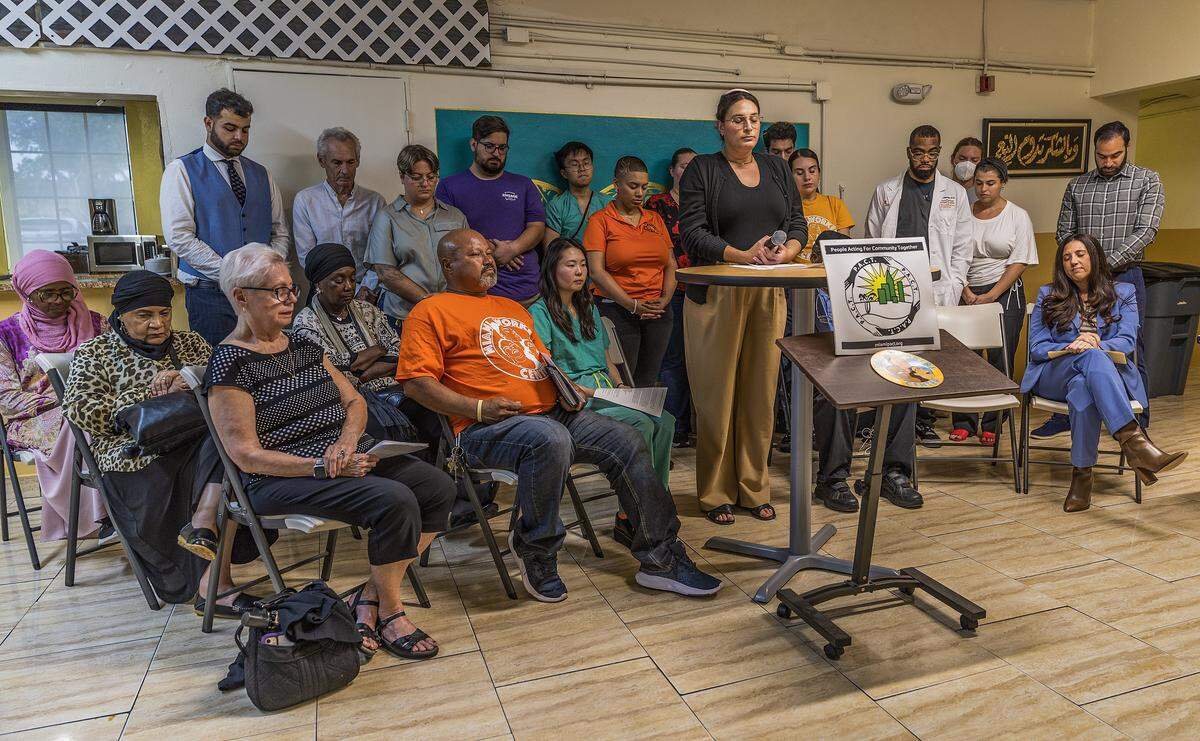
At the vigil, faith leaders across various denominations cited scripture about the dangers of unchecked wealth, the lack of affordable housing issues and other social problems. The interfaith aspect of the vigil is one result of PACT’s organizing work. The group is made up of some 40 churches, synagogues and mosques in Miami-Dade that come together to advocate for solutions to some of the county’s most pressing social issues.
“What’s the reason for our problems in society? And I’m telling you what it is.. Instead of you respecting God and worshiping God, you and I worship the businessman, we worship the banker,” said Imam Nasir Ahmad, spiritual leader of the mosque Al-Ansar.
Rabbi Jessica Jacobs of Temple Beth Sholom pointed out the imbalance in who receives legal representation in eviction cases.
“Only 3% of tenants have a lawyer to represent them in their eviction case, compared to 74% of landlords that are represented. The eviction diversion program is an opportunity to change this imbalance,” she said.
Jacobs also pointed to the Torah for guidance on how to treat the less fortunate in society.
“The Book of Deuteronomy tells us, do not harden your heart and shut your hand against your needy kin .. rather you must open your hand and lend whatever is sufficient to meet the need,” she said.
Rev. Candace Thomas — lead pastor at Christ Congregational United Church of Christ in Palmetto Bay — closed out the night in prayer.
“Let all those participating in the eviction diversion program get the help they need,” she said. “We pray for affordable housing, for just wages and a commitment to the Golden Rule — treating others as we would like to be treated.”
This story has been updated to reflect comments from Miami-Dade County Commissioner Oliver Gilbert.
This story was produced with financial support from Trish and Dan Bell and from donors comprising the South Florida Jewish and Muslim Communities, including Khalid and Diana Mirza, in partnership with Journalism Funding Partners. The Miami Herald maintains full editorial control of this work.
This story was originally published August 27, 2025 at 2:46 PM.