
Miami-Dade halted weed prosecutions, but thousands were jailed anyway. Most were Black
.jpg "Arrests for possession of small amounts of marijuana have decreased since the Miami-Dade State Attorney’s Office announced it would no longer prosecute the cases in August 2019. But a Miami Herald analysis of data from the Miami-Dade Clerk of Courts shows that more than 4,200 people have still been arrested for misdemeanor marijuana possession since the announcement — and that nearly 60% of the defendants were Black.")
Fred Johnson was 33 years old when he was arrested for the first time.
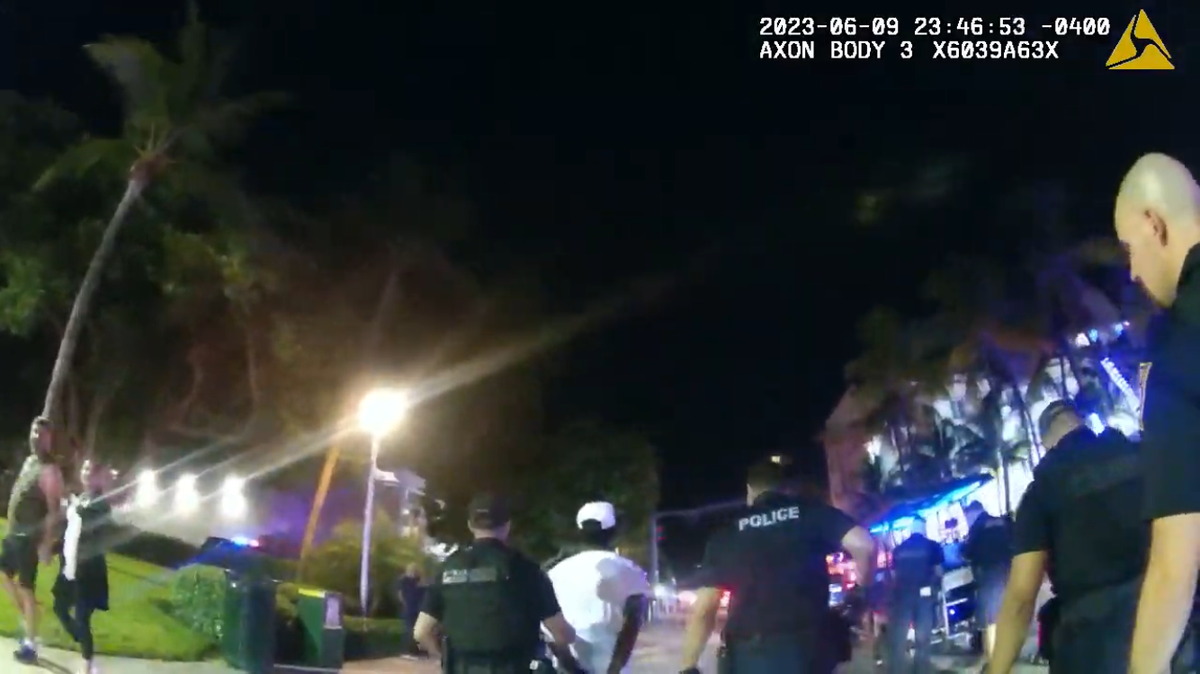
On a Friday night in June 2023, shortly before midnight, Johnson was smoking a joint as he led a golf cart tour of Ocean Drive for his business.
A police officer walking the strip approached Johnson and asked him and several tourists to step out of the cart. Johnson was placed in handcuffs. Outside the Clevelander hotel, about a half-dozen officers surrounded Johnson and searched him, finding three baggies with a total of an eighth of an ounce of cannabis inside, according to an arrest report. Johnson was arrested and spent about 17 hours in jail before being released on bond.
“It was very embarrassing and very traumatizing,” Johnson told the Miami Herald. “I didn’t know why I was being treated the way I was being treated.”
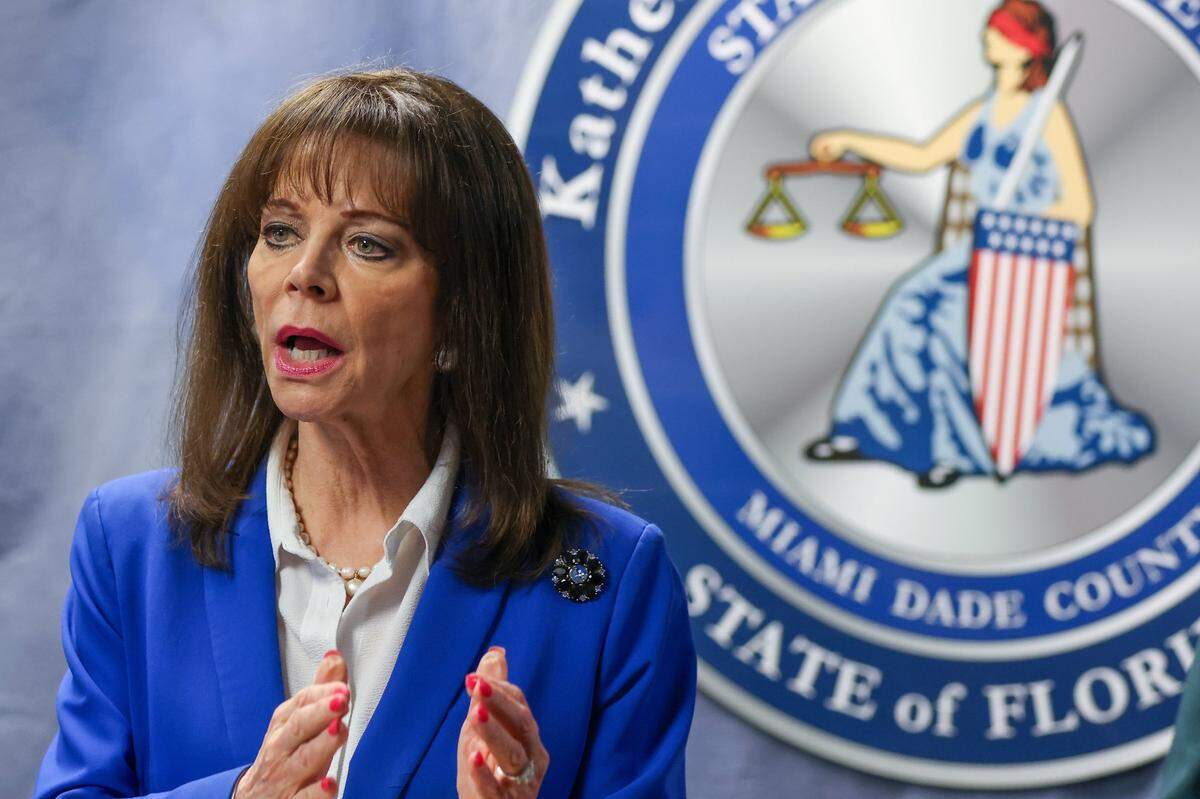
Johnson’s marijuana arrest came nearly four years after Miami-Dade’s top prosecutor, State Attorney Katherine Fernandez Rundle, in 2019 vowed to stop prosecuting such cases after hemp — a substance that looks and smells like marijuana — was legalized in Florida.
But police departments across the county continued to make arrests anyway, locking up more than 4,200 people on misdemeanor marijuana charges over the past five years. Nearly 60% of those cases were brought against Black defendants like Johnson, despite Black people making up just 18% of Miami-Dade’s population.
In at least 97% of the cases, prosecutors ultimately dropped the charges, according to a Miami Herald analysis of data from the Miami-Dade Clerk of Courts.

The continuing arrests are a “waste of taxpayer resources,” diverting funding and attention that should instead go toward “keeping our communities safe,” said Kara Gross, the legislative director and senior policy counsel for the American Civil Liberties Union of Florida.
“These arrests can have lifelong implications, even for a minor offense that the prosecutor’s office has said they are not going to be prosecuting anymore,” Gross said.
The arrests have continued despite shifting attitudes about cannabis as more states have legalized it for recreational use — something Florida could vote to do on Nov. 5 under Amendment 3.
Carlos Martinez, Miami-Dade’s elected public defender, said high volumes of arrests for such low-level crimes can strain the justice system. Both he and Fernandez Rundle have recently raised concerns about staffing shortages.
“All these low-level misdemeanor arrests, it takes prosecutor time away from prosecuting the really serious cases,” Martinez said.
The Herald’s analysis revealed a striking increase in the proportion of misdemeanor marijuana arrests of Black people in Miami-Dade County. Although the arrests have decreased substantially since Fernandez Rundle’s memo went out, the proportion of Black people arrested for the offense has gone up.
Between Jan. 1, 2018, and Aug. 5, 2019 — the date of Fernandez Rundle’s announcement — 47% of charges involving misdemeanor marijuana possession were filed against Black defendants. Since the announcement, 59% of charges have been lodged against Black defendants. The disparity comes despite data showing that Black people and white people use marijuana at similar rates.

Gross said the Herald’s analysis confirmed “what the data has always shown: that marijuana policies and arrests disproportionately target people of color and particularly Black people.” That includes a 2020 ACLU report that found, nationwide, Black people were 3.6 times more likely to be arrested for marijuana possession than white people.
Johnson, who lives in Miami Gardens, believes his arrest is a case in point. He noted that the sergeant who arrested him falsely accused him of selling drugs, despite finding such a small amount of marijuana in his backpack.
After Johnson was arrested, body-worn camera footage shows the sergeant saying to another officer: “I’m telling you, they’re dealing and stuff like that.”
“You don’t see anybody else of any other race going through this … and being as aggressively handled,” Johnson told the Herald.
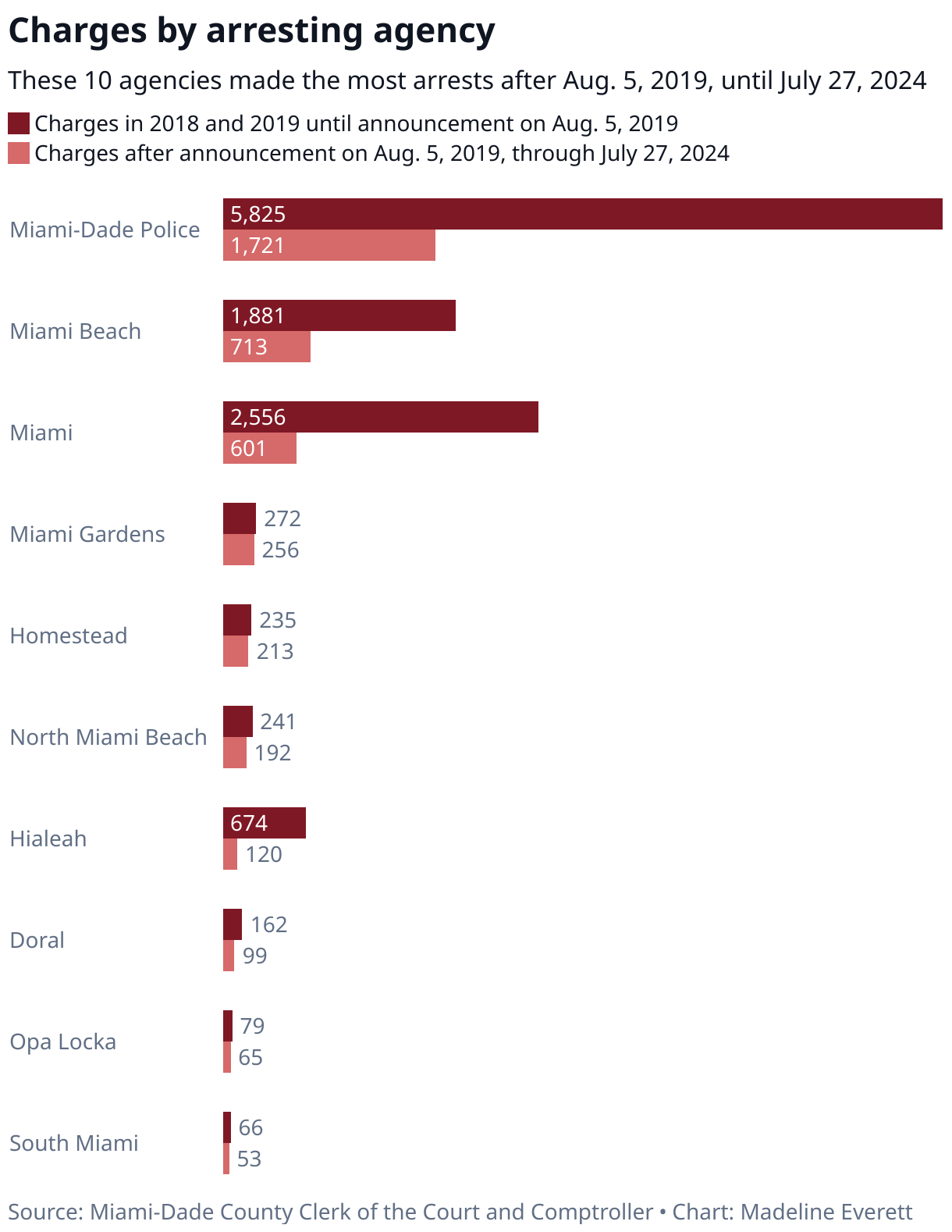
Since the 2019 State Attorney memo, many police departments in Miami-Dade have loosened their enforcement of marijuana laws or stopped making arrests entirely. But the Miami Beach Police Department stands out for its strict and ongoing enforcement.
Officers in Miami Beach have made more misdemeanor marijuana arrests than any other police department in the county except for the Miami-Dade Police Department, which has seven times as many sworn officers, according to the Herald’s analysis.
READ MORE: As marijuana arrests become less common in Miami-Dade, one city’s approach stands out
Earlier this year, Miami Beach officials removed an option for officers to issue civil citations in lieu of making arrests for marijuana possession. Police departments across Miami-Dade County have had the option to issue $100 civil citations for pot possession since 2015.
Racial disparities in marijuana arrests have also been acute in Miami Beach. Before Fernandez Rundle’s announcement, about 62% of misdemeanor marijuana possession charges in Miami Beach were filed against Black defendants, a figure that stayed mostly the same — rising slightly to 66% — after the announcement, the Herald’s analysis shows.
Only about 6% of Miami Beach residents are Black, though it is a popular destination for Black tourists.
Miami Beach officers charged Johnson with having less than 20 grams of cannabis, a misdemeanor that was dropped six days later. He was also hit with a criminal city ordinance violation for smoking marijuana in public. After choosing to fight the case without a lawyer, Johnson was ordered by a judge to pay $393 in court fees, records show. He received a “withhold of adjudication,” a form of probation that does not constitute a conviction.
But the arrest was a mark on his otherwise clean record, something he says has already limited his professional prospects. Late last year, Johnson, a former health insurance agent, tried to break back into the field by applying for a job during open enrollment season. But his arrest record prevented him from moving past a background check, he said.
“That pretty much ruined my health insurance license,” Johnson said.
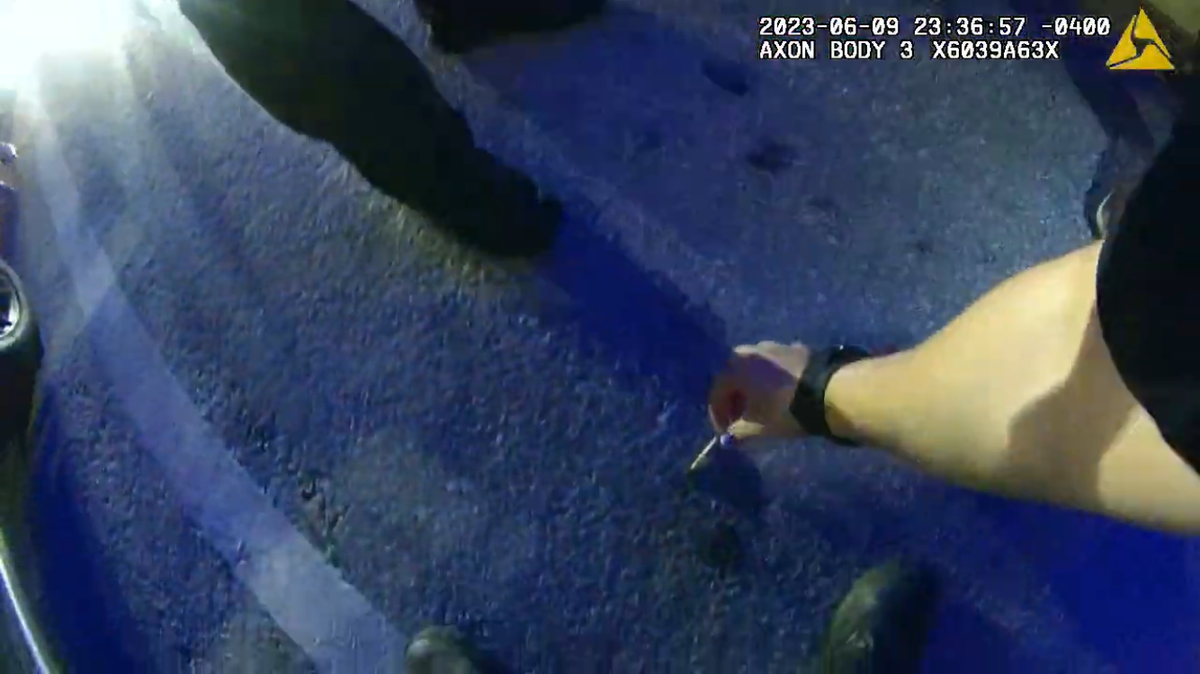
In response to questions from the Herald about the arrest, Miami Beach police spokesperson Christopher Bess said it did not appear that officers violated any of the department’s standard operating procedures.
Bess said the department doesn’t believe that racial bias is playing a role in how marijuana laws are enforced.
“The Miami Beach Police Department is committed to upholding all local and state laws to ensure the safety and well-being of our residents, visitors, and community members,” he said.

‘There must be a prioritization’
In her August 2019 memo, Fernandez Rundle explained that her office would no longer prosecute low-level marijuana offenses because of the costs and challenges of lab testing to distinguish between legal hemp and illegal cannabis based on THC concentrations — something the local crime lab was unable to do at the time.
By November 2020, the crime lab had developed a method for testing THC concentrations, according to a spokesperson for the Miami-Dade Police Department, which tests most of the drugs in cases from the Miami-Dade State Attorney’s Office. But cannabis cases remained a low priority both for the lab and for prosecutors. Since Fernandez Rundle’s announcement in 2019, only 15 people who were arrested on misdemeanor marijuana charges have been convicted, the data shows.
Stephanie Stoiloff, chief of the police department’s forensic services division, said the lab now “only accepts suspect cannabis cases from grow houses and/or submissions near trafficking thresholds” and that any other requests for analysis “are evaluated on a case-by-case basis.”
The State Attorney’s Office has continued its practice of dropping the vast majority of misdemeanor marijuana charges. Spokesperson Ed Griffith said charges are considered on a case-by-case basis but that the office is more focused on deadly substances like fentanyl.
“With the increase in the varieties of dangerous substances that are now seen, it certainly causes an increase in the workload of the Crime Lab, and there must be a prioritization in the lab as to what cases are going to be tested,” he said.
Data from the Miami-Dade Clerk of Courts further shows how low-level marijuana arrests have been deprioritized by law enforcement as hemp was legalized and public sentiment softened.
In 2018, there were more than 8,900 charges for misdemeanor marijuana possession countywide, the data shows, and in the first seven months of 2019, before the memo went out, there were nearly 4,400 charges filed.
After the State Attorney’s Office said it was halting prosecutions that August, only 286 charges were filed for the remainder of the year. The number of cases plummeted to 408 in 2020, then hovered around 1,000 in each of the next three years. This year, Miami-Dade is on pace for about 1,200 such charges.

Weeks after Fernandez Rundle’s memo went out in August 2019, the Miami-Dade Police Department — the largest police department in the county — instructed officers to issue civil citations for misdemeanor possession of marijuana, regardless of the person’s criminal history, whether the person was smoking in public or whether “the cannabis is packaged in a manner indicative of drug sales.”
A misdemeanor amount is 20 grams or less, or about enough to fit in a sandwich bag. The corresponding charge is punishable by up to a year in jail and up to $1,000 in fines. Department spokesman Andre Martin said the current policy is to issue a civil citation in lieu of an arrest for first-time marijuana possession offenders but that someone with a criminal history could be eligible for charges.
“With most misdemeanors, we have discretion,” he said.
City of Miami police also issued a legal bulletin in August 2019, saying officers were “strongly encouraged” not to make arrests when the only charge was cannabis-related.
Miami police now say their policy is to issue civil citations for 20 grams of marijuana or less, until a third citation. Arrests are generally not made unless it’s in conjunction with another charge, officials said, though officers have the discretion to make an arrest or issue a citation. Since Fernandez Rundle’s announcement, 83% of arrests by Miami police for misdemeanor marijuana possession have had at least one other associated charge, according to the Herald’s analysis.
“If you ask the average officer, they don’t want to be tied up for hours on a misdemeanor arrest in which there’s a reasonable alternative,” said Miami Assistant Police Chief Armando Aguilar Jr.
Gross, of the ACLU, said the discretion that officers are afforded can allow racial biases to play a bigger role.
“It creates a system of distrust with law enforcement,” she said. “It’s a longstanding issue where very minor offenses — marijuana, loitering, jaywalking — are very aggressively enforced in communities of color.”
A ‘predicate for searches’
Despite a lack of prosecutions for marijuana possession in recent years, police across Miami-Dade County continue to pursue the arrests in part because the drug can lay the groundwork for vehicle searches and additional charges, according to law enforcement officials and defense attorneys who spoke with the Herald.
For years, officers have relied on the sight and smell of marijuana to establish probable cause to search cars without a warrant after traffic stops.
“It’s a predicate for searches all the time,” said Kenneth Weisman, a Miami-based criminal defense attorney. “That’s what I see more than marijuana prosecutions.”
The legalization of hemp in Florida complicated things for law enforcement, given that the plant looks and smells like marijuana. In her August 2019 memo, Fernandez Rundle advised officers to use additional factors to establish probable cause when officers want to search a vehicle, such as “nervousness,” “furtive movements” or “trying to hide a substance.”
The Florida Supreme Court has yet to weigh in on the matter. But arrest reports reviewed by the Herald suggest the smell of marijuana is still a common pretext for searches and can lead to more serious charges.
Chad Piotrowski, a Miami criminal defense lawyer, said traffic stops often stem from something minor, like tinted windows or an illegal license plate frame. Then, the smell of marijuana “gets [police] into the car” to conduct a search and potentially recover weapons or other drugs.
“They use it as a pretext,” he said. “I think that’s clear as day.”
From Jan. 1, 2018, until Fernandez Rundle’s announcement on Aug. 5, 2019, about 35% of arrests for misdemeanor marijuana possession in Miami-Dade were paired with at least one additional charge, according to a Herald analysis of publicly available case dockets.
After the announcement, more than three-quarters of those cases have included additional charges — an indication, attorneys said, that officers are moving away from making standalone marijuana possession arrests but continue to lean on the sight and smell of marijuana in their police work.
The State Attorney’s Office hasn’t asked police to change their approach, leaving it up to each agency to decide when to make arrests.
“Each of Miami-Dade County’s 37 separate police departments are overseen by their individual municipal governments,” said Griffith, the State Attorney’s Office spokesperson. “It is these governments that regulate the overall approaches and directions taken by their own police departments.”
Gross, of the ACLU, believes the only solution is for police to stop making arrests for small amounts of marijuana altogether. Legalizing the drug, she said, would be essential to addressing racial disparities and creating a more fair system.
“It is just a waste of our taxpayer resources,” Gross said, “and the vast majority of Floridians understand that.”
Miami Herald reporter Chuck Rabin contributed to this report.
BEHIND THE STORY
MOREThe Miami Herald obtained data on misdemeanor marijuana charges from the Miami-Dade County Clerk of Courts through a public records request. The data included case numbers, created date, race, ethnicity, arresting agency, charge description and disposition. Race included the categories white, Black or African American, Asian/Pacific Islander, American Indian/Alaska Native, and unknown. If the person was Hispanic, that was listed under a separate category for ethnicity. Each row represented one charge of misdemeanor marijuana possession under Florida Statute 893.13(6)(b).
The Herald subsequently used a browser automation tool to run each case number through the Miami-Dade County Clerk of Courts online criminal case system. This provided additional details about each case, including the arrest date, length of time that the case was open, additional charges and docket entries.
This story was originally published October 29, 2024 at 5:00 AM.