U.S. Supreme Court makes final decision on Miami’s voting map for upcoming election
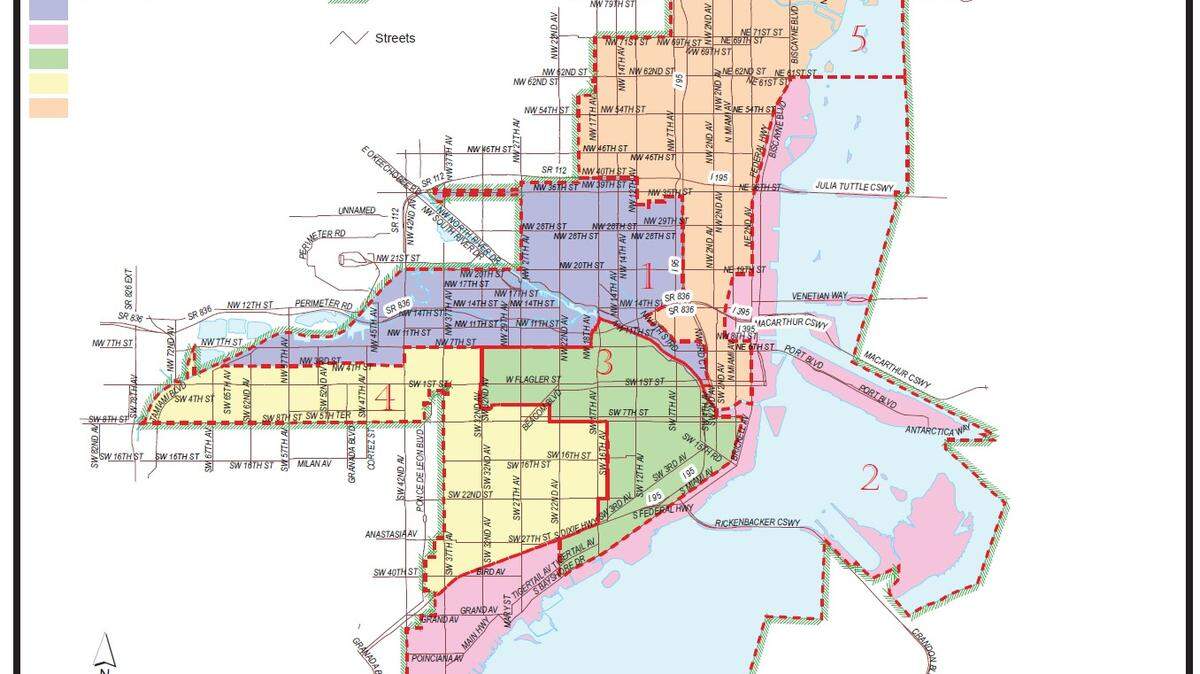
The U.S. Supreme Court ruled on Thursday in a legal battle over which voting map should be used for Miami’s upcoming elections, deciding that a map drawn by the city should be used.
The map, approved by the City Commission in June after a federal judge rejected an initial map drawn in 2022, leaves one commissioner in his district and places a candidate outside of the district he’s lived in for 20 years.
After several appeals that moved the case through federal courts, the Supreme Court decided that a map drawn by the city be used to determine who can vote and who can run for City Commission seats in districts 1, 2 and 4 in the Nov. 7 elections. Three incumbents are running for reelection: District 1 Commissioner Alex Díaz de la Portilla, District 2 Commissioner Sabina Covo and District 4 Commissioner Manolo Reyes.
In the city map, District 3 Commissioner Joe Carollo’s home remains inside his district — the other map placed his home outside of his district, which could have led to a residency issue for Carollo.
The city map creates a problem for Miguel Gabela, an auto parts dealer who has been campaigning since February to run against Díaz de la Portilla. Gabela’s home is no longer in the district under the city map. In a separate legal case, he is suing the city over the issue in Miami-Dade Circuit Court.
Read more: Legal fight over Miami’s city voting map has reached U.S. Supreme Court. Now what?
Thursday’s decision is one part of a broader pending federal lawsuit against the city that was filed by community groups in late 2022. The organizations, which include two local chapters of the NAACP, accused commissioners of approving an unconstitutional voting map in March 2022 that racially gerrymandered city districts.
The plaintiffs asked a federal district court judge to temporarily block the 2022 map for this year’s election while both sides prepare for a trial in 2024. In May, the judge agreed, forcing the city back to the drawing board.
Commissioners approved a new map in June, which was rejected again. The advocacy groups submitted a different map, which was chosen by a federal judge July 30. The city quickly appealed, and a three-judge panel from the U.S. Court of Appeals for the 11th Circuit sided with the city in a 2-1 decision. Then the ACLU appealed to the U.S. Supreme Court, leading to Thursday’s decision.
Justice Clarence Thomas, who is assigned to handle cases that come out of the 11th Circuit, asked both sides for their arguments. The Supreme Court’s order denying the appeal was brief, but it stated that the case had been referred to the full nine-person court. The order did not say how the justices voted.
In a statement, Díaz de la Portilla said city residents “won big today as our nation’s highest court recognized that political shenanigans by special interest groups will not be tolerated by an impartial Supreme Court.”
“They said enough is enough and I agree,” the commissioner wrote. “Our City Commission approved maps meet constitutional standards and protect our City of Miami neighborhoods. End of story.”
Daniella Pierre, president of the NAACP Miami-Dade Branch, said in a statement the decision was “extremely disappointing and disheartening,” but they will continue to push for a map they see as fair.
“Fair and equal representation is a right, and our communities should be electing who represents them,” Pierre said. “Elected officials should not be choosing their constituents. This decision will not stop us from ensuring that all Miamians have their voices heard, including Black and Hispanic communities who were specifically targeted by the racially gerrymandered map.”
The legal back-and-forth was focused solely on which temporary map should be used for the November election. The case is expected to go to trial in early 2024.
Carolyn Donaldson, board member of one of the community groups, Grove Rights and Community Equity Inc. (GRACE), said in a statement that the decision shows why the city needs more districts, an idea that commissioners have dismissed in the past.
“This decision makes it even more apparent that additional districts are needed and the next path to balance representation and protect neighborhoods,” she wrote.
This story was originally published August 17, 2023 at 5:39 PM.