Miami candidate sues city over voting map because his house is no longer in district
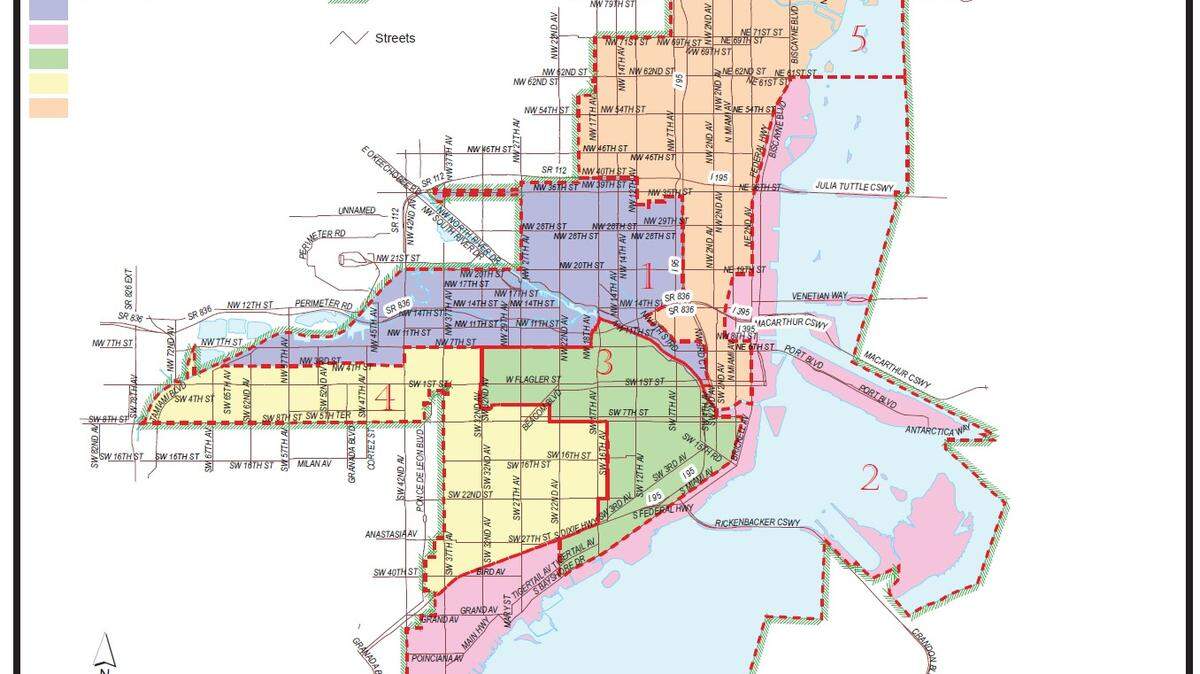
A candidate for Miami City Commission is suing the city to stop the use of a voting map that excludes his home from the district he’s lived in for 20 years — a new legal challenge amid an ongoing battle over how to draw the city’s political boundaries.
Miguel Gabela, an auto parts retailer who is running against incumbent District 1 Commissioner Alex Díaz de la Portilla, is accusing the city commission of violating city and state laws by passing a voting map that excludes Gabela’s home from District 1, where he has been campaigning since February. In 2019, Díaz de la Portilla beat Gabela to win the seat and return to elected office for the first time in years. They are the only two people who have filed to run for District 1 this year.
According to the lawsuit filed Monday in Miami-Dade County Circuit Court, a published agenda for the June 14 meeting improperly stated that the hearing would not allow public comment on the discussion about changing the city’s district boundaries. Commissioners approved a new map that day, weeks after a federal judge tossed out a previous voting map that is being challenged in a separate, unresolved federal racial gerrymandering lawsuit.
Other online notices for the meeting advertised a public comment period for the discussion, but the published agenda stated that “no member of the public may address the City Commission” during the discussion. The commission still allowed the public to speak, and Gabela voiced his displeasure for being drawn out of the district he wants to represent. Hours later, the commission approved a map that excluded Gabela from District 1.
On Monday, City Attorney Victoria Méndez said the city is aware of the lawsuit and reviewing the allegations.
“We will respond accordingly once we are properly served,” she said.

On Monday, Gabela told the Miami Herald the approval of the new map was a political move to prevent him from running because Díaz de la Portilla feared losing in the November election.
“What they were doing was wrong,” Gabela said.
In a statement Monday, Díaz de la Portilla said that living in the district a candidate wants to represent provides a “needed connection to the district and an understanding of how government can best serve the interests of those constituents.” The commissioner said Gabela was admitting he is not a District 1 resident, making him unqualified to represent the area.
“Instead of fighting the city he supposedly wants to help govern, Gabela should help inform the voters of where the law requires them to vote,” the commissioner said. “That would be an ideal example of public service, something I strive to do every day.”

Gabela’s lawsuit, filed by attorney David Winker, also accuses the city of breaking a newly enacted state law that prohibits city governments from changing district boundaries 270 days before a regular general election. The law, which went into effect July 1, also bans the drawing of districts to favor or hurt candidates or incumbents based on their addresses.
The legal argument based on the new law could hinge on how the court interprets the back-and-forth happening in an ongoing federal lawsuit over the city’s redistricting plan. Community groups represented by the American Civil Liberties Union have accused the city of drawing racially gerrymandered districts that unconstitutionally pack Black and Hispanic voters in certain districts.
The federal case has taken several turns recently.
On July 30, a U.S. District Court judge sided with the community groups and ordered their preferred map to be used for the November election. Friday night, a three-judge panel from the U.S. Court of Appeals for the 11th Circuit ruled 2-1 to rejected the lower court’s decision, allowing the city to use the commission-approved June 14 map. On Sunday, the ACLU asked the U.S. Supreme Court to vacate the appellate decision and block the city’s map, urging the court to rule by Friday.
The appellate court’s decision reintroduced the city map after July 1, when the new state law took effect. Monday’s lawsuit argues the city’s approval of the map violates the new law because the map was drawn to disfavor Gabela.
“That’s going to be my argument,” Winker said.
This story was originally published August 7, 2023 at 7:22 PM.