Miami-Dade plan for more housing next to public transit seeing backlash. Here’s why
When Miami-Dade County Commissioner Oliver Gilbert laid out a vision last year to allow taller buildings near transit lines in cities, he declared it was time for “big and difficult” action to address the county’s traffic congestion and affordable housing needs.
But after almost a year of fierce opposition from municipal leaders, what began as an ambitious plan to force cities to accept increased housing density near public transportation routes has turned into a watered-down version of the proposal.
Gilbert’s revised legislation, introduced earlier this year, would allow cities to maintain control of their local zoning laws and guarantee that single-family neighborhoods won’t be touched. That’s a win for municipal leaders who railed against the original plan, saying it could have irreversibly changed the character of Miami-Dade’s more spacious suburbs.
“Now these single-family homes are protected,” Pinecrest Mayor Joseph Corradino told the Miami Herald after the County Commission advanced Gilbert’s updated proposal in an initial 8-3 vote on June 1. “It’s a win for Pinecrest any way you look at it.”
Gilbert’s legislation has exposed tensions between city and county leaders as Miami-Dade seeks to expand its transit system and address a housing affordability crisis. While planning experts say it’s essential to add more housing along transit routes, some city officials and their constituents are staunchly opposed to taller buildings and population spikes in their neighborhoods.
“Every community wants to limit what can be built in it,” said Grace Perdomo, executive director of Transit Alliance Miami. “The result is that the buck keeps getting passed and no one is building what needs to be built.”
READ MORE: HUD secretary says Miami ‘epicenter’ of affordable housing crisis
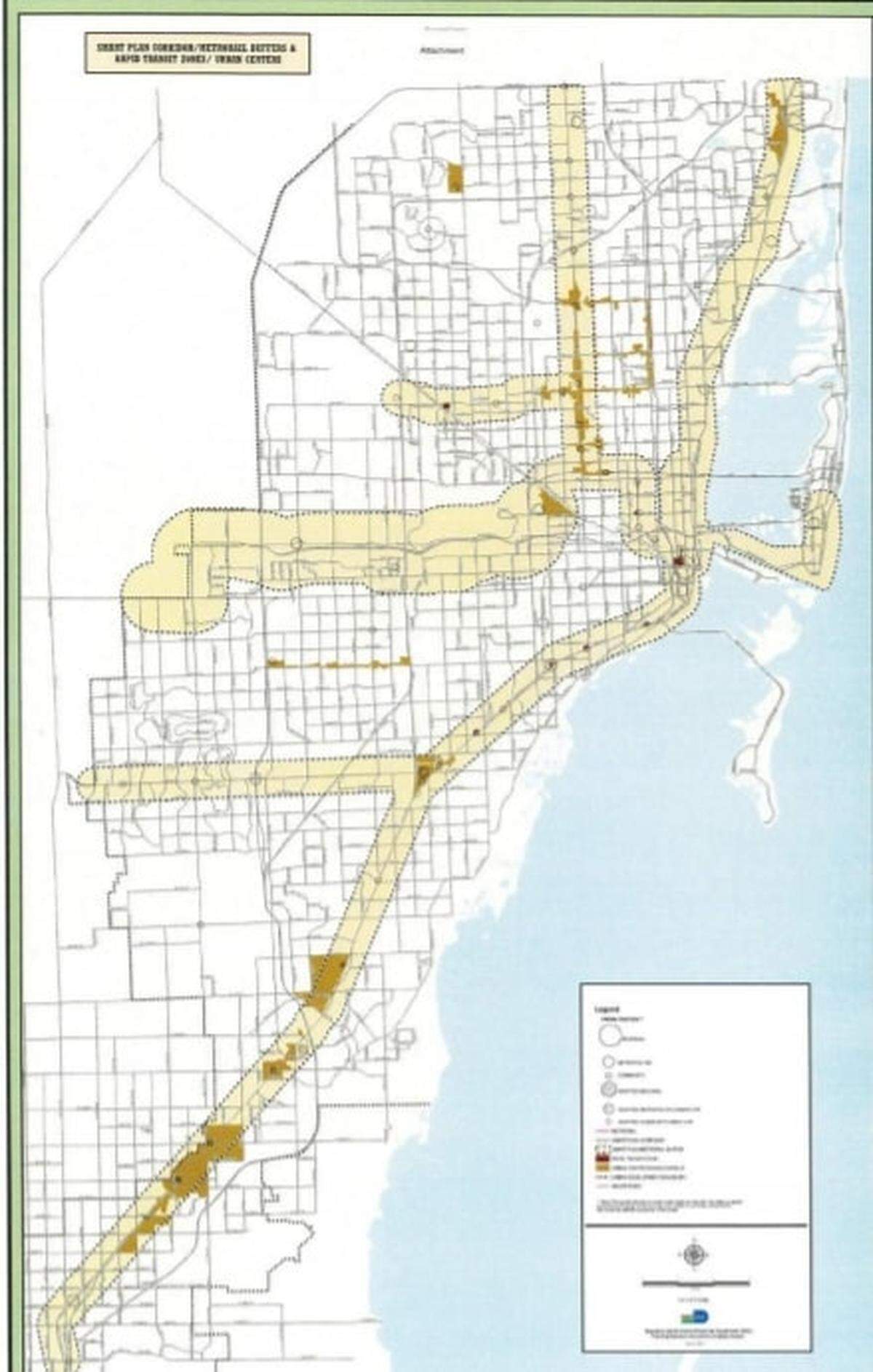
Under Gilbert’s plan, cities would be added to the county’s existing Rapid Transit Zone, which currently only applies to unincorporated areas outside city limits that are governed by county zoning rules.
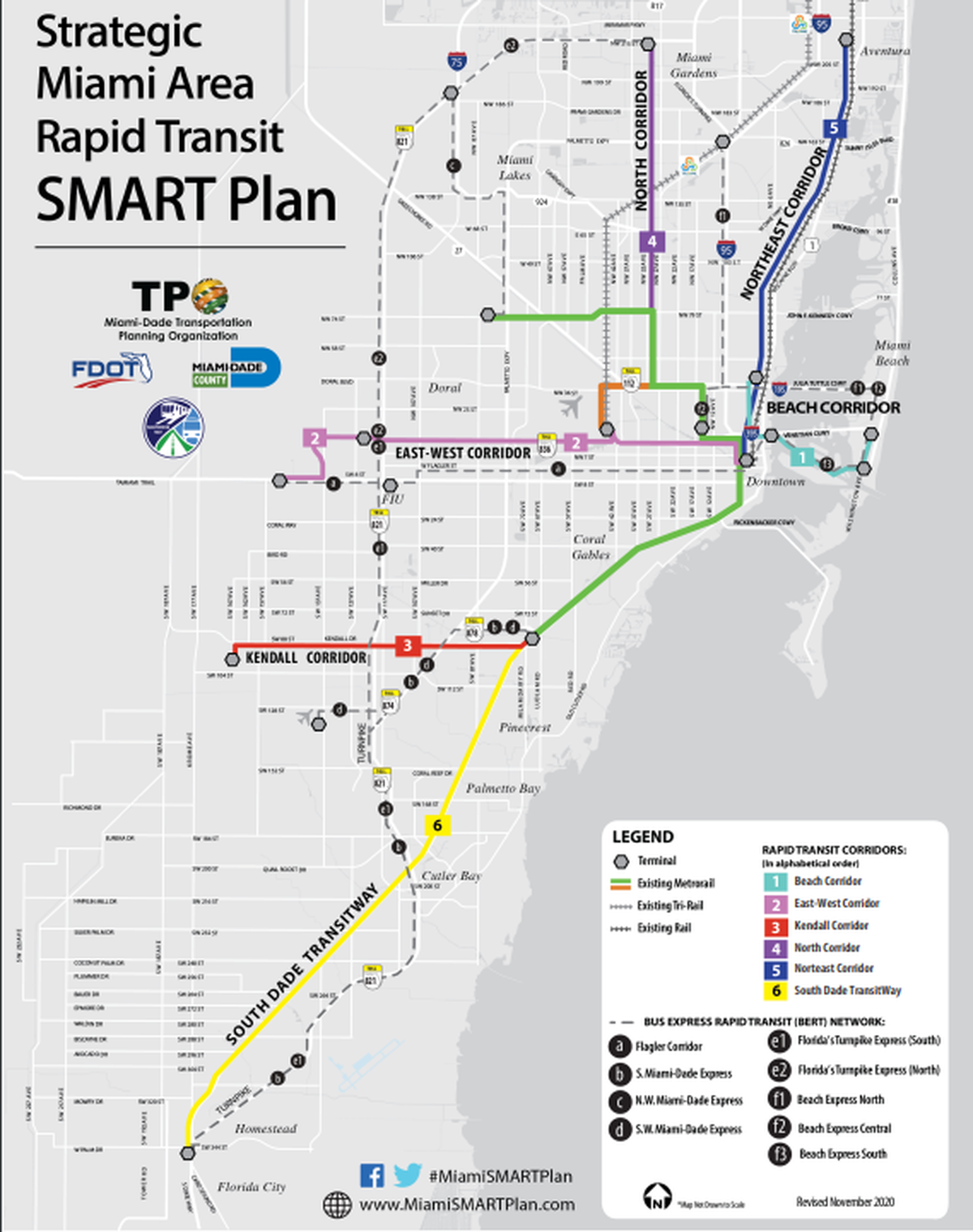
Within the zone — which includes 25 miles of express bus and Metrorail routes laid out in a 2016 plan — developers are allowed to construct mid-rise buildings within a half-mile of existing and planned rapid-transit corridors in exchange for accepting a set of county rules. The idea is to encourage new housing close to six mass transit corridors that stretch from the western Miami-Dade suburbs to Miami Beach and from the Broward County line to Florida City, making it easier for residents to take a train or bus to work rather than driving on already crowded roads and highways.
The revised proposal asks cities to submit plans to the county within the next two years showing they’re making an effort to encourage housing development near public transportation. To measure that, Gilbert’s legislation asks cities to meet minimum “floor-area ratio” requirements — a mechanism intended to limit open space and encourage denser development while letting cities keep their own height restrictions in place.
Cities could make the case to remove certain areas from the requirements if they would result in “incompatible” development in, or next to, neighborhoods zoned for single-family homes or duplexes.
Some cities are requesting a “carve-out” from the plan entirely.
“The item is a really long way from what it was, but it’s just not far enough,” Palmetto Bay Mayor Karyn Cunningham said at a June 6 Village Council meeting.
Gilbert said he doesn’t plan to give any city a pass from participating.
“It is wholly unfair to other cities who are going to bear the burden of housing and transit,” he said in an interview. “I respect municipal leaders speaking for their municipal interest, but this is a community goal.”
The ordinance has no penalties if municipalities don’t comply. But it would give the county commission the power to take stronger action at a later date to force lagging local governments to play ball. Its passage would for the first time impose a county requirement for cities to allow more construction around transit routes. A public hearing on the legislation is set for July 13.
“We’re asking you to do this, but we’re not penalizing anyone,” County Commissioner Raquel Regalado, a former critic of the legislation who now supports it, said during a June 8 meeting with Gilbert and municipal leaders. “We’re just saying: ‘Let’s do this.’”
Some homeowners inside the targeted suburbs still see the county’s plan as a threat to their communities.
“We’re a bedroom community. We’ve always been a bedroom community,” Laura McNaughton, founder of Concerned Citizens of Pinecrest, told Gilbert and Regalado. “People moved away from the cities for our open spaces.”
“Carve us out,” she said, according to a county audio recording of the meeting.
What’s different in revised plan
The original proposal could have substantially increased the housing stock of some suburban cities. In Miami Springs, officials calculated that the initial plan could have doubled the city’s population of 14,000 people, allowing for more than 6,000 apartments and condos near the Okeechobee and Miami International Airport Metrorail stations.
Miami Springs officials now say the city already meets the requirements in the new proposal. In a June 21 letter to the county, City Manager William Alonso asked for confirmation that Miami Springs “is effectively ‘taken off the map’ ... and that the City does not need to take any further action if the RTZ Ordinance is adopted in its current form.”
In response, a county official said he would need more information before weighing in.
In Pinecrest, which is near two Metrorail stations and borders the county’s planned rapid-transit bus system, an analysis of Gilbert’s original draft ordinance by the Miami-Dade League of Cities found that zoning rules that currently allow 6,600 units would have been changed to allow 63,000.
Corradino, the mayor, said the original plan would have impacted over 3,500 acres of land in the village and allowed 125 housing units per acre in areas that currently allow just one or two. The revised legislation would affect no more than 50 acres, he said.
“It’s a very flexible way of doing things,” Corradino said, adding that the required floor-area ratios are “at the very low side” for development around transit stations.
The proposal requires about 13% of new units near transit to be affordable to families making less than $100,000 — but only in unincorporated areas, letting cities decide whether to require affordable units.
Ned Murray, associate director of the Jorge M. Pérez Metropolitan Center at Florida International University, said “everyone needs to be at the table” to solve Miami-Dade’s affordable housing crisis. About half of all households in the county pay more than 30% of their income for housing and experts say the county needs to add tens of thousands of affordable units to address the problem.
“This shouldn’t just be Miami-Dade County government’s problem,” Murray said. “All the municipalities have a role and responsibility in addressing it.”
Kevin Greiner, an urban planner and economist who helped craft an affordable housing master plan for the city of Miami, said it can take years to get buy-in from local leaders and homeowners.
“It’s a painful discussion, but it has to happen,” he said. “You can’t hammer it down from the top.”
South Dade cities push back
Some of the loudest opposition to Gilbert’s plan has come from South Miami-Dade, where a planned electric bus system is slated to run express routes along a 20-mile path parallel to U.S. 1.
In March, Palmetto Bay and Pinecrest joined three other cities to their south — Cutler Bay, Homestead and Florida City — in presenting a united front against the original proposal, saying in letters to Gilbert that they already have plans in place to encourage development near transit routes.
“The South Dade Municipal Coalition would like to stress that it is critical that each municipality maintain the right of self-determination in local affairs,” the letters said, “and urges you to consider an approach that allows the municipalities to work collectively to solve the challenges that exist in South Dade.”
In Pinecrest, despite Corradino’s insistence that the revised plan gives the village sufficient control over its housing destiny, the Rapid Transit Zone proposal continues to cause a firestorm in a city that takes pride in its “one-acre lots, lush canopy and vibrant parks.”
Some residents saw Gilbert’s proposal last year as such a grave threat that they formed a group, Concerned Citizens of Pinecrest, in part to fight it. The group is gathering signatures for a potential ballot referendum that would ask residents to mandate a citywide vote before any changes to the zoning code could take effect.
Corradino is sparring with the group, releasing a stream of emails and videos that tout the village’s opposition to the original Gilbert plan and calling the petition unnecessary.
“Pinecrest was the first to identify this threat and led the resistance against it,” Corradino wrote in a June 24 email. “We ask the petitioners to drop this effort, which is creating great confusion in the community about something that will no longer be an issue.”
The Concerned Citizens group has blasted Corradino for promoting a plan that could lead to taller buildings along U.S. 1, a crucial part of the planned express-bus system in South Miami-Dade. That area in Pinecrest has been flagged in past county reports as an obstacle to the county’s transit-oriented development goals.
For some Pinecrest residents, bringing taller buildings to their suburban village is a non-starter.
“These radical changes could impact our Village and potentially be irreversible,” the Concerned Citizens group says on its website.
The conversation in Pinecrest stands in contrast to at least one of its Miami-Dade peers. Miami Gardens has already submitted a plan to the county showing how it will fashion its own Rapid Transit Zone district to add density without affecting single-family homes.
“Miami Gardens is already poised for this conversation,” said Gilbert, who was the city’s mayor for eight years until 2020. “They protected their single-family homes. We’re not trying to destroy anybody’s city. We’re trying to plan for the future.”
This story was originally published June 30, 2022 at 8:00 AM.