
Cities fight ‘jaw-dropping’ Miami-Dade County zoning expansion near transit routes
Before filing legislation to let taller buildings go up near transit lines in cities across Miami-Dade, County Commissioner Oliver Gilbert circulated a draft proposal to some municipal leaders for their reactions. That’s when the opposition began.
“It would totally devastate our city,” Mayor Maria Puente Mitchell said during a well-attended Aug. 9 meeting of the Miami Springs City Council also attended by Gilbert.
An analysis by the city administration found Gilbert’s draft plan would clear the way for adding more than 6,000 apartments and condominiums in neighborhoods near the Okeechobee and Miami International Airport Metrorail stations and eventually double the city’s population of 14,000 people. Mitchell called the proposal “jaw-dropping.”
Gilbert told Miami Springs leaders he’d change his plan to drop single-family home neighborhoods in Miami Springs from the expanded Rapid Transit Zone district, but an uphill fight remains to win city support for a dramatic increase in the number of homes near trains and express buses.
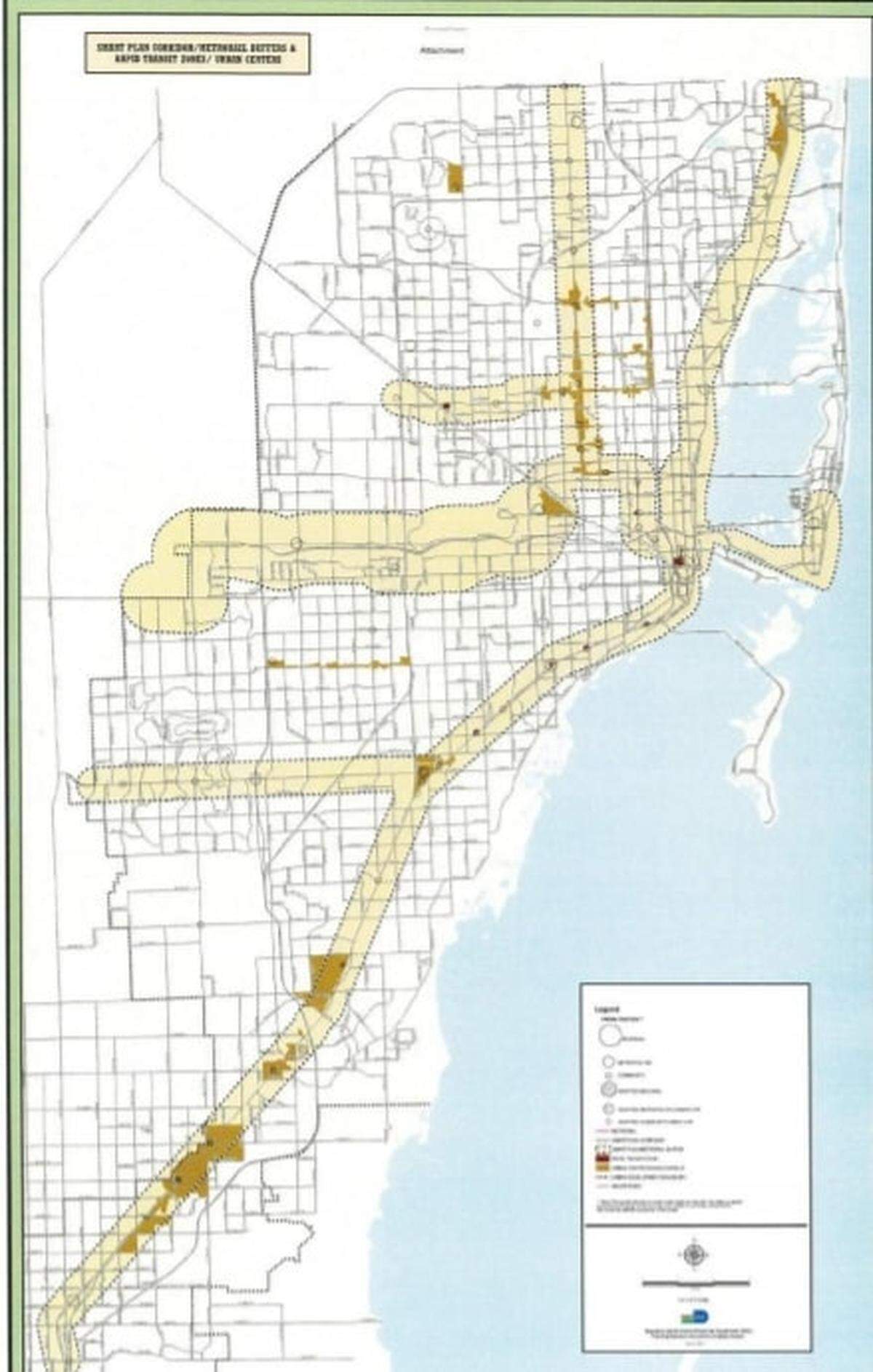
As originally floated, Gilbert’s proposal would add municipalities to the county’s existing Rapid Transit Zone in areas outside city limits.
The zone allows developers to construct mid-rise buildings within a half-mile of the county’s existing and planned rapid-transit corridors, including the 25 miles of routes in the 2016 SMART Plan, which stretches from the western suburbs to South Beach, and from the Broward County line to Florida City.
Where developers are currently allowed to build three-story apartment buildings, the transit zone generally allows six stories, and areas targeted for more intense development could go as high as 15 stories. There are also requirements that developers include a mix of housing, with about 13% of new units priced to be affordable to families making less than $100,000.
For suburban neighborhoods, the density switch would be dramatic. An analysis by the Miami-Dade League of Cities of a Gilbert draft ordinance found that in Pinecrest, which is near two Metrorail stations and fronts the county’s planned rapid-transit bus system, zoning rules that currently allow 6,600 units would be on track to see more than 63,000 — a nearly 900% increase.
The strategy behind the zone is to encourage new housing close to transit lines, making it easier for residents to take a train or bus to work rather than driving on already crowded roads and highways.
Creating more housing along the rapid-transit bus routes also could help Miami-Dade be more competitive for federal rail funds, which typically go to routes with the densest populations near future stations.
“We’ve tried doing nothing. ... We need to show we’re not just going to have empty lots and single-family homes up and down corridors,” Gilbert, a former mayor of Miami Gardens, said in an interview. “The feds will never give us money to build it. Independent of that, it would be too expensive to operate because the riders wouldn’t be there.”
Gilbert hasn’t filed his transit-zone legislation, and said he’s in the process of reworking the plan to address opposition from cities. One change will be backing off mandatory imposition of density rules by the county, he said.
“I think this can be collaborative, and it should be. ... We can comprise,” said Gilbert, who also serves as chair of Miami-Dade’s Transportation Planning Organization, which oversees long-term planning for transit. “But we have to get something done.”
For now, Gilbert’s effort is drawing fire inside County Hall, too. Raquel Regalado, a fellow commissioner whose district includes the southern end of Miami and surrounding suburbs, sent a memo on Aug. 12 asking that her District 7 constituents be left out of the plan.
The “manner in which this item has been rolled out has created chaos and confusion in several districts,” Regalado wrote to fellow commissioners. “It has been disheartening to watch the proposer of this ordinance ‘negotiate’ with municipalities in the absence of County Commissioners that represent these areas.”
A day later, Gilbert wrote back, defending his talks with cities as a rare effort to get public input ahead of filing legislation. “I’m not ‘negotiating’ with municipalities,” he wrote. “The only thing I seek from our municipal partners is ideas.”
In an interview, Regalado said Gilbert’s outreach to some city leaders left out most of the public, adding to anxiety about the proposal. “If he had followed our process, we could provide people with more information,” she said.
Joseph Corradino, mayor of Pinecrest and president of the Miami-Dade League of Cities, said municipalities don’t want to cede zoning control to the county for areas near transit. The Gilbert proposal would let builders appeal city zoning decisions inside the transit zone to the county commission.
Corradino also sees general resistance to allowing more density in the suburbs of South Miami-Dade, despite a longtime push to get Miami-Dade to follow through on plans for a Metrorail extension to Florida City.
“Folks say: ‘We want Metrorail.’ I say: ‘Really, I don’t think you want Metrorail. Metrorail comes with density,’ ” he said. “It could be seen as hypocritical to argue for rail and not for the density that comes along with it.”
Grace Perdomo, executive director of Transit Alliance Miami, said there’s no avoiding the fact that more housing units closer together makes it easier to sustain bus and train systems.
“Nothing matters more to making transit work than population density,” she said. “That math is: How many people will that mile of transit reach?” Even so, she said Miami-Dade can’t just lift density restrictions and expect success, since the same quantity of housing won’t work everywhere. “You need to define density,” she said. “There’s no catch-all to every location.”
In Palmetto Bay, Mayor Karyn Cunningham calls the rapid-transit zone a threat to the identity of a village that recently cut back on the density developers are allowed inside municipal limits. “This would really impact negatively the character and fabric of our community,” she said. “It’s not good for Palmetto Bay.”
Cunningham said she’s looking for the same kind of carve-out Regalado requested for all of District 7, and which Miami Springs secured at the Aug. 9 meeting with Gilbert.
When Gilbert spoke in Miami Springs, he told Mitchell and the other Miami Springs leaders not to worry because he planned to exempt the area near Okeechobee, a leafy enclave where streets are named Redbird, Starling and Thrush.
“We will take the Bird Section off the map,” Gilbert said to applause from residents behind him. “We’re good.”
In his response to Regalado, Gilbert said the county can’t let resistance to development continue to worsen traffic and depress construction of affordable housing.
“We can no longer afford a not in my backyard mentality,” Gilbert wrote. The rapid-transit zone legislation “is big and difficult and necessary to accommodating our growth, while stopping our continual decline into traffic congestion and gridlock.”
This story was originally published August 17, 2021 at 9:25 AM.