
Monorail disruptions on the MacArthur: Traffic plan shows lane closures for construction
A proposed monorail system would bring a rapid transit line gliding over the MacArthur Causeway’s notorious traffic between Miami and South Beach, but not before causing lane closures and other disruptions required to build the $1 billion project, according to a plan circulated by the developer behind the effort.
Documents prepared by developer MBM Partners reveal draft plans to divert traffic from some eastbound lanes during the three-year construction effort of the Miami Beach Monorail as roadside crews assemble the pilings needed to support the first mass-transit line between downtown and the region’s top tourist destination.
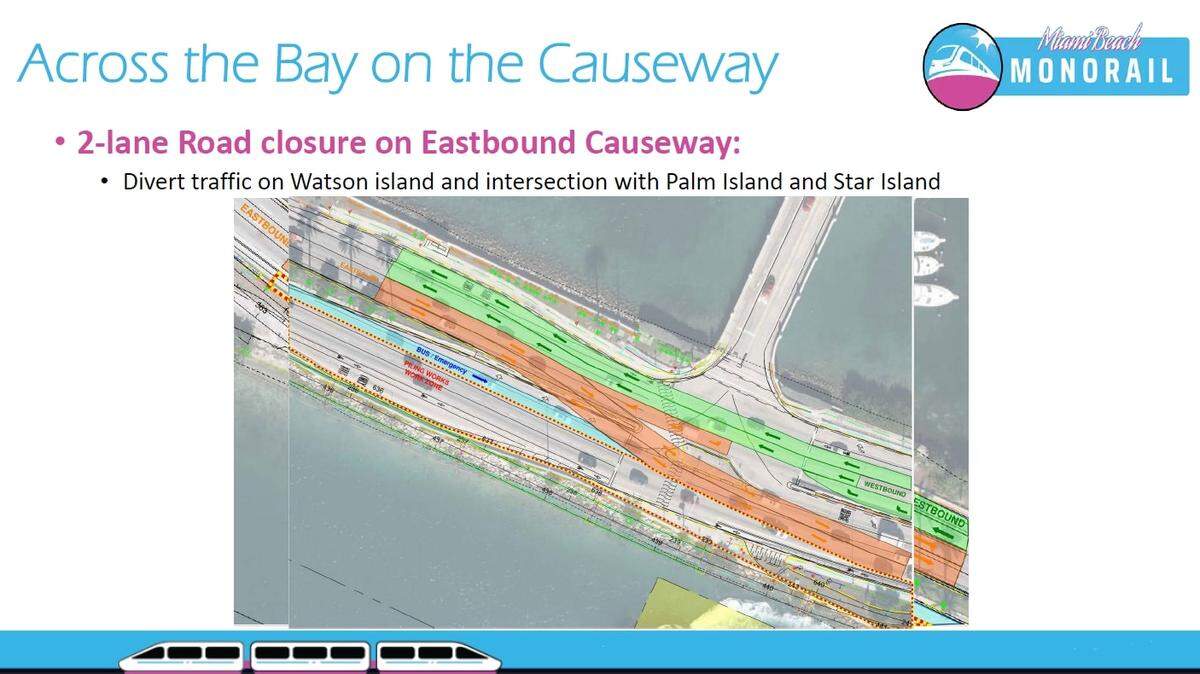
A Jan. 11 presentation given to Fisher Island residents about traffic impacts for the posh island’s ferry terminal off the causeway shows eastbound lanes to Miami Beach closed to regular traffic for at least a segment of the MacArthur. The presentation, obtained by the Miami Herald, shows drivers shifted to a modified westbound section with two lanes heading in both directions.
The for-profit monorail group pursuing the project — a partnership that includes Genting, the casino company providing the Miami waterfront property for the main monorail station — hopes to start work in 2024, according to documents filed with Miami-Dade County, which would own the system and fund it.
It’s not clear how long the lane diversions would last for the project, which is still awaiting an endorsement by Mayor Daniella Levine Cava and approval by the County Commission. A project update filed with the county on Jan. 18 said cost projections include traffic plans that, pending government approval, would force the “closure of the right lane of the causeway during the whole duration of the project.”
Transit advocates say temporary lane closures are worth the inconvenience of creating a new train system that would finally give commuters and tourists a transportation option beyond buses and cars on the MacArthur.
“There will be some short-term pain. ... Long-term, this is better for everybody,” said Matthew Gultanoff, founder of the Better Streets Miami Beach group, which advocates pedestrian and cycling upgrades in the city. While Gultanoff said he would prefer Miami-Dade link its existing Metromover system to South Beach for monorail’s $1 billion price, he noted drivers are already dealing with lane closures and rerouting from Florida’s nearly $1 billion redo of highways leading to the MacArthur. “There’s no uproar over that,” he said.
Details remain scarce for the planned traffic changes on one of the busiest bridges in Miami-Dade County, a thoroughfare connecting South Beach with downtown Miami. The county’s Department of Transportation and Public Works, which attended the Fisher Island briefing and is in discussions about the traffic plans with the monorail group, declined an interview request.
When the Miami Herald submitted a records request for the Powerpoint slideshow from the Fisher Island briefing, the agency said it did not have the document and wouldn’t ask the developers to produce it. The monorail group is operating under a $14 million county project to prepare pre-construction studies, including the traffic studies and presentations. The partnership includes Meridiam, an infrastructure investment firm with headquarters in Paris. The company was also part of the development group that built and operates Florida’s PortMiami Tunnel project.
The Herald obtained the Powerpoint from the Fisher Island briefing through a different source, and it offers the first glimpse at what commuters, tourists and residents could face on the MacArthur if Miami-Dade proceeds with the long-sought “Baylink” transit route between the shores of Biscayne Bay.
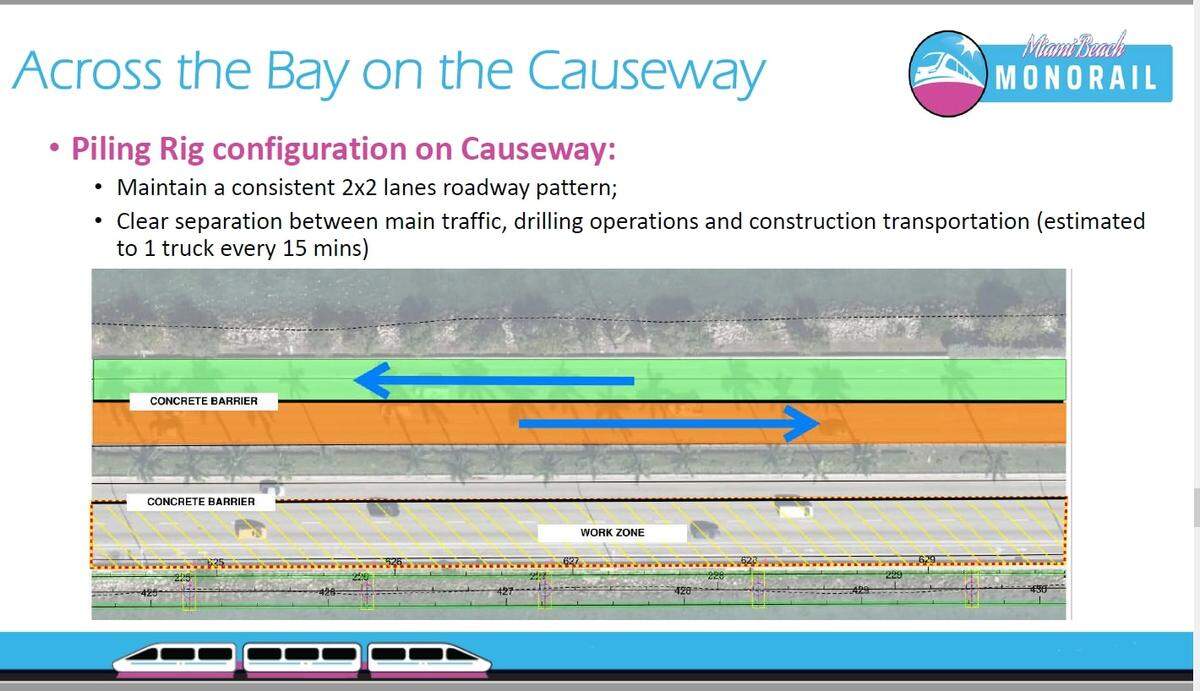
Where the six-lane MacArthur meets the bridge to Star Island, the Powerpoint shows the eastbound segment of the causeway dedicated to construction and a single lane for emergency vehicles and buses. The westbound side is converted to four lanes, with two going east and two going west.
It’s not clear how long that configuration would last. Another slide on the Powerpoint shows the current layout of three westbound lanes on the north side of the causeway, and the closure of the shoulder and one lane on the south side heading east.
Ralph Garcia-Toledo, president of Aqualand Development, a partner in the monorail effort, said it’s too early to discuss a traffic plan that’s still under discussion and would need county and state acceptance. “We have various scenarios,” he said in a text message. “None have been approved.”
Garcia-Toledo also declined an interview on the topic, referring questions to the county.
Transportation and Public Works declined to allow an interview of agency employees who have been in discussions about the traffic plans or who attended briefings of various groups along the MacArthur. The agency released a statement saying it’s too early to provide the kind of details offered some members of the public in recent briefings.
“At this time the department is under negotiations,” the statement read. “All maintenance of traffic activities will require traffic analysis and approval from the respective permitting agency.”
Extended lane closures on the MacArthur have caused traffic backups in the past. During temporary closures of two westbound lanes for emergency repairs of part of the bridge in 2018, Miami-Dade lifted tolls on the Venetian Causeway to address gridlock on the MacArthur and the Florida Department of Transportation recommended “motorists wishing to leave Miami Beach use alternate routes to avoid additional traffic.”
Large public works projects often bring objections along the construction routes, and the monorail pitch along the MacArthur was bound to be a tough sell. On Fisher Island, the developers want to rework how island residents and their visitors arrive by ferry, with eastbound and westbound vehicles assigned to different boats.
A Sept. 21 briefing with the Miami Children’s Museum didn’t sway leaders of the institution and its affiliated school on the south side of the MacArthur. The organization objects to the rerouting of a perimeter road that services its parking lots, and worries monorail infrastructure will obstruct a billboard that generates revenue for the museum.
“At this point, the museum is vehemently opposed to monorail,” said Jeffrey Berkowitz, chairman of the nonprofit’s board. “We have very serious concerns about the negative impacts on the museum.”
The presentation for the Children’s Museum shows a traffic pattern for that segment of the MacArthur that looks largely unaltered. While parts of the road serving the museum would be closed for construction of a maintenance facility for the monorail system, drawings depict a MacArthur with all three eastbound lanes intact and a bike lane maintained as well.
A less disruptive traffic plan would likely cost more. The first price update the monorail group filed with Miami-Dade in November listed $18.4 million in savings from “building the causeway supports from land” rather than on barges over Biscayne Bay. A notation said that plan “assumes going 2x2 lanes along the causeway during construction.”
For now, the monorail project’s main challenge is the overall cost. While proposed in 2020 at roughly $600 million to build, expenses have soared to more than $1 billion. The monorail partnership would pay for construction costs upfront and operate the monorail system in exchange for yearly payments from Miami-Dade now estimated at about $117 million — roughly $2 million a week.
“I really didn’t like it before,” said Miami Beach Mayor Dan Gelber, an anti-casino activist and leading opponent to the monorail project. “So obviously the prospect of massive cost overruns and maddening traffic stoppages is not making it more attractive.”
This story was originally published February 15, 2022 at 6:00 AM.