Documents show rifts remain in negotiations for Beckham Miami soccer stadium complex
After two and a half years of quiet negotiations, the controversial no-bid deal to build a $1 billion soccer stadium complex for Miami’s Major League Soccer team still faces considerable obstacles, according to internal documents obtained by the Miami Herald that offer the public’s first glimpse inside the talks.
The next step for co-owner David Beckham’s eight-year quest to field an MLS franchise in a Miami stadium is a major vote at Miami City Hall, though it’s unclear when that will happen. City administrators and Inter Miami’s ownership said they’re optimistic, but attorneys for both sides apparently can’t even agree on where they have disagreements.
A new memo from Miami’s legal counsel, sent to City Manager Art Noriega on Thursday and obtained through a public records request, outlines a number of key questions that remain unresolved during talks to finalize terms that would clear a path for the massive redevelopment plan known as Miami Freedom Park.
What happens if Inter Miami wants to relocate the team? Who is financially responsible if someone successfully sues to invalidate the lease after the land is redeveloped? Will team owners sign leases guaranteeing construction of public soccer fields, sufficient parking and other public benefits packaged with the stadium proposal? Will the club play all of its home games at the new stadium? Will Inter Miami commit to keeping “Miami” in the team’s name?
The memo highlights significant gaps that apparently exist between the city and the team, which debuted last year in a rebuilt stadium in Fort Lauderdale attached to their training facility. The soccer club’s lawyer, however, insisted to the Herald that the parties are actually closer to an agreement.
“We look forward to clarifying these points with the city manager,” said attorney Richard Perez, of Holland & Knight, who is representing the soccer club in the talks. “Further, the team’s ownership is 100% committed to keeping Miami in the team name. The contractual commitment is an easy one as it only reinforces the significant investment in time and money already made in building the Inter Miami CF brand.”
Still, the multiple memos from outside attorneys hired by the city show slow progress over the last year on core issues across four separate complex agreements that are supposed to boil down to a simple concept — a privately financed stadium, retail, hotel and office complex and adjacent park.
Some of the outstanding issues in the June 17 memo are steeped in legal provisions meant to protect the city from unwanted financial exposure, particularly if litigation nullifies the lease after buildings are built. Some address construction deadlines and penalties for missing them.
One disagreement focuses on whether the lease documents should include explicit requirements for public benefits, such as public soccer fields, or whether those matters should be finalized when the team seeks zoning approvals in the future. The team is seeking to rezone the parkland through a special area plan, a method for developers to trade public benefits for expanded development rights.
Miami Freedom Park representatives pushed back against the memo’s portrayal, saying they are addressing several of the outstanding issues in proposals currently moving between the city and the team. Recent lease proposals reviewed by the Herald show the team is proposing assurances that Inter Miami would play all regular season and playoff home matches at Miami Freedom Park, and that the team and city would negotiate the cost to the city if the lease is invalidated and the city takes full possession of the complex.
The city’s attorneys chafed at a proposal that Miami Freedom Park’s rent could be reduced in line with the consumer price index. Club owners said the rent should go down with the CPI if that occurs, but not below the minimum set by voters when they approved the basic outline of the lease terms — about $3.5 million annually.
Not mentioned in the city’s June 17 memo: specific numbers on rent payments to the city or details about potentially expensive environmental remediation — Melreese was built atop toxic ash from an old municipal incinerator, contamination team owners have pledged to handle at no cost to the city.
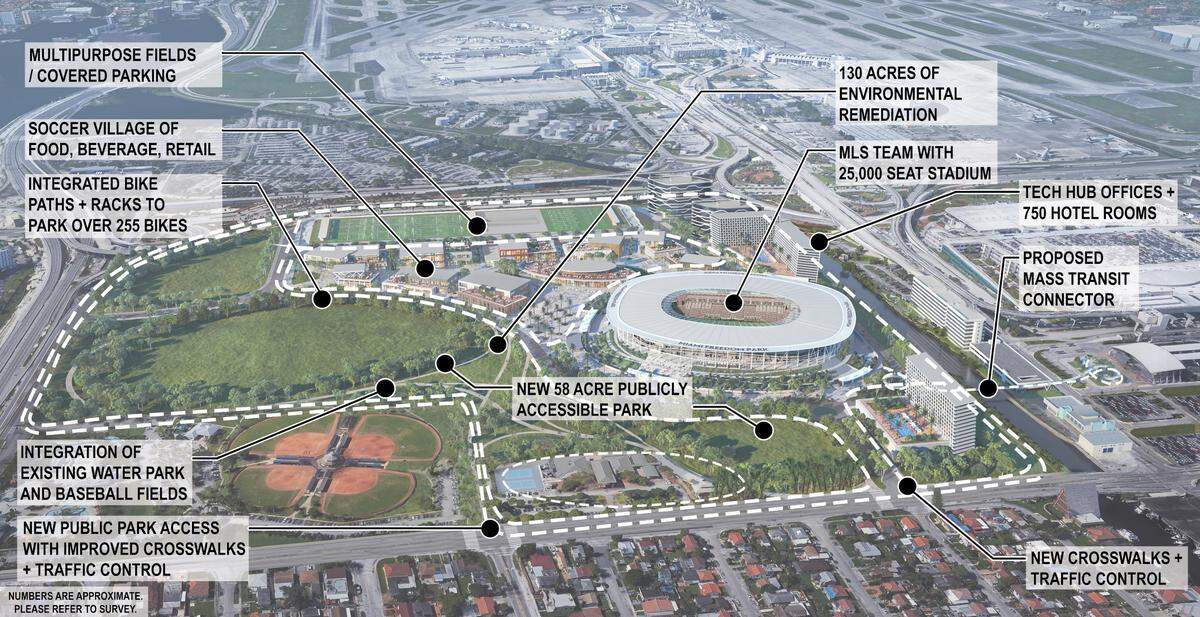
Beckham and his partners want to replace city-owned Melreese golf course next to Miami International Airport with a massive commercial center featuring hotels, office buildings, a shopping center and a 25,000-seat stadium to host Inter Miami’s home games. The project would include public soccer fields sitting atop of a three-story garage and a 58-acre public park.
Mayor Francis Suarez has supported the project since the summer of 2018, when Beckham and Jorge Mas, MasTec chairman and Inter Miami’s managing owner, first pitched their vision to the city. In a November 2018 referendum, 60% of voters authorized city administrators to skip the normal bidding process and negotiate terms for a 99-year lease. The COVID-19 pandemic put negotiations on hold for a few months in early 2020 around the same time Noriega was hired to run the city administration.
Mas recently told the Herald that his team was “extremely close and in the final stages of agreeing to a lease” with the city. The latest memo, authored by attorneys at three law firms — Shutts & Bowen, O’Melveny & Myers and Fowler White Burnett — suggests there might be more daylight between the city and the soccer club’s ownership.
Overall, the city’s lawyers say the soccer group is asking for too much flexibility across four contracts — two ground leases, a construction administration agreement and a non-relocation agreement.
“[The ownership team] has clearly stated its belief that because the city is not contributing funding for the stadium, and because Miami Freedom Park is promising to pay rent and generate property taxes, it deserves to have unusually broad flexibility in the development as a whole and mild repercussions if it fails to deliver any of the promised elements of the development,” reads the June 17 memo.
Perez disputed the memo’s conclusions.
“We are optimistic that we have entered the final stretch of negotiations,” Perez said. “As evidenced — in black and white — by the drafts presented to the city, the June 17 memorandum from the city’s legal advisors mischaracterizes Miami Freedom Park’s position on the handful of remaining negotiation points.”
Noriega recently told the Herald that money is not the issue at this point, though he’d prefer to see the city secure more upfront guarantees on payments and public benefits, as well as a proper plan to replace rezoned parkland.
“We’re still looking at contributions for park space, and timeliness of the project as well,” Noriega said in a June 10 interview. “It’s also not my intention to defer a lot of money.”
Noriega said he felt both sides could work out compromises in hopes the commission could vote on the agreements in the next few months. He and other city administrators are set to meet this week with Inter Miami representatives to discuss remaining concerns.
The details will be crucial once the hundreds of pages of contract language are finalized before a commission vote. Four of five city commissioners would need to approve for the deal to move forward.
“Stadium deal” is like a four-letter word in Miami, where the phrase evokes a maligned public financing agreement that paid for the Miami Marlins ballpark, now called loanDepot Park. The deal left taxpayers on the hook for nearly $2 billion in debt payments over several decades.
Miami Freedom Park’s negotiations also stand in the shadow of another controversial billion-dollar land deal — Flagstone Island Gardens, a hotel and marina complex planned for city-owned land on Watson Island. First approved by voters in 2001, the project has stalled for two decades amid financing problems and lawsuits. In 2019, Miami commissioners approved a $20 million settlement to avoid a legal judgment that could have topped $100 million.
This story was originally published June 23, 2021 at 7:00 AM.