
After rail fight, modern buses moving closer to taking the spotlight in Miami-Dade
Miami-Dade’s transit system moved closer this week to a historic upgrade of bus options after the county agreed to hire an engineering firm to oversee construction of the region’s first rapid-transit bus system as a cheaper — and less popular — alternative to rail.
Commissioners approved the contract needed to start work on the $300 million, 20-mile project along South Miami-Dade’s busway.
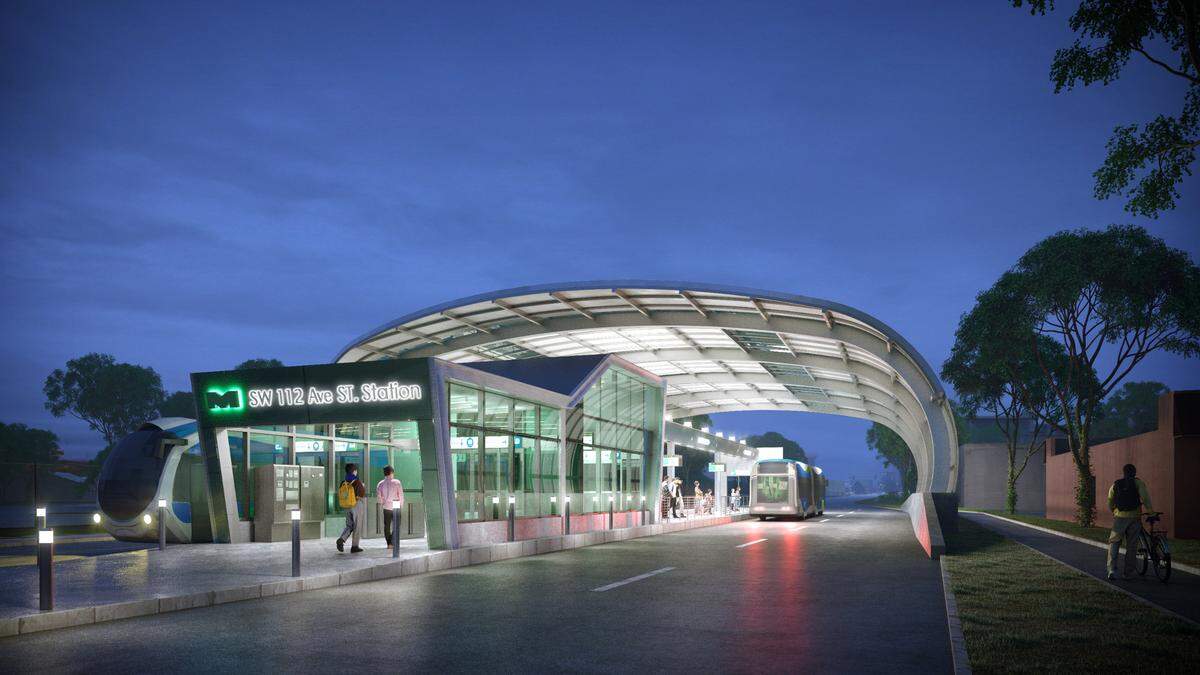
The project includes 14 stations that will for the first time bring air-conditioned platforms, group boarding, advanced ticketing and other rail-like perks to bus travel in the Miami area.
It’s the first of two modernized bus systems to emerge from the approval pipeline in Miami-Dade, accelerating a test of just how much excitement a transit project can generate if tracks aren’t involved.
“It will be better than what we have,” Florida City Mayor Otis Wallace said of the “bus rapid transit” project that would connect his city with the Dadeland South Metrorail system. “The hue and cry was for the promised rail system that everyone wants. Including me.”
Tuesday’s unanimous vote officially ended a brief skirmish to stall the bus project and revive an effort to extend rail south. A southern Metrorail extension was pitched to voters in a 2002 referendum that created Miami-Dade’s half-percent transportation sales tax, leaving the bus option as a broken promise for many.
In 2018, commissioners rejected a $1.3 billion plan to extend Metrorail south in favor of the $300 million rapid-transit bus option. In late June, commissioners awarded a $368 million contract to OHL USA to build the bus system and other related projects along the busway, which runs parallel to U.S. 1.
After winning an open seat in November representing part of South Miami-Dade, Commissioner Kionne McGhee asked to put the OHL contract on hold in order to invite bids from private rail developers.
With Mayor Daniella Levine Cava declining the request, McGhee last week dropped his objection to what he’s now describing as the mayor’s “BRT” plan.
In office since November, Levine Cava opposed the bus system as a county commissioner and pressed for rail but said she wouldn’t seek to reverse the approved construction contract if elected mayor.
“I am a team player,” McGhee said. “I want to see the Cava BRT plan succeed. But I stand with the people...They want to know their voices are being heard.”
One rider’s opinion
Cameo Parrish, a frequent bus rider in South Miami-Dade, said she’d like to see the county invest more in neighborhood routes to help people like her get to the busway without long waits. She called the rapid-transit bus project a clear step down from the Metrorail extension that was pitched to voters.
“It’s going to be a two-seat ride,” she said of the bus system that connects to Metrorail, requiring a transfer for someone commuting to downtown Miami or other points north. “We should have the rail. Period. Period.”
Assuming construction starts on time later this year, the South Miami-Dade bus system will be the first of the six SMART Plan legs to see a major new transit line. Launched in 2016, the SMART effort involved transit studies for six commuting corridors.
Those approved for rail remain in the negotiation or bidding phases — monorail on the MacArthur Causeway, elevated rail to Miami Gardens, and commuter stations along existing Brightline tracks — with funding decisions still pending.
For South Miami-Dade, the bus line has already qualified for $200 million in federal and state funding, a contractor hired and, as of Tuesday, inspectors under contract to supervise the work. The agreement requires the stations be designed so that they can be converted to street-level rail depots in the future, should ridership increase enough to justify federal funding for a train system.
Tuesday’s vote approved a $22 million contract with HNTB Corp. to oversee OHL’s work, including inspectors and engineers to represent Miami-Dade in monitoring the South Miami-Dade projects.
With that contract approved, Miami-Dade’s Transportation Department said OHL was given the green light to begin work immediately. The first phase will be designing work for the stations, followed by construction later in 2021. Service is scheduled to start in early 2023.
All aboard
Unlike existing bus routes where passengers step up from the curb to a vehicle that takes fares one by one, the rapid-transit system would run on 14 stations with air-conditioned areas and equipment to allow advanced ticketing and group boarding off a platform.
Part of the project includes gates for blocking traffic on streets intersecting the busway.
A 2018 county-funded study found the rapid-transit bus system costing less than $300 million could provide a 45-minute ride from Florida City to the Dadeland South Metrorail station — roughly the same forecast for a street-level Metrorail extension on that route estimated to cost more than $1 billion.
There’s another rapid-transit bus system approved for the East-West SMART corridor, which includes parts of Southwest Eighth Street near Florida International University and dedicated bus lanes along the median of State Road 836.
That’s still awaiting approval for federal and state funding, which Eileen Higgins, the commissioner who heads the county’s Transportation Committee, says should arrive next summer.
“It’s very exciting,” she said. “These are great projects happening all over the world, and they’re built very quickly.”
It’s the ease of federal funding that Alice Bravo, Miami-Dade’s outgoing transit director, says will end up a major selling point for rapid-transit bus systems as the county considers them elsewhere.
“You get the same time savings as you do by train,” she said. “The only difference is you get to build the project sooner — and with certainty.”
This story was originally published February 2, 2021 at 7:44 PM.