
Seeking third term as county mayor, Alex Penelas banks on fond memories in Miami-Dade
When the candidates for Miami-Dade mayor took the stage together for their first debate last fall, four sitting county commissioners joined a one-time officeholder whose name hasn’t been on a ballot for 16 years.
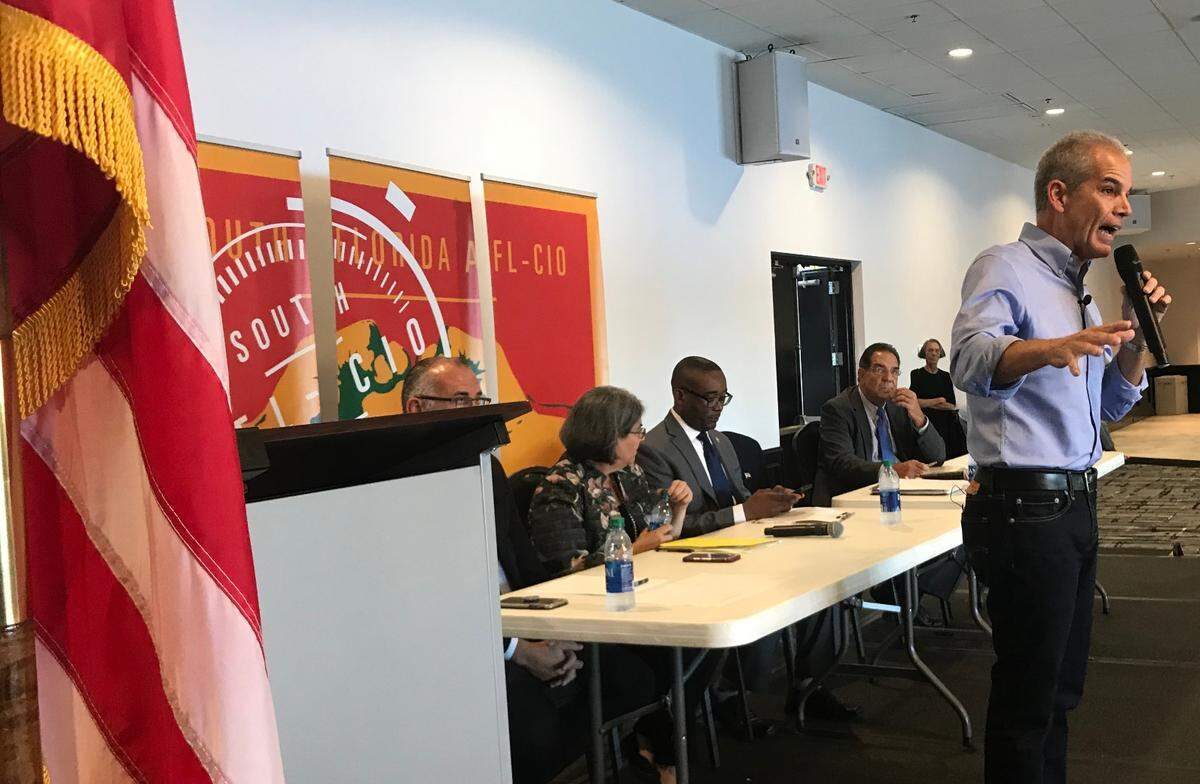
Alex Penelas didn’t look out of practice. While his rivals from the commission gave their remarks from the lectern set up for speakers that October afternoon, Penelas pulled the wireless microphone out of its cradle, stepped out in front of the table and waltzed in front of the Doral union hall audience, leaving his opponents to watch his back.
“Some of you may recall this story. My father was a member of Local 355. Any 355ers here?” the former two-term mayor and one-time U.S. Senate candidate told the AFL-CIO audience, his back to his rivals seated behind him. “Growing up in a working-class family, in a union family, really taught me some lessons.”
Sixteen years after leaving office, a grayer, thinner and richer Penelas is the one to beat in the 2020 race for the job he held between 1996 and 2004. When Jean Monestime dropped his candidacy in April, that left three commissioners running for mayor — Esteban “Steve” Bovo, Daniella Levine Cava and Xavier Suarez. They have more recent history with county voters and hold sway over a $9 billion county budget. But they haven’t been able to compete with the Penelas fund-raising chops. The former mayor has more than a $500,000 advantage over his closest rival, Levine Cava, in terms of money to spend.
A clash between the Gimenez and Penelas eras
The comeback bid by the 58-year-old father of three has made the 2020 race to succeed Carlos Gimenez a clash over two eras, with Penelas slamming the current government as ineffective and his rivals from the County Commission warning against a return to the cronyism and broken promises they claim defined the Penelas administration.
“Penelas invented business as usual,” Suarez said. “That legacy is very problematic.”
Though a county manager was the county’s top administrator at the time, Penelas was mayor when the county’s housing agency misspent money and subsidized developers who failed to build homes for the poor. The scandal was documented by the Miami Herald’s 2006 House of Lies series.
The roster of Penelas friends and donors who held contracts at Miami International Airport helped thrust that county facility into the center of an effort (which failed) to create an independent authority to run the airport.
Penelas argued government scandals erupted before and after he took office, and that he helped launch the Ethics Commission and other watchdog efforts to investigate wrongdoing.
He points out Gimenez and commissioners rely on county vendors for donations, and his opponents have voted on no-bid deals at MIA and ratified contracts snagged by ethical issues — like the $83 million purchase of rescue helicopters from a company cited by the Ethics Commission for improper communication with a county selection panel for the contract.
“Give me a break,” Penelas said in a recent interview. “I’ve been a choir boy compared to what’s happening now.” (Suarez voted against the helicopter contract in 2019, while Bovo, Levine Cava and Suarez joined a unanimous commission in voting for it.)
Running for a third term as county mayor, Penelas boasts the largest net worth in the race at $7.7 million after more than a decade in the real estate business. His financial disclosure form shows nearly $4 million in the bank. The Penelas home in Miami Lakes is valued at $1.25 million, and he and his wife own a Miami Beach condominium and cabana at an oceanfront building off 26th Street in Miami Beach.
Penelas also holds stakes in a portfolio of apartment complexes and land holdings in Miami, Hialeah and Opa-locka. The properties are registered under a company run by Jorge Ariel Lopez, a Hialeah-based real estate investor and president of the Lopez Companies.
Penelas isn’t listed in the corporate filings related to the properties, and his campaign disclosure is the first detailed look at his finances since leaving office in 2004.
His wealth-making after being mayor first got attention in 2011 when court filings revealed Penelas arranged $6 million in loans at 25% interest to an apartment developer. The arrangement became public during the coverage of high-interest loans by then-Hialeah Mayor Julio Robaina, who was running to succeed a recalled Carlos Alvarez as county mayor. Gimenez won that special election before being elected to two full terms.
Running for mayor, Penelas has touted his real estate investments as giving him the kind of private-sector experience he lacked the first time around in politics. It’s also helped fuel his campaign spending. His third largest source of donations comes from entities tied to Florida Value Partners, a real estate firm that operates out of the same Miami Lakes office as Penelas. Together, the companies have donated about $110,000 to the 2020 effort.
On a recent morning, Penelas arrived in an SUV with a campaign aide at the Northside Transit Village for a reception with clergy from churches in North Miami-Dade with predominantly Black congregations.
Their positions as church leaders make them sought-after endorsements in local elections, where “Souls to the Polls” events and other turnout efforts mobilize voters that are even more valuable for an Aug. 18 primary that will get a fraction of the participation seen in November. The group had agreed to endorse Penelas.
“He’s been my friend for a long time. I prayed with him while he was mayor before. I’ve counseled him. I’ve corrected him,” Pastor Carl Johnson of the 93rd Street Community Baptist Church said in introducing Penelas. “He’s a forthright thinker. ... He knows how to bring alliances together and get things done.”
When it was his turn to speak. Penelas reminded the audience that his cellphone number hasn’t changed since the time he was mayor. “You need to call me,” he said. “Sometimes I’ll ask for your guidance. Sometimes I’ll just ask for your prayers. Because there are difficult times ahead.”
When Penelas was last mayor in 2004, the office lacked the power it has today. Between 2008 and 2010, voters amended the county charter to eliminate the office of county manager and make the mayor Miami-Dade’s top administrator while retaining the veto power that Penelas held as an “executive” mayor.
In speaking to the pastors, Penelas said he’s ready to intervene with police administrators and fire officers on the spot if he witnesses the kind of egregious misconduct that led to the death of George Floyd in Minneapolis. “I’m running for strong mayor,” he said.
In an interview, Penelas said he didn’t want to be a “micro-manager” as head of county government and would “empower department directors to do their jobs.”
Penelas, the father of a third-grader with his wife of 25 years, Lilliam, has come out against reopening schools, given the current spread of the coronavirus. He’s also criticized Gimenez for ongoing spats with city mayors over closure announcements and a lack of outreach before implementing and lifting COVID restrictions.
“I would work with my municipal colleagues,” Penelas said in a recent Miami Lakes debate. “Not in spite of them.”
More Miami-Dade mayors back Penelas
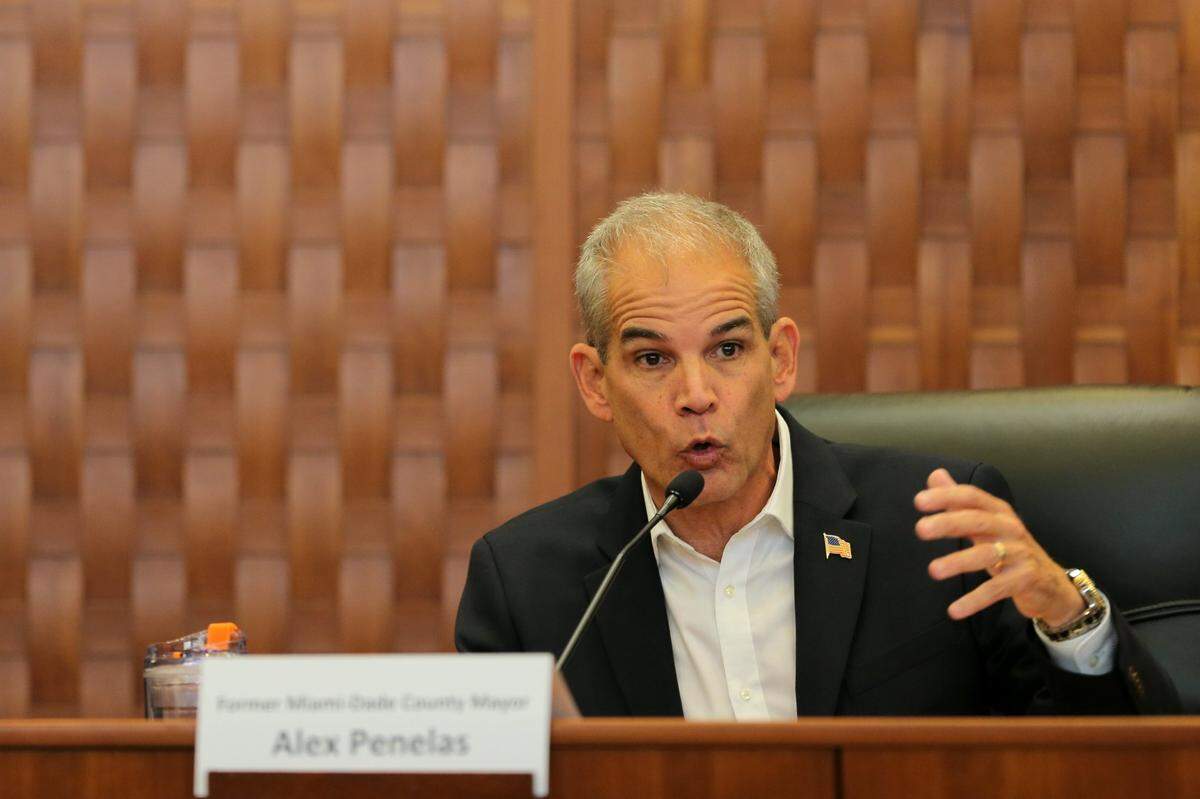
So far, Penelas dominates the endorsement scorecard for Miami-Dade mayors, securing backing from 11 of them. His rivals just have one or two. Among the mayors backing Penelas are the leaders of Coral Gables, Miami Shores, Florida City, Aventura and Hialeah.
Though once a rising star in the Democratic Party, Penelas isn’t campaigning as a Democrat in the nonpartisan race for mayor. Rival Levine Cava so far has the most high-profile Democratic endorsements, including from Miami Congresswoman Debbie Mucarsel-Powell, while Penelas has complained about a mayoral race that’s “all about partisanship.”
When he ran in the Democratic primary for the U.S. Senate in 2004, Penelas finished third in his home county, behind Peter Deutsch and the eventual nominee, Betty Castor.
During that campaign, former Vice President Al Gore issued a statement calling Penelas “the single most treacherous and dishonest person I dealt with” during the 2000 presidential election, which Gore would have won with 538 more votes in Florida.
As mayor, Penelas broke with the Clinton administration in 2000 over the forced return of Elián González to his father in Cuba. He also was largely absent from the Gore fall campaign in Miami-Dade and didn’t object when the county’s canvassing board halted its recount of the presidential ballots after Election Day.
Mike Fernandez is top Penelas donor
For his 2020 mayoral race, the top Penelas backer is a former mega-donor for the Republican Party, Miami healthcare mogul Mike Fernandez. His political committee supported Andrew Gillum in the 2018 Florida gubernatorial race, and Fernandez and related entities have so far given Penelas about $300,000.
In all, Penelas had about $2.5 million to spend as the election ad wars heated up in July, compared to $1.7 million for Levine Cava, and less than $1 million for Bovo and Suarez.
Penelas grew up in Miami after his parents moved to the city from Cuba, where his father was a labor organizer and jailed under the Fidel Castro regime. A graduate of the University of Miami law school, Penelas won a seat on the Hialeah City Council at age 25. In 1990, he won a countywide seat to what was then called the Dade County Commission.
He was elected as the County Commission’s youngest member in 1990, then defeated fellow commissioner Arthur Teele in the 1996 race for county mayor.
A central part of the Penelas legacy was bound to be a top issue in the 2020 campaign if he didn’t run. In 2002, Penelas led the referendum campaign that created the county’s half-percent sales tax for transportation. The campaign was built around an historic expansion of bus and Metrorail service that never materialized, despite the tax generating about $3 billion in revenue over 18 years.
His rivals point to the 2002 plan for a 10-mile rail extension along Northwest 27th Avenue and another six-mile leg connecting the western suburbs with Metrorail as proof voters shouldn’t trust Penelas again.
A fight on the ‘half-penny’ transit tax
The 2002 plan showed signs of trouble shortly after voters approved the new tax, with 66% of votes cast.
In 2003, the county reported “significant and worrisome impacts” on the financial plan, and by 2007 construction costs for the Metrorail extension north ballooned nearly 60% to $1.45 billion, according to a report Gimenez’s office released in 2019 as Penelas began his latest mayoral campaign. The project died in 2008 when it failed to secure federal funds.
The following year, Miami-Dade commissioners endorsed a major change in the rules governing the “half-penny” tax. Facing a budget crisis, commissioners endorsed a plan to spend the tax subsidizing day-to-day costs for the transit system. Prior rules only allowed the money to fund operations for projects approved under the referendum, including free Metromover service (it previously cost 25 cents) and new bus routes.
None of the commissioners running for mayor were in office in 2009, but the subsidies continued through the 2019 budget.
The Gimenez administration said the practice ended in 2020, once debt service for the voter-approved projects became high enough that there wasn’t extra cash to subsidize operations beyond the $84 million tied to Metromover and other improvements promised in 2002.
Penelas, who won the endorsement of Miami-Dade’s transit union, has framed the “half-penny” failures as a selling point for his candidacy.
He points out the only Metrorail expansion paid for by the new tax revenue — a two-mile extension to MIA that opened in 2012 and cost about $500 million — won commission approval while he was still in office. He blames the failed Metrorail plans on commission votes to use the transportation tax to subsidize day-to-day operations of the system instead of reserving it to pay debt on big projects.
He also uses the transportation tax to showcase his record of going big in politics when he had a seat in the commission chambers and occupied the mayor’s office suite on the 29th Floor of the Stephen P. Clark Center in downtown Miami.
As a county commissioner in the 1990s, he helped former Miami Herald President and General Manager Alvah Chapman convince voters to create a 1% surtax on restaurant bills and use the money to fund services for people experiencing homelessness. Last year, it generated about $30 million.
He tried in 1999 to win a full 1% transportation tax, but voters rejected it. He came back three years later with a referendum that passed. The same year, county voters approved a new property tax to fund youth services known as the Children’s Trust. It generated more than $130 million last year.
Also in 2002, Penelas and another former Herald executive, Publisher David Lawrence, led a successful campaign for a statewide referendum that required state-funded pre-K services be available for every 4-year-old across Florida.
“The 29th Floor should be a place for vision and strategy,” Penelas said in a recent interview, describing his planned approach to becoming the county’s top administrator as well as its elected leader. “I did this as mayor before. My expertise is the bully pulpit.”
This article was updated to correct the County Commission vote tally in 2019 to approve the purchase of new rescue helicopters. The commission approved the contract with a unanimous vote.
The Miami Herald has written articles about other candidates for Miami-Dade mayor, and has more to come. Click here to read about Esteban “Steve” Bovo, Daniella Levine Cava, Alex Penelas, Xavier Suarez, and first-time candidates Monique Nicole Barley and Ludmilla Domond.
This story was originally published July 23, 2020 at 6:00 AM.