
Xavier Suarez banks on Miami-Dade voters liking two Miami mayors: him and his son
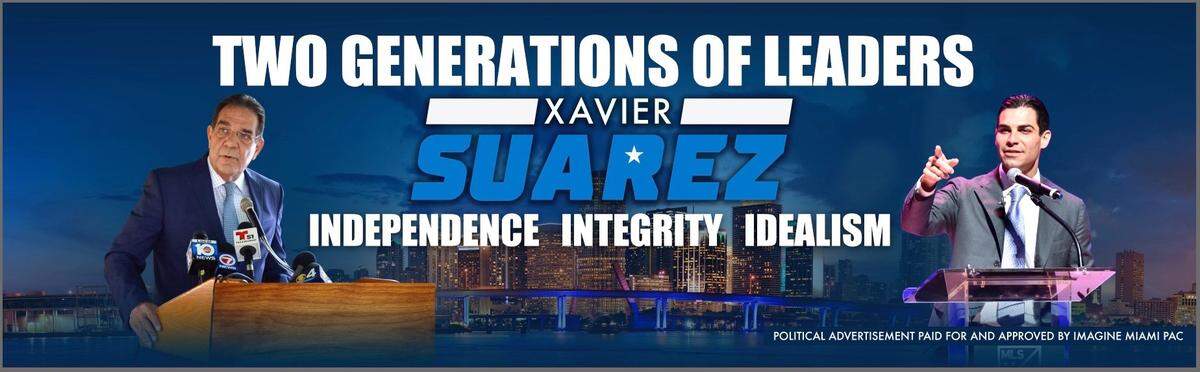
When Xavier Suarez’s political committee bought billboard space on I-95 this spring, the ad featured a photo of the former Miami mayor addressing supporters on the day he announced his run to succeed a term-limited Carlos Gimenez as MIami-Dade mayor.
But Suarez, 71, didn’t have the space to himself. About 40 feet away on the same billboard, another Suarez at a different lectern smiled high above motorists: Francis Suarez, Miami’s current mayor and the candidate’s 42-year-old son.
“Two Generations of Leaders,” read the slogan of the banner paid for by Imagine Miami, the political committee the elder Suarez launched in 2011 shortly after winning the county commission seat he holds today. “Independence. Integrity. Idealism.”
A politician who made his mark in the 1980s as Miami’s first Cuban-born mayor, Suarez has endured long enough in local government to run countywide with the help of his son, the first Miami mayor born inside city limits.
While the younger Suarez enjoys a growing national profile as a Republican mayor who contracted COVID and now backs strict measures against it, his father is presiding over a campaign to lead the county government — Xavier Suarez’s second try in 24 years to become Miami-Dade mayor.
The son figures large in the father’s campaign, but Francis Suarez wasn’t eager to see his father run for county mayor in 2020.
“He wasn’t gung-ho,” Xavier Suarez said.
His son confirmed a lack of enthusiasm, but tied it to anxiety about seeing his father lose — a concern the younger Suarez said he doesn’t hold anymore, given the state of the campaign. “I want him to be successful in everything he does...I know how difficult a county mayor’s race can be.”
A Miami and Miami-Dade mayor from the same family?
Suarez is running for mayor in part on his long-standing plan to permanently eliminate transit fares, a wish-list scenario that suddenly came true in March when Miami-Dade made bus and train rides free to reduce the risk of COVID spread between passengers and drivers.
While the Gimenez administration is counting on federal relief dollars to compensate for $80 million in lost transit fares, Suarez brushes aside the daunting financial challenge for Miami-Dade to go it alone without daily transit revenue from riders.
“Free fares are no different than trolleys or Metromover,” two transit options that don’t charge fares but account for less than 20% of Miami-Dade’s roughly $375 million transit expenses. He cites the nearly $9 billion spent each year by Miami-Dade’s government, the ability to tap state funds, and the cost savings available from eliminating fares for buses and Metrorail. “Free fares is easy to explain because it is simply extending what we have in place.”
From his commission record, Suarez points to funding for a summer jobs program, affordable-housing projects in his district and rehab efforts for homes of low-income residents as examples of how the county can boost prosperity.
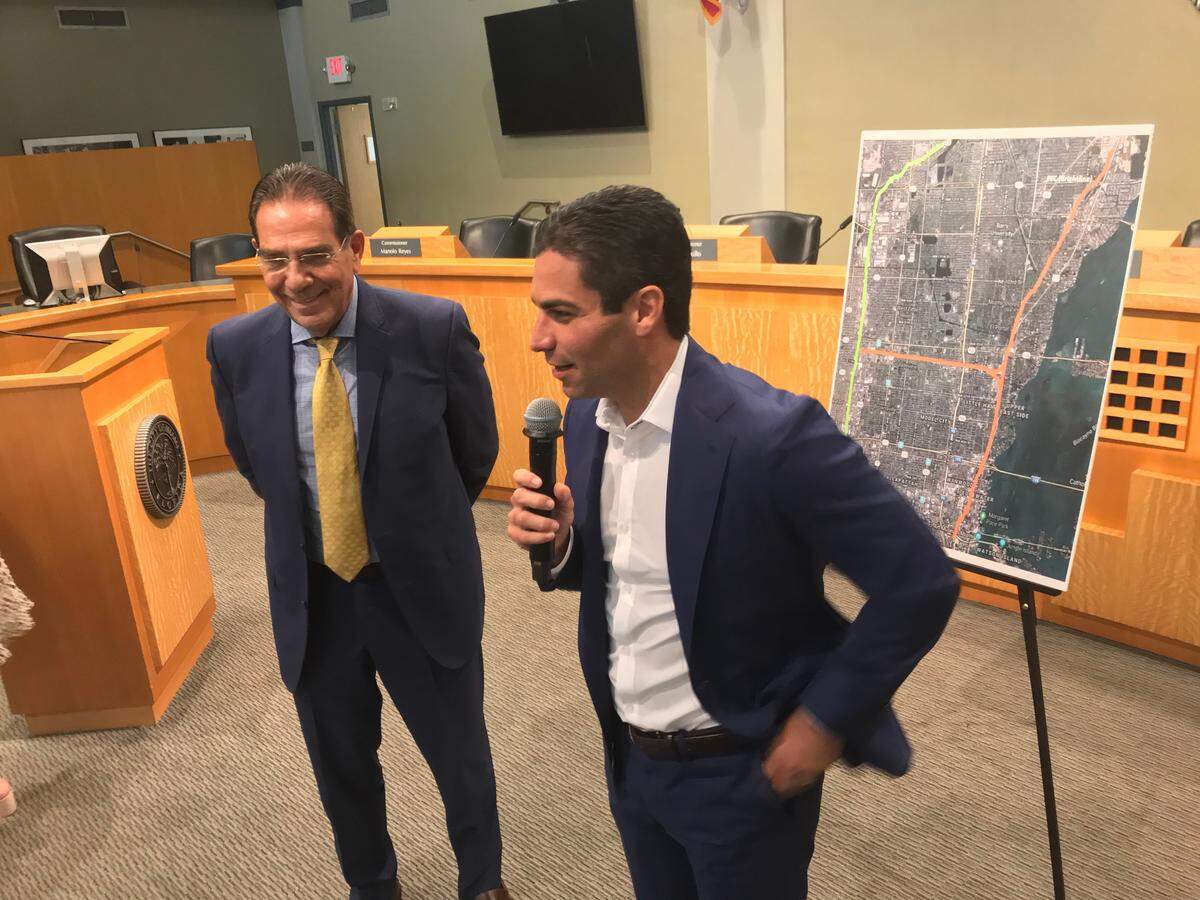
He also highlights the fights he didn’t win against the Gimenez administration, including votes against the administration’s budget proposals and transit initiatives that include a possible monorail to Miami Beach and a $76 million Aventura station for a new commuting line by the Brightline rail company.
In 2018, Suarez was the lawyer behind litigation against Gimenez over claims the county misspent the half-percent sales tax voters approved in a 2002 referendum under then-mayor Alex Penelas. Gimenez called it a “political stunt” and later forced Suarez to find another lawyer for the ongoing litigation because state open-meeting laws barred private conversations with a plaintiff who sits on a county transportation board.
“I’m the anti-Gimenez,” Suarez said, reflecting a feud that stretches back to when he lost his first commission race to the county mayor, who once served under Suarez as Miami’s fire chief.
‘I’m the anti-Gimenez’
Suarez and his son share a common foe in Gimenez, who helped defeat a 2018 referendum by the Miami mayor to add administrative powers to his post. The 2020 mayoral race sets up the possibility of a sharp pivot for city-county relations, with Miami’s mayor going from a rival presiding over Miami-Dade to his father.
Along with testing the countywide appeal of the Suarez name, the 2020 mayoral race gives Xavier Suarez a time back in the spotlight after nine years as one of 13 county commissioners.
A Harvard-trained lawyer, Suarez entered Miami City Hall in 1985, becoming the first Cuban-born mayor of a major U.S. city. He served until the fall of 1993, opting against running for another term. Three years later, the city declared a financial emergency to deal with a mounting revenue shortfall. “To a certain degree, a lot of what Opa-locka has been going through lately, Miami was going through in the ‘90s,” rival candidate Esteban “Steve” Bovo, a fellow county commissioner, said in a recent interview. “Suarez was knee deep in it.”
As mayor, Suarez won praise for walking into an outraged crowd of residents in Overtown after an off-duty white police officer shot and killed Black motorcyclist Clement Lloyd, sparking days of unrest over racial injustices in the city.
Suarez also helped start a years-long boycott of Miami conventions by the NAACP and other groups after he refused to meet with Nelson Mandela weeks after Mandela’s release from an apartheid-era prison in 1990, citing the South African leader’s praise of Fidel Castro.
Though he served as Miami’s mayor twice, Suarez’s official biography on his commission page only mentions the first stretch between 1985 to 1993.
It was his return to office in 1997 that brought his most famous and chaotic moments in public life, including a nighttime visit to a constituent who wrote him a critical letter. By March, he was out of office after a judge invalidated the November election, citing ballot fraud. About three dozen people were charged with mail-in ballot fraud or other violations, including a Suarez campaign worker arrested while wearing a “Suarez for Mayor” t-shirt. (Suarez says now: “I didn’t even know we had T-shirts.”) A county prosecutor called it a “well-orchestrated conspiracy to steal the election,” but no evidence surfaced tying the fraud to Suarez himself.
The scandal left incumbent Joe Carollo as mayor, another longtime Suarez rival back in power today as a city commissioner.
A second try for county mayor, facing Alex Penelas again
Suarez finished fourth in the 1996 county mayor’s race that put Penelas in office. Suarez lost the District 7 commission race to Gimenez in 2004, then won the seat in a 2011 special election when Gimenez gave it up to run for mayor.
After holding the seat for nine years, representing the southern edge of Miami, Key Biscayne, parts of Coral Gables, and Pinecrest and South Miami, he must leave office in November because of term-limit rules.
Through most of the summer, the Suarez county campaign remains in low gear. Suarez has largely avoided the online efforts and face-to-face voter events that his rivals are pursuing on an almost daily basis.
After nine months, Suarez’s campaign account had only spent $15,000. His best-funded rival, Penelas, spent more than that in the first two weeks of June alone and $167,000 in all. The Suarez campaign does not have a website with biographical information or positions — only a link to donate money.
The other two county commissioners running for mayor in 2020, Bovo and Daniella Levine Cava, have food distributions, ZOOM town halls and video messages almost every day touting themselves. When Francis Suarez held a city hall press conference on a recent Saturday morning during a food distribution, Levine Cava was there but his father wasn’t.
The Suarez pace picked up in July. Francis Suarez recorded a Spanish-language robocall for his father, encouraging voters to call the county commissioner’s cellphone. (“I was on the phone for an hour” after it launched, Xavier Suarez said.) Mailers went out featuring both Suarezes.
Operatives from rival campaigns and outside pollsters see Suarez’s name recognition as particularly valuable heading into an election during a pandemic. All six candidates who qualified for the ballot face each other in a single, non-partisan primary Aug. 18. That includes two first-time candidates: Monique Nicole Barley and Ludmilla Domond.
The top two finishers will compete in a fall run-off on Election Day assuming no candidate gets more than 50% of the primary vote. With the COVID crisis complicating door-to-door campaigning and get-out-the-vote events, it’s harder than expected for lesser-known candidates to create the kind of name recognition to compete with a former county mayor and a former Miami mayor with an even better-known son.
“You’re competing against the coverage of the coronavirus and the looming presidential election. It’s very difficult and it’s very expensive,” said Carlos Lopez Cantera, the former lieutenant governor who considered a mayoral run in 2020 but now is supporting Bovo. For Suarez, the COVID situation makes it easier to win votes. “He can tout his experience, and he shares a lot of name recognition with his son,” he said.
A registered independent who dropped his Republican affiliation in 2012, Suarez can’t count on party backing for a county race that’s officially non-partisan but still expected to play out along some fault lines between Democrats and Republicans.
Penelas was the last Democrat to serve as county mayor, and Levine Cava has been active in Democratic campaigns since she took her commission seat in 2014. Bovo, a former Republican state lawmaker, is praising President Donald Trump while touting himself as the only conservative in the race.
Suarez said he wrote in John McCain’s name in the 2016 election, and won’t say who he’s supporting in 2020. “At this point, I’m not picking,” he said.
His top donor so far is Coral Gables lawyer Mike Eidson, who gave nearly $80,000. Suarez has backed Eidson’s blueprint for how the county should revive the Coconut Grove Playhouse, a controversial project in Suarez’s district.
The donor leader board could change soon as Suarez also picked up the backing of Norman Braman, the auto magnate with a large Miami dealership and a regular Republican donor. Suarez pointed to Braman’s support as evidence of his bipartisan appeal, noting community leader and former rap star Luther Campbell also endorsed his campaign. “I think I am a unifying force,” Suarez told the Miami Herald Editorial Board. “I have the endorsement of Uncle Luke on one side, and Norman Braman on the other.”
Born in Las Villas, Cuba in 1949, Suarez recalls collecting rifle shells from soldiers stationed at his house during his father’s time in jail for political offenses under Fidel Castro.
The family came to the United States in 1961, including Suarez and his 13 brothers and sisters. He won a presidential scholarship to Villanova, where he studied mechanical engineering, then to Harvard for a law degree and a master’s in public policy.
A father of four and a grandfather, he’s married to Rita Suarez, a teacher. Their primary residence is a condominium off Brickell Avenue, one of three apartments they own. Adding in the two Miami Beach condos, their real estate holdings were valued at $1.6 million in Suarez’s financial disclosure, with a net worth of about $780,000 once mortgages are deducted. He reported income of $100,000 from his solo practitioner law practice.
No income is listed from Suarez’s side pursuit as an author. He has written six books. That includes 2017’s “Science and the Theory of God,” by the self-publishing company Author House, a philosophical exploration of science, his Catholic beliefs, and religion in general. “This book is in great part devoted to...a plausible, holistic understanding of what the creator probably intended when she/he/it sent the galaxies flying,” Suarez wrote.
On a recent morning, Xavier Suarez was conducting an interview on a sidewalk outside the Lyric Theater in Miami’s Overtown neighborhood, two miles north from the county district he represents. As he spoke, a city Public Works truck stopped and Stacey Dean leaned out the window to take a picture.
“I’ve always admired what he’s done for the community,” said Dean, 49, a laborer with the city agency. “He’s still working.”
Minutes before, Suarez, was chatting with some people he arranged to meet outside the Lyric. That included Cornelius Shiver, director of the Community Redevelopment Agency tax district that uses city and county dollars to invest in neighborhood projects, including the Lyric and the Plaza at the Lyric affordable-housing complex next door.
Shiver praised Suarez’s support of redevelopment projects over the years, describing the candidate as well-schooled in what Miami and the rest of the county needs. “He already knows what the problems are,” Shiver said.
The Miami Herald has written articles about other candidates for Miami-Dade mayor, and has more to come. Click here to read about Esteban “Steve” Bovo, Daniella Levine Cava, Alex Penelas, Xavier Suarez, and first-time candidates Monique Nicole Barley and Ludmilla Domond.
This story was originally published July 23, 2020 at 6:00 AM.